

TL;DR
- Stop building lead lists by geography alone. Horizontal prospecting burns through leads because the pitch never matches the buyer’s specific needs.
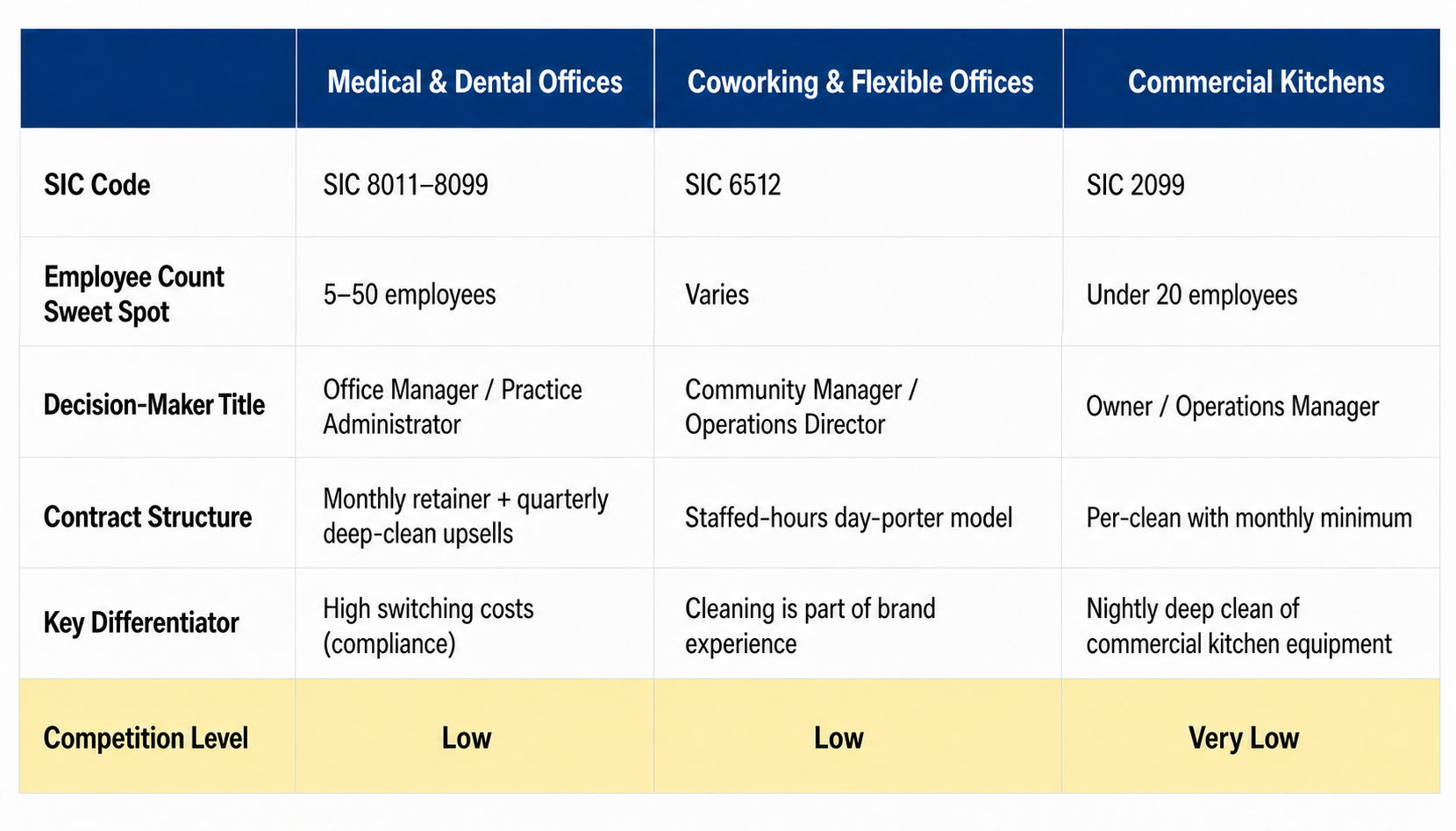
- Focus on underserved verticals like medical offices (SIC 8011–8099, NAICS 6211), coworking spaces (SIC 6512, NAICS 531120), and commercial kitchens (SIC 2099, NAICS 311999). Each has distinct compliance needs, decision-makers, and contract structures.
- Build your list using a precise filter sequence: geography, then four-digit SIC code, then employee count (as a proxy for size), and finally executive title.
- Qualify every lead with a five-point checklist before scheduling a walkthrough to avoid wasting hours on prospects who were never going to close.
- Use a 14-day, multi-channel outreach sequence. A single cold call is not a campaign; consistent follow-up across phone, email, and direct mail is where pipeline builds.
If you’ve ever pulled a list of 500 businesses in a 20-mile radius, called through all of them, booked four walkthroughs, and closed one contract, you know the frustration. The problem isn’t your work ethic. The problem is that the list treated a dental office, a warehouse, and a law firm as interchangeable prospects. They aren’t.
Commercial cleaning leads convert when they are built by industry vertical, not by geography alone. Each vertical has a different decision-maker, a different contract structure, and a different scope of work. Your list needs to reflect that reality before you pick up the phone.
This guide is for building service contractors (BSCs) and janitorial companies that need a repeatable way to generate qualified leads. We’ll cover which verticals to target, how to filter a business database to build those lists, how to qualify prospects before the walkthrough, and how to sequence your outreach to turn records into conversations.
Why Horizontal Prospecting Burns Through Commercial Cleaning Leads
Most janitorial companies build prospect lists by geography and employee count: every business in a set of ZIP codes with 10 or more employees. This horizontal approach feels efficient, but it produces a list where a medical clinic sits next to a tech startup. The clinic needs OSHA-compliant cleaning, biohazard protocols, and a consistent night-clean schedule. The startup needs a flexible day-porter service that adapts as its headcount changes.
When a sales rep calls both with the same generic pitch, neither prospect hears language that matches their procurement process or operational needs. This is why so many cold calls go nowhere. I’ve seen teams burn through a list of 1,400 local businesses in three weeks with a sub-1% conversation rate because the same script landed on veterinary clinics, law offices, and warehouses, none of which shared a contract cycle, a decision-maker title, or a cleaning scope.
Contrast this with vertical targeting. A list filtered to SIC codes 8011–8099 (health services), narrowed to companies with 10–100 employees, produces a group of prospects who all share similar compliance needs. The decision-maker is almost always the office manager or practice administrator. The rep can reference ISSA CIMS certification, name the specific scope-of-work items that matter to medical facilities, and get a much higher tag rate. The list itself is where lead quality problems originate and where they can be solved.
Read more: Commercial Cleaning Lead Solutions
Three Underserved Verticals Worth Building Lists For
The most obvious verticals—general office buildings, schools, and retail—are saturated with competing BSCs. The cleaning companies that build pipeline faster often target niches where fewer competitors are prospecting and where the contract value or retention is higher.
The following three verticals are growing, often underserved by generalist janitorial prospectors, and have distinct list-building characteristics.
Medical and Dental Offices (SIC 8011–8099, NAICS 6211)
Medical and dental offices are high-value cleaning contracts because their compliance requirements create high switching costs. Once a practice finds a BSC that understands biohazard disposal, exam-room sanitization, and HIPAA-related privacy concerns, they are unlikely to switch vendors over a small price difference.
To build this list, filter a business database by the SIC code range 8011–8099 and NAICS 6211 for medical offices. The sweet spot for employee count is typically 5–50 employees; these practices are large enough to outsource cleaning but too small to be locked into a large group purchasing organization (GPO). The decision-maker is almost never the physician or owner; filter for titles like “Office Manager” or “Practice Administrator.” The contract is usually a monthly retainer with quarterly or semi-annual deep-clean upsells like a strip and wax or carpet extraction.
Coworking and Flexible Office Spaces (SIC 6512, NAICS 531120)
Post-2020 commercial real estate trends created a surge in coworking and flexible office spaces, and they have unique cleaning needs. Unlike a traditional office, these spaces often require a day-porter service because members see the cleaning happening in real time; it’s part of the brand experience. This changes the contract from a simple night clean to a staffed-hours model, which can significantly increase monthly recurring revenue.
The decision-maker is typically the “Community Manager” or “Operations Director,” not a traditional facilities manager. You can find them by filtering for business name keywords like “coworking” or “flexible office,” or by filtering for SIC 6512 and NAICS 531120. The trade-off is data freshness. This is a newer, more fluid industry, so a record from 18 months ago might reference a space that has already closed or changed operators.
Commercial Kitchens and Commercial Kitchen Facilities (SIC 5812, NAICS 722511 and 722310)
Commercial kitchens are commercial food-preparation facilities that only handle delivery and takeout orders. Most janitorial companies overlook them because they aren’t prospecting for restaurant-style cleaning. These facilities require nightly deep cleans of commercial-grade kitchens, including hood vents, grease traps, and floor drains.
To find them, filter by SIC 5812 and NAICS 722511 or 722310, then narrow by a small employee count (under 20) and a recent new-business formation date, as many of these facilities launched after 2020. The decision-maker is usually the “Owner” or “Operations Manager.” The contract structure is often per-clean with a monthly minimum, providing a steady stream of recurring work from a low-competition vertical.
How to Build a Vertical-Specific Lead List Using Business Data Filters
A vertical-specific list is only as good as the filters used to build it. Let’s walk through a concrete example: building a list of medical offices in the Dallas-Fort Worth metro area.
- Start with Geography. Define your service area first. In a business database like InfoFree, you can search by a list of ZIP codes, a city, or a radius around your office. A 20- to 30-mile radius is realistic for most cleaning operations. Avoid searching an entire state; it creates a list you can’t efficiently service.
- Apply the SIC Code Filter. This is the most important step. For our example, we’d apply the four-digit SIC codes for health services, 8011 through 8099. This single filter removes every non-medical business from the list, instantly focusing your efforts.
- Filter by Employee Count. Employee count is a rough but useful proxy for square footage. For single-location medical practices, a filter of 5–50 employees targets organizations large enough to need outsourced cleaning but small enough to make decisions locally.
- Filter by Executive Title. This is where you separate good lists from great ones. Instead of targeting “Owner” or “CEO,” filter for decision-maker titles like “Office Manager” or “Practice Administrator.” These are the roles that actually manage vendors and approve cleaning contracts in a medical practice.
- Review and Refine. Look at the resulting list count. If it’s under 50 records, consider widening your geographic radius. If it’s over 500, you might tighten the geography or add a revenue filter to focus on larger practices.
A compiled database like InfoFree’s contains approximately 22 million U.S. business records, with business data being triple-verified and rated at 95% accuracy. However, you should still expect some records to be outdated. The goal is to build a list that is directionally correct and gives your sales team a strong starting point. As a final note, remember that you are responsible for ensuring any outreach complies with DNC, TCPA, CAN-SPAM, and applicable state privacy laws.
How to Qualify a Commercial Cleaning Lead Before the Walkthrough
The walkthrough is the most expensive part of the commercial cleaning sales process. It costs travel time, estimating time, and proposal-writing time. The real cost of a bad commercial cleaning lead is not the price of the record but the estimator’s afternoon: driving to a site, measuring square footage, and writing a proposal for a prospect whose contract renewal is nine months away.
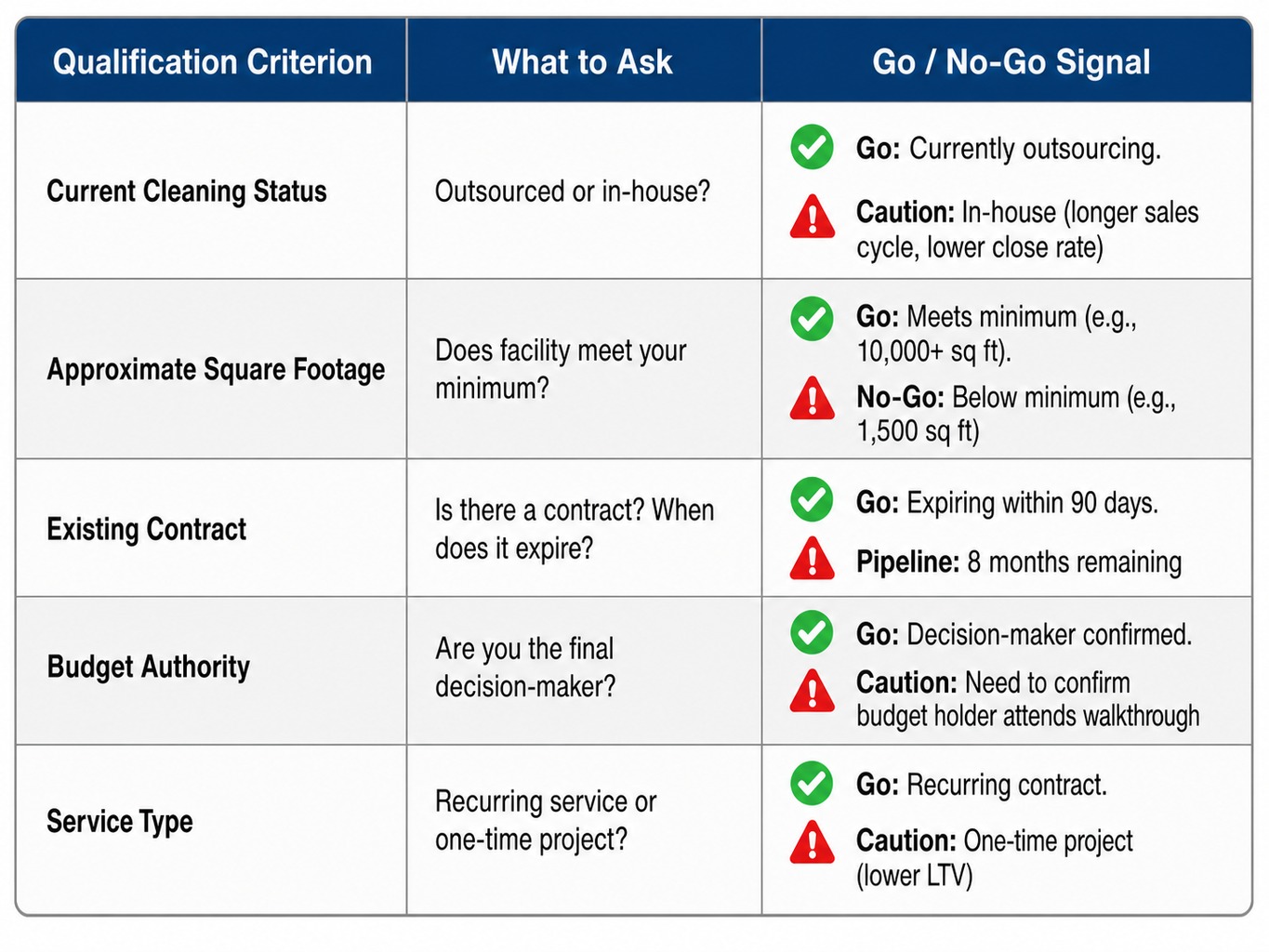
Before scheduling a walkthrough, a sales rep should confirm five things by phone or email:
- Current Cleaning Status: Is the prospect currently outsourcing cleaning, or is it handled in-house? If it’s in-house, the sales cycle will be longer and the close rate will be lower.
- Approximate Square Footage: Does the facility meet your company’s minimum contract size? A 1,500-square-foot office may not be worth pursuing if your model is built on 10,000+ square-foot facilities.
- Existing Contract: Is there a cleaning contract in place, and when does it expire? A prospect locked into a contract for another eight months is a future pipeline opportunity, not an active lead for this quarter.
- Budget Authority: Is the person you’re speaking with the final decision-maker? If not, you need to confirm the actual budget holder will attend the walkthrough.
- Service Type: Are they looking for recurring service or a one-time project like a post-construction clean-up? One-time jobs have their place, but recurring contracts are the foundation of a stable cleaning business.
Treating every lead as walkthrough-worthy is a recipe for a slow pipeline and a burnt-out estimator. Use this checklist to protect your team’s time.
Outreach Sequencing: How to Work a Commercial Cleaning Lead List
A list is not a campaign. Most cleaning companies pull a list, call through it once, and declare the leads dead when 90% don’t answer. Office managers and property managers are busy; they aren’t waiting for your cold call. A disciplined, multi-channel approach is required to earn their attention.
Here is a simple 14-day outreach cadence you can implement:
- Day 1: Introductory Call. You will likely get voicemail. Leave a message that names their industry and a specific pain point (e.g., “calling about your janitorial needs as a medical practice”). Do not leave a generic “we clean offices” pitch.
- Day 2: Follow-up Email. Reference the voicemail. Include a one-paragraph summary of the scope of work relevant to their vertical. For a dental office, this might mention terminal cleaning of operatories.
- Day 5: Second Call Attempt. A simple, professional follow-up.
- Day 7: Direct Mail. A one-page letter offering a complimentary site assessment. If you have a comparable client in their vertical, mention it. Physical mail stands out in a digital world.
- Day 10: Third Call Attempt.
- Day 14: Final Email. Offer a specific, time-limited window for a walkthrough (e.g., “I have two openings next Tuesday afternoon for a 15-minute site assessment”). This creates a real reason to respond now.
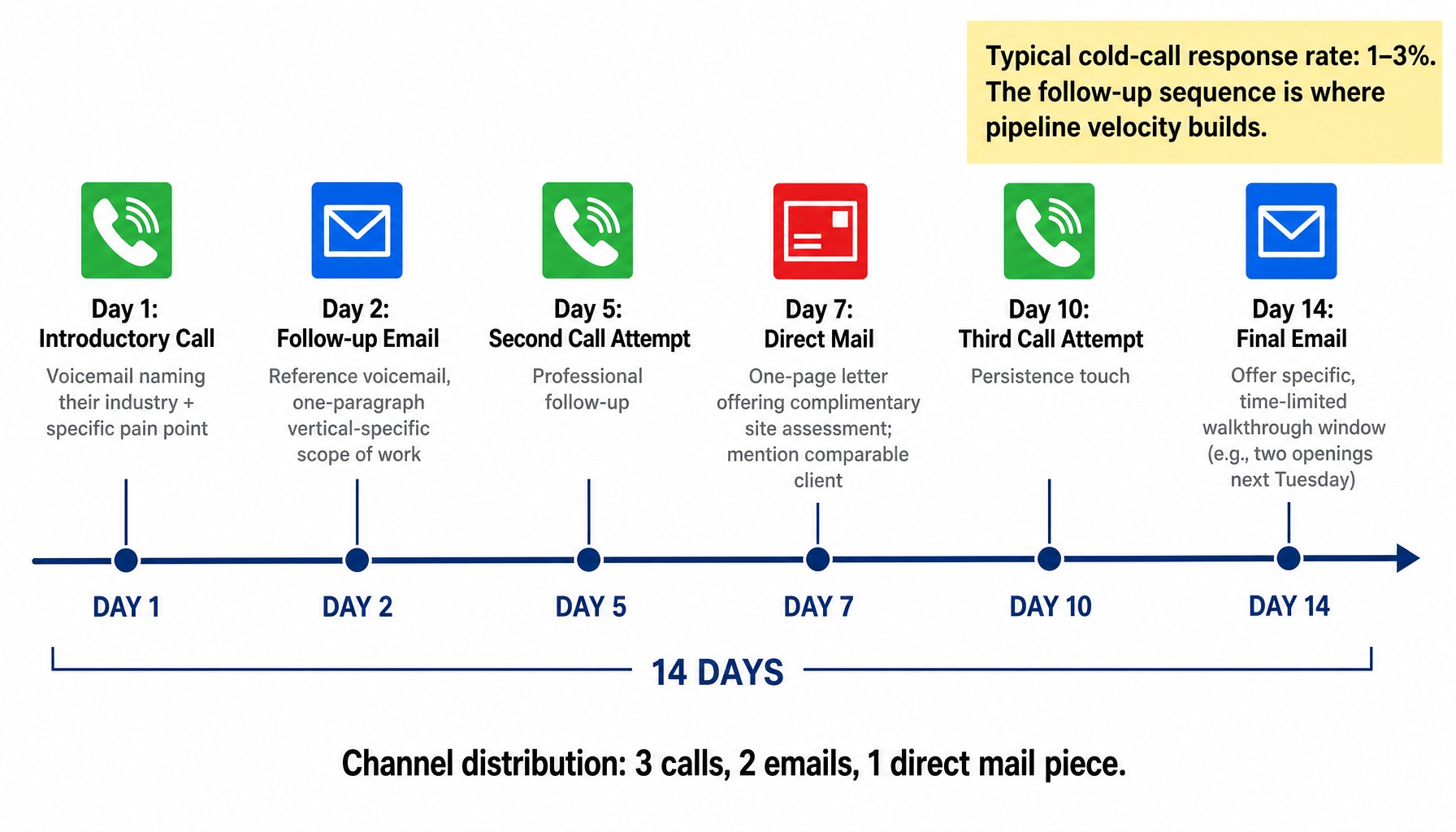
As most sales practitioners will tell you, initial cold-calling response rates typically run 1–3%. The follow-up sequence is where the real pipeline velocity comes from. And as always, ensure your calling, emailing, and mailing activities comply with all DNC, TCPA, CAN-SPAM, and relevant state privacy regulations.
Read more: ZIP Code Mailing Lists – Buy Mailing Lists by ZIP Code from Infofree
Building Vertical-Specific Cleaning Lead Lists in InfoFree
This article has built a specific tension: effective prospecting requires filtering by four-digit SIC code, geography, employee count, and executive title. Most cleaning companies either don’t have access to a business database with those filters or pay per-record every time they pull a new list, making iteration expensive.
InfoFree is designed to resolve this tension. Our platform gives you access to a database of 22 million U.S. businesses, with business records that are triple-verified and rated at 95% accuracy. You can execute the exact filter sequence described in this guide—SIC codes 8011–8099, employee count 5–50, a 20-mile radius, and the “Office Manager” title—to build a targeted list in minutes.
Our flat-rate subscription includes unlimited search and view across the entire business database, with export limits that vary by plan. This means you can test multiple vertical filters, compare list sizes, and refine your targeting without worrying about per-record costs. Furthermore, the same platform includes our integrated lead management tool, CRM101, allowing you to log calls, track walkthrough status, and manage the 14-day outreach cadence without needing a separate tool.
Search commercial cleaning prospects by SIC code, location, and decision-maker title
From Horizontal Lists to Vertical Pipelines
The single most important shift a janitorial company can make in its sales process is to recognize that lead quality is determined by the list, not the pitch.
When you target prospects by vertical using SIC codes and decision-maker titles, you create a list where every business shares similar needs, contract structures, and budget authority. Your sales pitch, scope-of-work templates, and qualification questions become reusable assets, not one-off efforts reinvented for every call.
Pick one vertical from this article. Build a focused list of 50–100 prospects using the filter sequence we outlined. Work it with the 14-day outreach cadence. The clarity and momentum you gain from speaking to a consistent audience will change how you think about prospecting.
Frequently Asked Questions
What close rate should I expect from a vertical-targeted commercial cleaning lead list?
Think of this in two steps. First, cold outreach usually gets a low response rate, often around 1–3%. That just means a small share of people will reply or agree to talk. Second, once you have a real walkthrough with a qualified prospect, the close rate is much higher. For many BSCs, closing 20–40% of those walkthroughs is a reasonable directional benchmark. Those numbers are not the same thing; they are two different stages of the sales process.
Are pay-per-lead services worth it for janitorial companies?
Pay-per-lead services like Thumbtack or Angi deliver inbound leads, but they are often shared with multiple competitors, which compresses close rates. As industry observers note, shared commercial leads can run $18–$50 each, with exclusive leads reaching $75–$125. Building your own list produces exclusive prospects you can re-contact without additional per-lead fees.
What is the average customer acquisition cost for a commercial cleaning contract?
Customer acquisition cost (CAC) depends on the lead source and contract value, but industry ranges for commercial cleaning typically fall between $150 and $500 per new account. This accounts for list costs, outreach labor, and walkthrough time. Higher-value contracts (e.g., monthly retainers over $2,000) naturally justify a higher CAC.
Should I buy leads or invest in SEO for my cleaning business?
They serve different timelines. Building your own lead lists from a business database produces prospects you can contact this week. SEO and optimizing your Google Business Profile build inbound lead flow over 6–12 months. Most cleaning companies benefit from running outbound prospecting now while building inbound channels in parallel.
How do I target property managers for janitorial contracts?
Property managers control budgets for multi-tenant buildings. Filter a business database by SIC codes for real estate management (like 6531 for real estate agents and managers), then narrow by geography. The decision-maker is typically the “Property Manager” or “Facilities Director.” Expect a longer sales cycle, as these contracts are often rebid annually.