

Key Takeaways
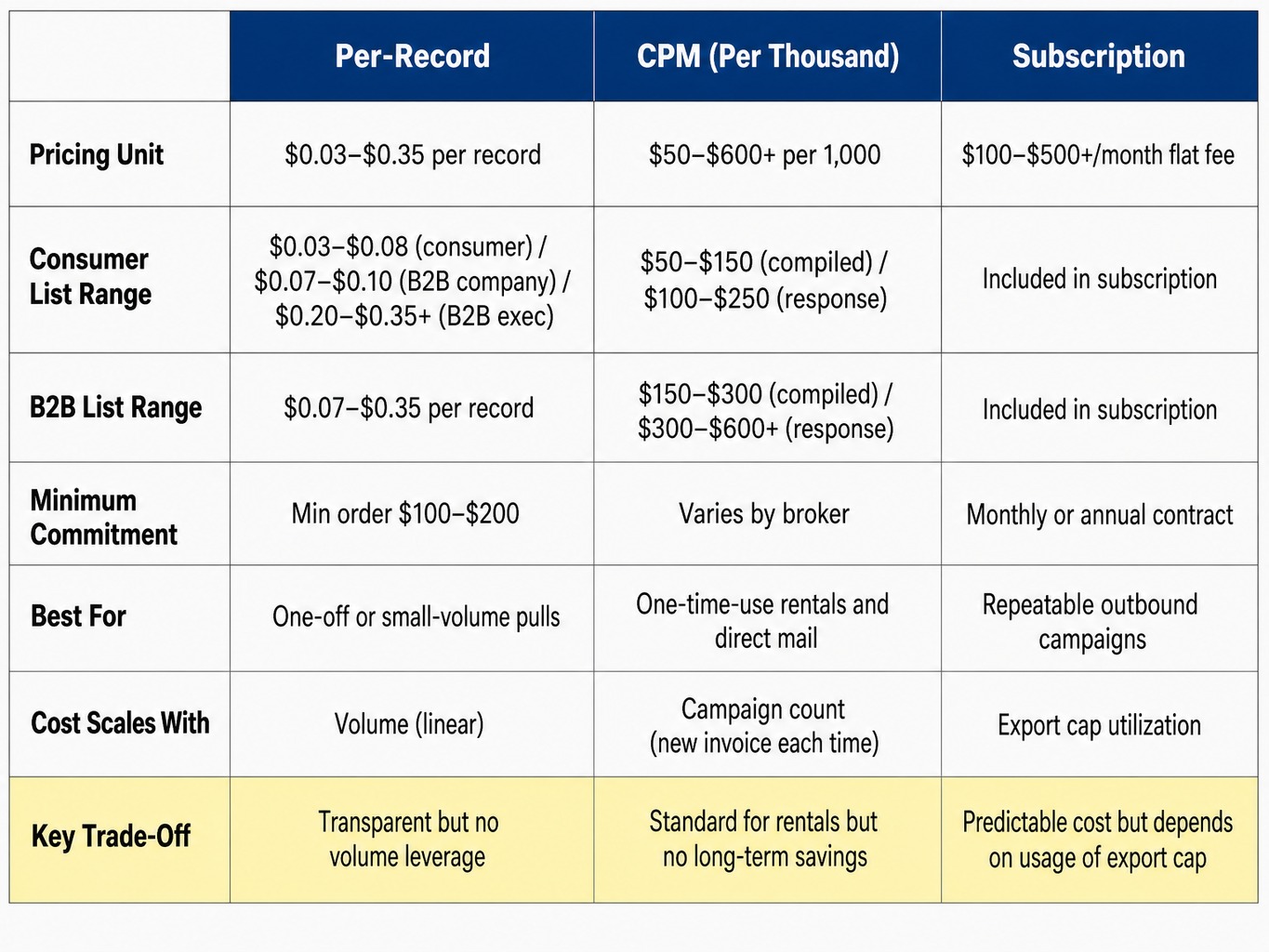
- Mailing list pricing uses three models: per-record ($0.03-$0.35/record), CPM ($50-$600+/thousand), or subscription ($100-$500+/month). The right model depends on your campaign frequency and volume.
- The sticker price is misleading. Hidden costs for verification, hygiene, and suppression can increase your effective cost per contact by 30-80% before you send a single email or mailer.
- Data decay is a real cost. B2B lists lose about 25% of their value annually due to job changes, while consumer lists see 10-12% churn from moves. This requires a budget for replacement.
- Don’t compare quotes. Instead, calculate your effective cost per deliverable contact: (Total Spend) / (Records – Bounced – Suppressed). This is the only metric that matters for campaign planning.
- Subscription platforms shift the math from a variable per-record cost to a fixed monthly fee, which can be more economical for teams running repeatable outbound campaigns that require fresh data.
If you’ve ever been quoted a price for a mailing list, you know the initial math seems simple. A list of 50,000 consumer records at $0.05 per name should cost $2,500. But it’s common for a list like that to lose 11,000 records to duplicates, undeliverable addresses, and suppression files before a single piece of mail is sent. The effective cost per deliverable contact isn’t five cents; it’s closer to nine.
This is the central problem with understanding how much a mailing list costs. Pricing guides typically give you the sticker price but not the real-world math that determines what you actually pay per usable contact.
This article gives you that math. We’ll compare the three primary pricing models per-record, cost per thousand (CPM), and subscription and break down the cost drivers that move prices up or down. More importantly, we’ll cover the hidden costs vendors often do not advertise and give you a simple framework for calculating your effective cost per deliverable contact.
Three Mailing List Pricing Models and What Each Actually Costs
Mailing list pricing generally falls into three models. The right one for your campaign depends on how often you need fresh data and how many records you use at a time. Buyers often encounter per-record pricing first, but CPM and subscription models exist and completely change the cost equation for anyone running more than a one-off campaign.
Per-Record Pricing: What List Brokers Charge Per Name
Per-record pricing is the most straightforward model, common at traditional list brokers and data compilers. You pay a set price for each contact record you purchase.
- Consumer Demographic Lists: $0.03 – $0.08 per record
- Targeted Consumer Lists (with selects): $0.07 – $0.15 per record
- B2B Company Lists: $0.07 – $0.10 per record
- B2B Executive Lists (with titles): $0.20 – $0.35+ per record
Vendors in this category often require a minimum order, often around $100-$200 or a few thousand records. For reference, directmail.com publishes consumer rates at $0.034-$0.049 per record. The trade-off is transparency for a lack of leverage. Per-record is pay-as-you-go, but costs scale linearly. A team pulling 10,000 records every month pays the same rate each time, with no economic benefit for their repeat business.
CPM Pricing: How Brokers and Rental Houses Quote Per Thousand
Cost Per Thousand (CPM) is the standard quoting convention for list rentals and large-scale direct mail campaigns. Instead of a per-record price, you’re quoted a price for every 1,000 names on the list.
- Consumer Compiled Lists: $50 – $150 CPM
- Consumer Response Lists: $100 – $250 CPM
- B2B Compiled Lists: $150 – $300 CPM
- B2B Title-Specific or Response Lists: $300 – $600+ CPM
A critical distinction in CPM pricing is the difference between a base run charge and additional select charges. The run charge is the base CPM for accessing the list. Each filter you apply like income range, homeowner status, or SIC code adds a select charge, typically $5-$15 per thousand, per filter. A list with four selects can easily add $20-$60 CPM to your base price. The trade-off here is that CPM is standard for one-time-use rentals, but it means every new campaign requires a new invoice, preventing any long-term cost efficiency.
Subscription Pricing: Flat-Rate Access With Export Limits
Subscription pricing is the model used by modern sales intelligence and prospecting platforms like ZoomInfo, Apollo.io, and InfoFree. Instead of paying per record or per campaign, you pay a flat monthly or annual fee for access to the database.
- Small Team / Individual Plans: $100 – $500 per month
The key detail is that subscriptions typically offer unlimited search and view but cap the number of records you can export or download based on your plan tier. This distinction is crucial. A salesperson who searches frequently but only exports 2,000 contacts a month has very different economics than a direct marketer who needs to pull 50,000 records for a mail drop. The trade-off is predictability. Subscriptions favor teams that need ongoing, repeatable access to fresh data, but the annual commitment and export caps mean your effective per-record cost depends entirely on how much of the included capacity you actually use.
What Drives Mailing List Prices Up or Down
The price for a mailing list can span an order of magnitude, from under $0.03 to over $0.35 per record. That gap isn’t arbitrary; it’s driven by a handful of variables that compound to determine the final quote. The main factors are the list type (consumer vs. business), the depth of targeting (how many filters), the data source (compiled vs. response), freshness, and your usage rights.
How Select Charges and Targeting Depth Affect Your Invoice
Every filter applied to a list geography, age, income, homeowner status, SIC code, executive title is a “select,” and it almost always adds cost. As a rule, list cards from brokers show a base price per thousand and then stack select charges for each filter, so the final cost is rarely the base price. These charges typically run $5-$15 per thousand records per select.
Consider a B2C example: a base list of consumers costs $75 CPM. If you want to target only homeowners aged 55-75 with an estimated home value above $250,000 in three specific ZIP codes, you’ve just applied four selects. At $8 per thousand per select, that adds $32 CPM to your cost a 43% increase over the base price.
Read more: ZIP Code Mailing Lists – Buy Mailing Lists by ZIP Code from Infofree
This sounds like you’re paying more for less, but it’s counterintuitive. More selects raise the per-record cost but almost always lower the cost per qualified contact because you waste less of your campaign budget on people who were never going to be a good fit.
Compiled Lists vs. Response Lists: Why Source Quality Changes the Price
The source of the data is one of the biggest factors in mailing list pricing. A compiled list is assembled from public records, directories, credit bureaus, and other aggregated data sources. These lists are broad, offer granular filtering, and are relatively inexpensive ($50-$150 CPM for consumer, $150-$300 CPM for B2B).
A response list, on the other hand, is built from people who took a specific action: they subscribed to a magazine, requested a quote, or purchased a related product. These lists carry behavioral intent and cost 30-100% more because they consistently deliver higher response rates. The list is smaller and more expensive, but the campaign may be more profitable.
Some platforms, like InfoFree, compile their own databases from thousands of sources and use primary research to verify records. This approach aims to provide the scale of a compiled list with a higher degree of accuracy. For example, InfoFree’s business database is triple-verified and rated at 95% accuracy. Its consumer and household records are compiled from a separate set of sources and are not rated on the same standard, a reflection of the fact that consumer and business leads pricing follow different market norms because their underlying compilation economics differ.
The Hidden Costs Most Buyers Discover After the Invoice
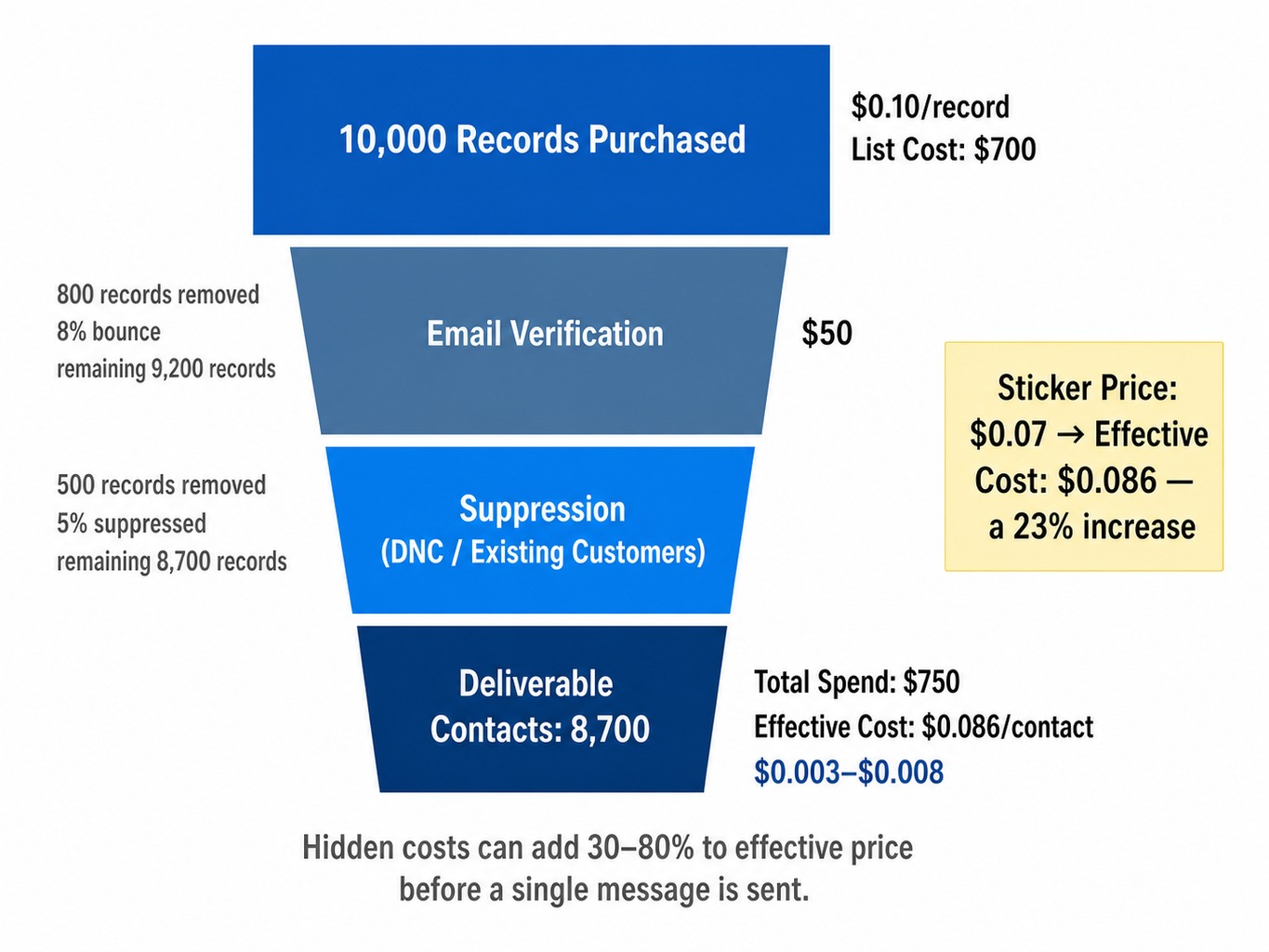
The price on the vendor quote is the acquisition cost, not the total cost of ownership. Teams frequently fail to budget for the critical steps that happen between purchase and deployment. These hidden costs for verification, hygiene, and data decay can add 30-80% to the effective price you pay per usable contact. And this is the part of the process where campaign budgets usually break.
Verification, Hygiene, and Suppression Costs
Before you can use a list, you have to clean it.
- For email lists: Verification to remove invalid, disposable, and role-based addresses is non-negotiable. Services like NeverBounce or ZeroBounce charge between $0.003 and $0.008 per email verified, or $30-$80 for a 10,000-record list. Sending to an unverified list risks damaging your domain reputation and getting blacklisted by ISPs.
- For physical mailing lists: As mail houses will confirm, running your list through NCOA (National Change of Address) processing costs $3-$8 per thousand, and CASS certification to standardize addresses adds another $2-$5 per thousand.
- For all lists: You must merge your new list against suppression files your existing customer list, internal opt-out lists, and federal Do Not Call (DNC) registries. This step alone can remove 5-15% of the records you just paid for. It’s also important to remember that verification services charge per record processed, not per record that passes, which means the worse the list quality, the more you pay in verification fees for contacts you will never use.
The practical impact is immediate. A 10,000-record email list bought at $0.10/record ($1,000) that loses 12% to verification bounces and 8% to suppression checks yields only 8,000 usable contacts. Your effective cost just jumped from $0.10 to $0.125 per contact. And this is all before accounting for your own compliance obligations under DNC, TCPA, CAN-SPAM, and applicable state privacy laws.
Data Decay and Replacement: The Cost of Keeping a List Current
A purchased list is a depreciating asset. The data starts going stale the moment you download it. Industry benchmarks show that B2B contact data decays at roughly 25-30% per year due to job changes, promotions, and company closures. Consumer data decays more slowly, but with roughly 10-12% of U.S. households moving annually, an unmaintained list quickly becomes undeliverable.
This decay isn’t just a quality issue; it’s a hidden cost.
Consider the replacement math: a team buys 10,000 B2B executive records at $0.25 each ($2,500). If 25% of those records become obsolete within a year, replacing them costs another $625. That’s effectively a 25% annual maintenance fee on top of the original purchase. This is the cost that per-record and CPM buyers often do not budget for, and it’s the primary reason teams running repeatable campaigns often find subscription models more economical over a 12-month period, despite a higher initial commitment.
How to Calculate Your Effective Cost Per Deliverable Contact
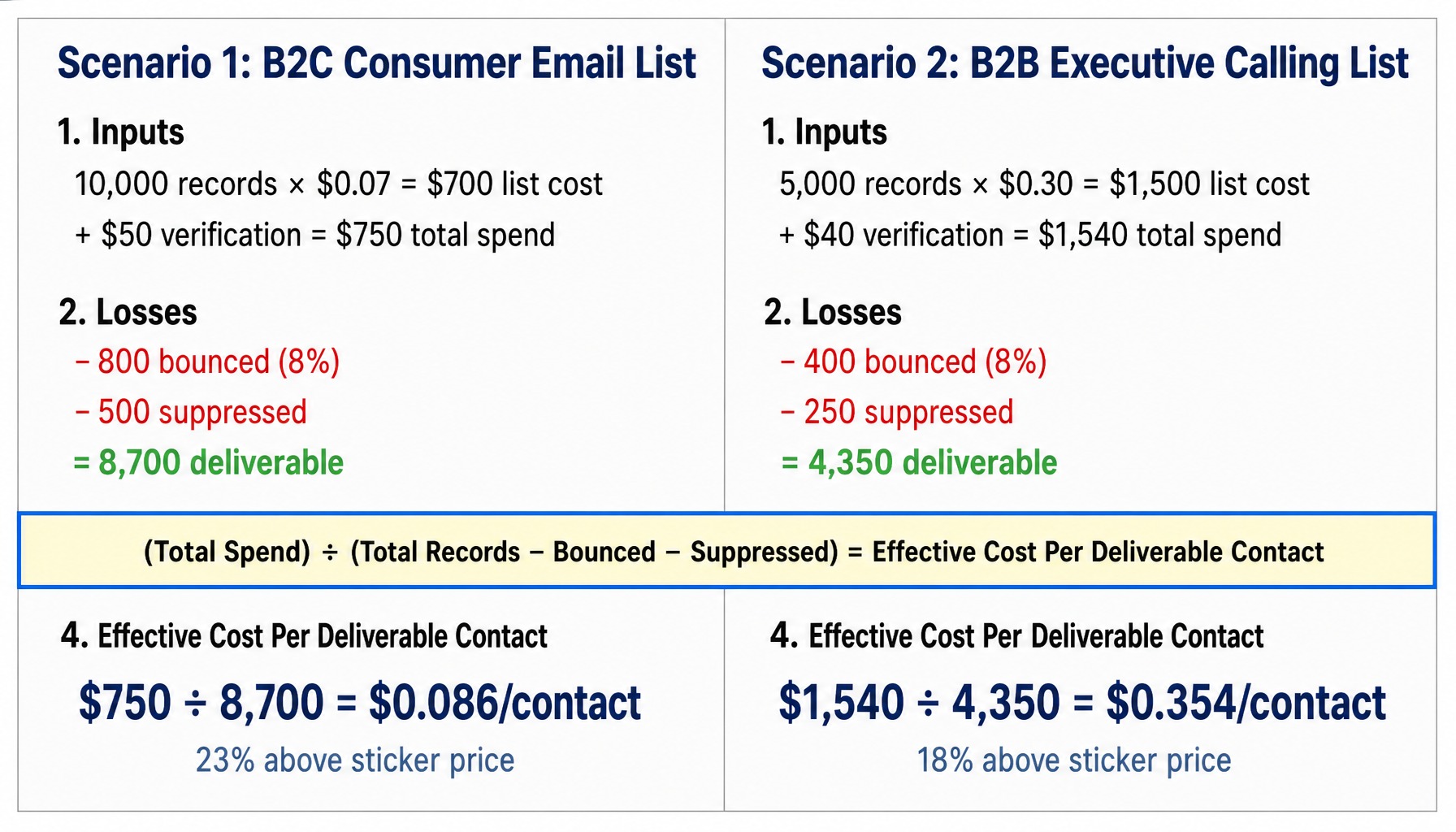
The only metric that truly matters for campaign planning is your effective cost per deliverable contact. This figure represents your total spend divided by the number of records that can actually receive your message.
The formula is simple:
(List Cost + Verification/Hygiene Costs) / (Total Records – Bounced – Suppressed) = Effective Cost Per Deliverable Contact
Let’s run two common scenarios:
Scenario 1: B2C Consumer Email List You purchase 10,000 consumer records at $0.07 each.
- List Cost: $700
- Email Verification Cost: $50
- Total Spend: $750
After processing, you find 800 invalid emails (8% bounce) and suppress another 500 records (DNC/existing customers).
- Total Records: 10,000
- Less Bounced/Suppressed: 1,300
- Deliverable Contacts: 8,700
Calculation: $750 / 8,700 contacts = $0.086 Effective Cost Per Contact (23% higher than the sticker price).
Scenario 2: B2B Executive Calling List You purchase 5,000 executive records at $0.30 each.
- List Cost: $1,500
- Phone Verification (optional, but wise): $40
- Total Spend: $1,540
Your verification pass finds 400 disconnected numbers (8% bounce), and you suppress 250 more against your internal DNC file.
- Total Records: 5,000
- Less Bounced/Suppressed: 650
- Deliverable Contacts: 4,350
Calculation: $1,540 / 4,350 contacts = $0.354 Effective Cost Per Contact (18% higher than the sticker price).
This framework applies regardless of the pricing model. The buyer who calculates effective cost before committing to a vendor will always make a better decision than the one who just compares quotes.
How a Flat-Rate Subscription Changes the Cost Math
The per-record and CPM models force you to re-run the cost calculation with every new campaign, compounding hidden costs with each invoice. A flat-rate subscription model offers a structural alternative by shifting the expense from a variable per-record cost to a predictable, fixed operational expense.
A platform like InfoFree provides unlimited search and view across both its business and consumer databases. That includes access to roughly 22 million businesses and up to 70 million executives on the B2B side, and approximately 270 million consumers and 170 million households on the B2C side. All records are searchable from a single interface, using the same workflow.
With a subscription, the cost of searching, filtering, and refreshing marketing lists is absorbed into the monthly fee. You are not penalized for running multiple searches or building different segments to test new campaign ideas. This is particularly valuable for teams that run repeatable outbound, direct-mail, email, or calling programs and need a steady supply of fresh prospects. While export limits vary by plan, the model eliminates the per-lookup and per-record fees that make frequent list-building expensive. InfoFree’s business records are triple-verified and rated at 95% accuracy; its consumer and household records are compiled from a separate set of sources and not rated on the same standard. When using any exported data, customers are responsible for following all applicable local, state, and federal laws, including DNC, TCPA, CAN-SPAM, and state privacy statutes. InfoFree provides the data; it is not liable for how customers use it.
See how flat-rate list access compares to per-record pricing for your campaign volume
The Only Metric That Matters
The single most important takeaway is this: mailing list cost is not the number on the quote. It’s the effective cost per deliverable contact after you account for verification, suppression, and data decay. The pricing model per-record, CPM, or subscription sets your starting point, but the hidden costs determine what you actually pay. The buyer who calculates this effective cost before choosing a vendor will spend less per qualified prospect over a 12-month period than the buyer who simply compares sticker prices.
Before you request your next list quote, run the effective-cost formula against your last three campaigns. The gap between what you paid and what you got will tell you whether your current model still makes sense.
Frequently Asked Questions
What is the typical minimum order size for a purchased mailing list?
List brokers generally require a minimum purchase of $100-$200 or between 1,000 and 5,000 records, whichever is greater. Specialty lists, such as those for healthcare or financial services, often have higher minimums. Subscription platforms don’t have per-order minimums but cap total monthly exports by plan.
Is it cheaper to build a mailing list organically or buy one?
Organic list building (e.g., lead magnets, opt-in forms) produces higher-engagement contacts but can cost $2-$15 per subscriber. Purchased lists are faster and cheaper per record ($0.03-$0.35) but have lower engagement. For teams needing volume quickly for a launch or direct mail campaign, purchasing is faster; for building long-term value, organic is usually better.
How much do firmographic and demographic selects add to the base price of a mailing list?
Each select, or filter, typically adds $5-$15 per thousand records at list brokers. Common selects include age, income, homeowner status, SIC code, and executive title. A list with four such selects can add $20-$60 CPM on top of the base price, so always ask for the all-in cost.
What does email verification cost, and is it worth paying for before a campaign?
Email verification services charge between $0.003 and $0.008 per record, or about $30-$80 per 10,000 emails. For any purchased list, this step is mandatory. Sending to unverified addresses can lead to high bounce rates, damage your domain reputation, and get you blacklisted by ISPs, making the small verification cost a necessary investment.
How does list rental differ from list purchase, and which costs more?
A rented list grants one-time use for a single campaign; the list owner includes seed records to detect unauthorized reuse. A purchased list typically grants unlimited use for a defined period. Rental often costs 30-50% less per use, making it ideal for testing a new segment. Purchasing is more economical for ongoing outreach to a proven audience.