


TL;DR
- Evaluate telemarketing lists on data recency, not record count. A smaller, recently verified list will always outperform a larger, aged list on dial-to-connect and right-party contact (RPC) rates.
- Compliance is your liability, not the provider’s. You are legally responsible for scrubbing lists against federal and state Do Not Call (DNC) registries before every campaign.
- Ask providers three questions to audit freshness: How are you continuously updating and validating your data? How many data fields are you actively maintaining? What are some ways you ensure data accuracy?
- B2B and B2C lists are not interchangeable. B2B requires firmographic data (company size, industry, title), while B2C needs demographic data (age, income, homeowner status).
- Use a 6-point rubric to score providers on data provenance, verification method, refresh cadence, compliance handling, export format, and contract terms. Walk away from any vendor who can’t provide clear answers.
Your new sales manager just invested in a 50,000-record telemarketing list. The cost-per-lead was low, the volume was high, and the team was excited to load it into the dialer. The first week was promising. The second week, the dial-to-connect ratio cratered. By week three, it’s below 4%. Half the numbers are disconnected, a quarter of the people who answer are on the National DNC registry, and the few right-party contacts you reach don’t match your target profile at all.
This scenario is the default outcome for most telemarketing list purchases. It happens not because the data was overtly “bad,” but because the buyer evaluated the list on two metrics that don’t predict performance: size and price.
The quality of a telemarketing list is determined by how recently its records were verified, how thoroughly it was scrubbed against current compliance registries, and how precisely its data fields match your campaign’s targeting needs. This guide provides a practical framework for evaluating telemarketing lists before you buy. We’ll cover how to audit data quality, navigate your legal obligations, distinguish B2B from B2C requirements, and apply a concrete scoring rubric to any data provider.
What Is a Telemarketing List and What It Is Not
A telemarketing list is a structured dataset of phone numbers and associated contact attributes like name, company, title, geography, or demographics compiled or purchased specifically for outbound calling campaigns. Critically, a legitimate list is scrubbed against Do Not Call registries before use to ensure legal compliance.
Here is the distinction most buyers miss: a telemarketing list is fundamentally different from a general marketing database or an email list. It carries phone-specific legal obligations under the Telephone Consumer Protection Act (TCPA), the FTC’s Telemarketing Sales Rule (TSR), and dozens of state-level laws that do not apply to email or direct mail. Yet many providers sell the same raw contact file for all three channels without adjusting the compliance layer.
For example, a B2C mailing list that happens to include phone numbers is not a compliant telemarketing list. It only becomes one after those numbers have been:
- Verified as active and correct.
- Flagged for their status as wireless or landline numbers.
- Scrubbed against the National DNC Registry and all applicable state-level DNC lists.
Treating a generic contact file as a ready-to-dial telemarketing list is the root cause of most compliance penalties and performance failures. The word “list” obscures critical differences in legal exposure and necessary data preparation.
Why Data Recency Matters More Than List Size
Sales leaders and marketers instinctively compare telemarketing lists by record count and cost-per-lead (CPL). But the variable that actually determines campaign ROI is how recently each record was verified. A 200,000-record list with a 60-day recency stamp will outperform a 500,000-record list compiled 18 months ago on every metric that matters dial-to-connect ratio, right-party contact (RPC) rate, and compliance exposure.
A call center that switches from a massive, aged list to a smaller, more expensive list of recently phone-verified contacts often sees its RPC rate double. The team makes fewer dials but has more conversations, driving down the effective cost per appointment. The obsession with list volume is a trap; focus on freshness instead.
How Fast Telemarketing Data Decays and What That Costs You
Phone data decays faster than almost any other marketing data. Industry estimates suggest B2B contact data decays at a rate of 2–3% per month , primarily due to job changes, promotions, and company acquisitions that render direct dials and titles obsolete. B2C data can decay even faster as consumers port numbers between carriers, households move, and wireless numbers get reassigned.
This constant churn, or “burn rate on a list,” means that a file purchased today is measurably less accurate in 30 days and significantly degraded in six months. If a provider cannot tell you the recency stamp on each record or batch, you must treat the list as aged, regardless of what the sales rep claims. The cost of this decay isn’t just wasted time on disconnected numbers; it’s the opportunity cost of your sales team talking to wrong-party contacts instead of qualified prospects.
Three Questions That Reveal How Fresh a Data Compiler Really Is
Instead of asking, “How many records are in the database?” or accepting a claim that data is “continuously updated,” ask questions that reveal how a compiler actually keeps its data current. The best providers should be able to explain their processes, sources, and quality controls not just give you a number.
1. How are you continuously updating and validating your data?
Data freshness isn’t simply about when a database was last “verified.” Ask a compiler to explain how new information enters the database and how existing information is updated, corrected, or removed.
Are they continuously incorporating new sources? How do they identify changes to businesses, locations, contacts, phone numbers, websites, and other data fields? What processes are used to validate conflicting information?
A strong compiler should be able to explain a continuous, multi-source data maintenance process rather than point to a single verification date.
2. How many data fields are you actively maintaining not just how many records?
A database can contain millions of records and still have outdated information if only a handful of fields are being maintained.
Ask how many individual data elements are being monitored and updated across the database. Phone numbers, addresses, business status, industry classifications, employee counts, websites, email addresses, ownership information, and other attributes can all change independently.
The important question isn’t simply, “How often do you update your database?” It’s “How much of the information within each record are you actively working to keep current?”
3. How do you ensure data accuracy?
Ask the compiler how they ensure the accuracy of their data and what happens when information changes or conflicts. A strong compiler should be able to explain the processes they use to validate information, identify discrepancies, and keep records accurate over time.
The bottom line: Don’t judge a data provider by the size of its database or a single “last updated” date. Ask how the company continuously gathers, validates, updates, and measures millions of records and millions of individual data points. That’s what tells you whether you’re buying a living, actively maintained database or a static file that happens to be called “fresh.”
Ask these three questions to audit any telemarketing leads provider.
Compliance Is Not a Feature It Is Your Liability
A single TCPA violation can result in penalties of $500 to $1,500 . A campaign calling just 10,000 non-compliant numbers can generate seven-figure legal exposure overnight. The most critical fact to understand when buying telemarketing data is this: purchasing a list does not transfer compliance responsibility to the provider. The caller is liable.
Compliance is not a checkbox on a vendor’s feature page; it is an ongoing operational obligation that you own. For example, many buyers assume a “DNC-scrubbed” list is safe to call indefinitely. But if the provider performed that scrub 45 days before delivering the file, dozens or even hundreds of consumers could have joined the DNC registry in the interim. Dialing those numbers creates liability that the buyer, not the provider, must answer for.
Federal DNC, TCPA, and FCC Consent Rules for Telemarketing in 2026
For any U.S. telemarketing campaign, you must navigate three primary federal regulatory layers.
- The National Do Not Call Registry: Managed by the FTC, this registry requires telemarketers to scrub their calling lists against it at least every 31 days. Best practice is to scrub before every new campaign, as consumers can register at any time.
- The Telephone Consumer Protection Act (TCPA): This FCC-enforced law restricts the use of automated telephone dialing systems (autodialers) and prerecorded messages, especially for calls made to wireless numbers. The FCC’s evolving “one-to-one” consent standard requires obtaining clear, prior express written consent before making automated marketing calls to a consumer’s cell phone.
- The Telemarketing Sales Rule (TSR): Enforced by the FTC, the TSR governs call timing (restricted to between 8 a.m. and 9 p.m. local time for the called party), requires transmitting accurate caller ID information, and mandates that you honor a consumer’s request to be placed on your internal do-not-call list immediately.
A provider’s claim of a “DNC-scrubbed” list does not mean the file is compliant at the moment of dialing. That responsibility is yours. Always consult with legal counsel to ensure your campaigns meet current compliance standards.
State Mini-TCPA Laws Most List Buyers Overlook
Compounding the federal rules, at least a dozen states have enacted their own “mini-TCPA” laws that are often stricter than their federal counterparts. States like Florida, Oklahoma, and Washington have passed laws with broader definitions of what constitutes an autodialer, while others like Indiana, Pennsylvania, and Texas maintain their own state-level DNC registries.
A provider’s standard “federal DNC scrub” does not cover these state registries unless explicitly stated and verified. A multi-state telemarketing campaign requires a state-by-state compliance review. Relying on a single “compliant” label from a data vendor is insufficient and creates significant, often unacknowledged, legal risk.
B2B vs. B2C Telemarketing Lists: Different Data, Different Rules
B2B and B2C telemarketing lists are not interchangeable. They draw from different underlying databases, require different data fields for effective segmentation, and carry different compliance considerations. A provider offering a “one-size-fits-all” list is a red flag.
For B2B telemarketing , the critical data fields are firmographic. You need to filter by:
- Company Name &Location
- Industry (SIC or NAICS codes)
- Company Size (Employee Count or Revenue Range)
- Executive Name &Title (e.g., “VP of Operations”)
- Direct-Dial Phone Number
Read more: Business to Business Leads List | Infofree
For B2C telemarketing , the key fields are demographic and geographic. You need to filter by:
- Individual Name &Household Address
- Phone Number (with a wireless vs. landline flag)
- Age &Income Range
- Homeowner status &Home Value
- Presence of Children or other household attributes
On the compliance side, calls to a corporate business line are generally exempt from the National DNC Registry. However, this exemption does not apply to calls made to a business owner’s personal cell phone or home phone line a distinction that trips up many B2B callers who purchase lists without clear phone-type flags.
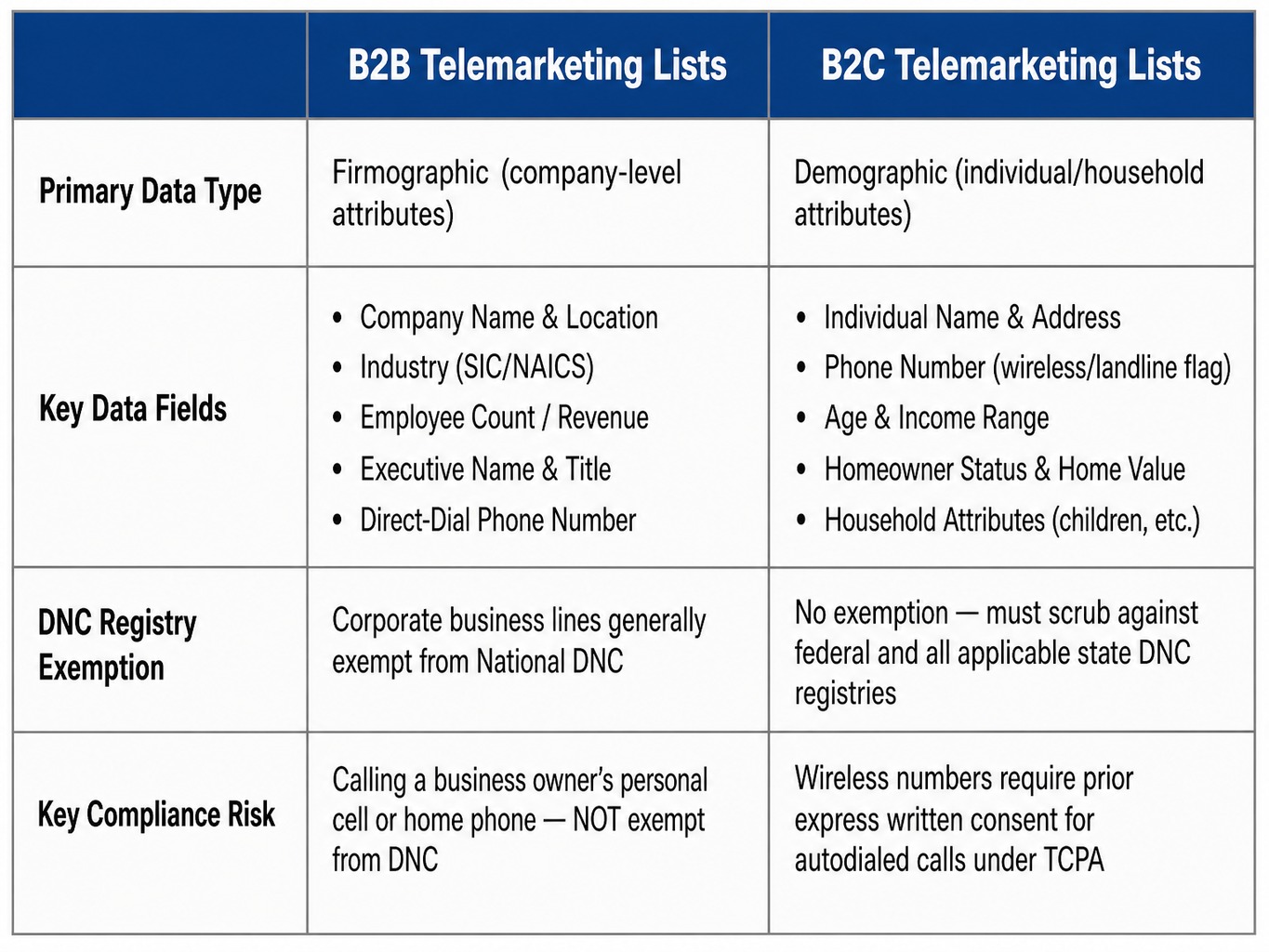
B2B and B2C telemarketing lists require different data and compliance approaches.
A Scoring Rubric for Evaluating Telemarketing Data Providers
Most buyers evaluate telemarketing data providers on price and promises. A better approach is to use a structured rubric that forces clarity on the factors that actually drive performance and mitigate risk. Use this 6-point scorecard in your next provider conversation.
- Data Provenance: Does the provider compile data in-house or resell it from third parties? An in-house compiler like InfoFree can answer specific questions about methodology and verification. A reseller often cannot, leaving you with unverifiable “black box” data.
- Verification Method: How is the data verified? Ask for the specific process. Is it “triple-verified” through primary research, phone-pinged for activity, cross-referenced with postal data, or simply aggregated? If they claim it’s verified, make them define the term.
- Recency &Refresh Cadence: How often is the entire database updated, and when was the last verification pass on the specific file you are buying? This is the most important question you can ask.
- DNC &Suppression Handling: Does the provider scrub against federal and state registries? How recently was the scrub performed? Can they accept and apply your own suppression list of current customers and internal do-not-call requests?
- Export Format &Integration: Is the data delivered in a clean, dialer-ready CSV format? Does it require significant manual cleanup or title normalization? Can it be easily imported into your CRM for follow-up?
- Contract Terms: Is the pricing per-record, a one-time list purchase, or a subscription? Are there annual commitments, auto-renewal clauses, or download caps that limit your access? Understand the full cost of ownership, not just the headline price.
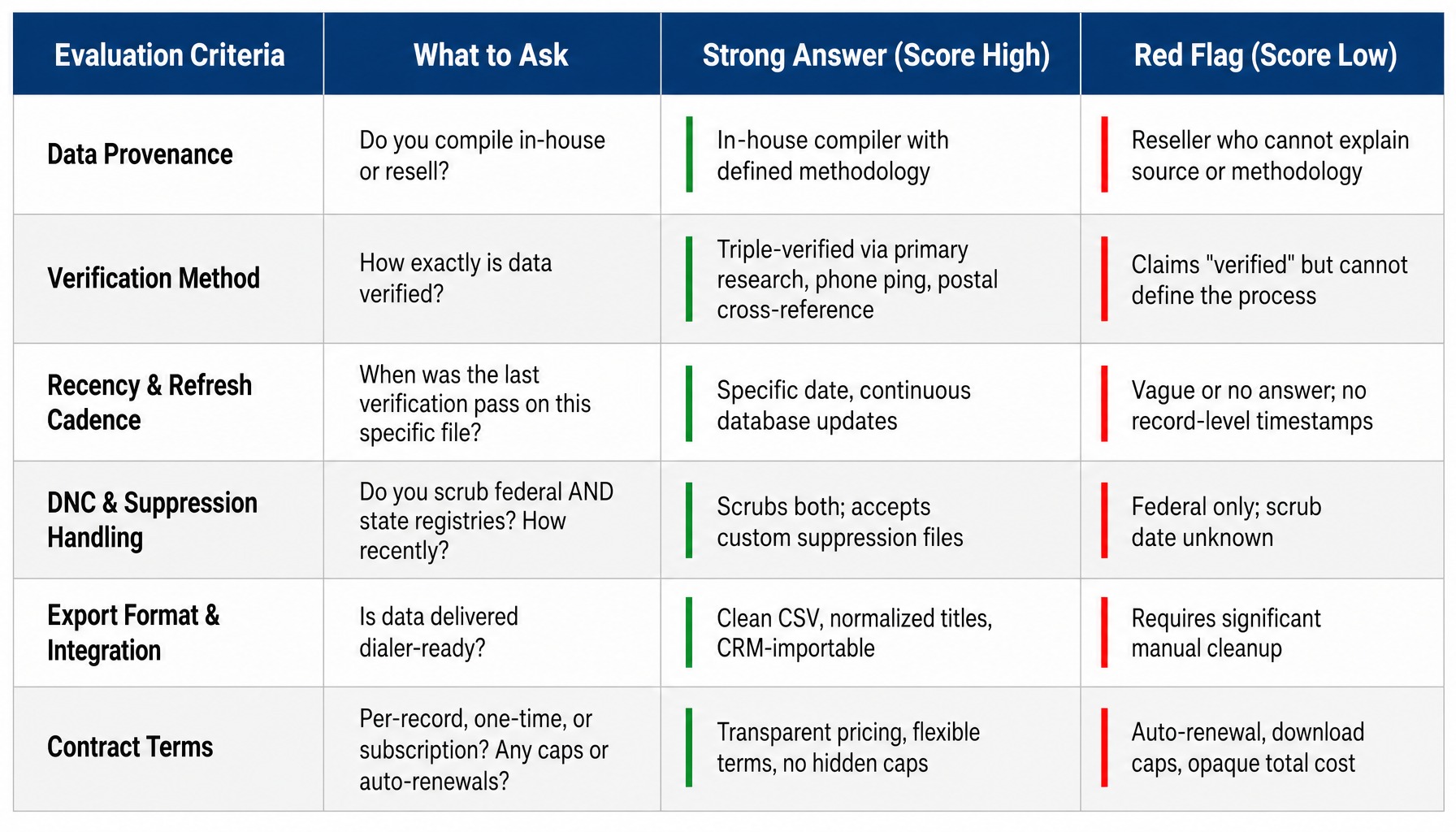
Score every telemarketing data provider against this 6-point rubric.
How InfoFree Addresses the Gaps Most Telemarketing List Buyers Face
This guide has established that most telemarketing list failures stem from three core problems: opaque data provenance, stale data that decays quickly, and unpredictable per-list pricing that punishes active prospecting. InfoFree’s platform is designed to solve these specific challenges.
Applying the rubric from the previous section, InfoFree provides clear advantages:
- Provenance &Verification: InfoFree is an original data compiler, not just a reseller. We build our business database in-house from thousands of sources and use a research team to triple-verify business records, backing our B2B data with a 95% accuracy claim.
- Recency &Refresh Cadence: Instead of selling static, decaying lists, InfoFree provides subscription access to continuously updated databases. With unlimited search and view access across 22 million businesses, up to 70 million executives, and 270 million consumers, your team can build fresh prospect lists on demand.
- Contract Terms: Our flat-rate subscription model makes prospecting costs predictable. You get unlimited search and view access plus our CRM101 contact manager without paying per-record fees that penalize growth.
While InfoFree provides the high-quality data, customers remain responsible for their own compliance with all DNC, TCPA, and other applicable telemarketing laws. Plan-specific limits apply to exports, downloads, and user seats.
Stop Buying Volume, Start Buying Confidence
The telemarketing list market rewards buyers who prioritize recency, compliance posture, and provider provenance not those who chase the largest record count at the lowest price. The difference between a list that produces a 12% RPC rate and one that produces a 3% rate is rarely the number of records. It is how recently those records were verified, whether the file was scrubbed against current registries, and whether the data fields precisely match your campaign’s targeting needs.
Before your next list purchase, apply the 6-point rubric from this guide to every provider on your shortlist. Ask the three freshness questions. And be prepared to walk away from any vendor who cannot give you a straight answer. Your dial-to-connect ratio, your cost per appointment, and your legal exposure all depend on it.
Read more: Sales Leads Lists from Infofree | Business &Consumer
Frequently Asked Questions
How often should I scrub a telemarketing list against the DNC registry?
The FTC requires that you scrub against the National Do Not Call Registry at least every 31 days. However, best practice is to scrub before every new calling cycle, because consumers can register at any time and state-level registries may update on different schedules. Scrubbing frequency should match your campaign cadence.
What is the difference between aged telemarketing leads and real-time verified leads?
Aged leads are records generated weeks or months ago often from opt-in forms sold at a discount because their responsiveness has declined. Real-time verified leads are records confirmed as current within days of delivery. Aged leads cost less per record but produce lower contact rates, so the effective CPL is often higher.
Can I legally cold call numbers from a purchased telemarketing list?
Generally yes for B2B calls to business lines, but calls to personal cell phones are subject to TCPA and DNC rules. For B2C, you must scrub against federal and state DNC registries, honor internal do-not-call requests, and obtain prior express written consent for autodialed marketing calls to wireless numbers.
What data fields should a quality telemarketing list include beyond phone numbers?
For B2B: company name, SIC/NAICS code, employee count, contact name, title, and direct-dial number. For B2C: individual name, address, phone type (wireless vs. landline), age, income, and homeowner status. A list missing phone-type flags is a compliance risk, as wireless numbers have stricter TCPA rules.
How do suppression lists work in telemarketing, and why are they critical?
A suppression list is a file of contacts that must be excluded from calling, including your internal DNC list, the federal DNC registry, and state registries. Before each campaign, this file is matched against your calling list to remove protected numbers. Skipping this step is a primary source of TCPA complaints.