


TL;DR
- Evaluate lead sources by cost-per-issued-policy, not cost-per-lead. Shared, exclusive, aged, live transfer, and self-generated leads have different conversion profiles.
- Time your T65 outreach to the prospect’s Initial Enrollment Period (IEP), which begins three months before their 65th birthday month. The highest conversion happens before their birthday, not after.
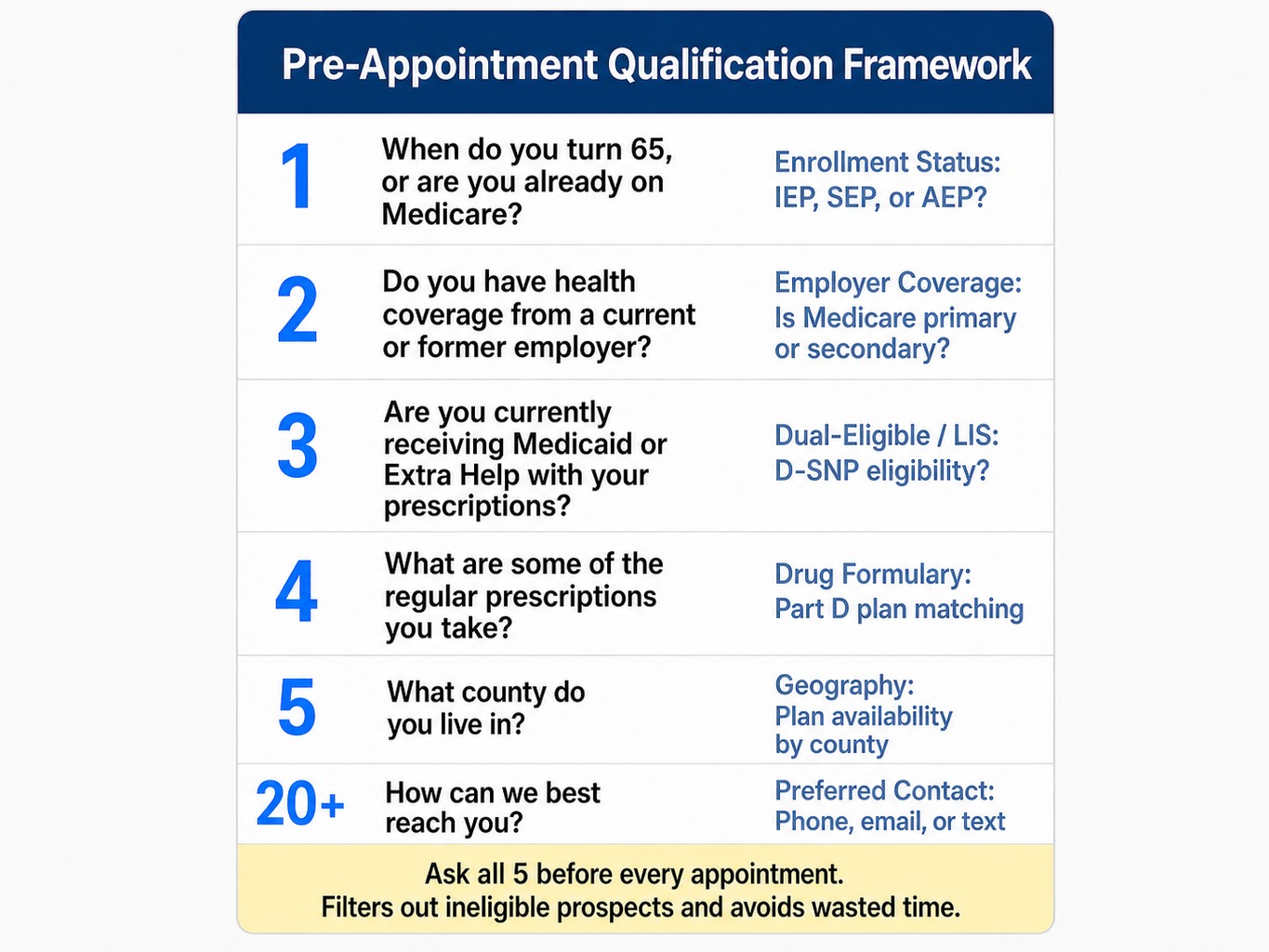
- Use a five-question framework to qualify every lead by phone before the appointment to filter out ineligible prospects and avoid wasted time.
- Build your own prospect lists using a consumer database to control filters like age band and county, giving you precisely timed and targeted T65 campaigns.
- Compliance is not optional. Understand the rules for Scope of Appointment (SOA), TCPA/DNC, and CMS marketing guidelines to protect your business from fines and carrier termination.
Remember, regardless of the source, any outreach you conduct calling, emailing, or mailing requires you to comply with DNC, TCPA, CAN-SPAM, and all applicable state and federal regulations. The responsibility for compliance sits with you, not the lead vendor.
The T65 Timing Window Most Agents Misuse
Turning 65 (T65) leads are the most valuable and predictable segment in Medicare prospecting, yet their timing is the most misunderstood. Most agents and lead vendors begin targeting consumers on or after their 65th birthday. This is a critical mistake.
The T65 Initial Enrollment Period (IEP) is a seven-month window that begins three months before the birth month, includes the birth month, and extends for three months after. An agent who first contacts a prospect in the month they turn 65 has already lost the three-month window when that person was actively researching options and most receptive to guidance.
Consider a prospect turning 65 in October. Here’s the timeline that matters:
- July (3 months prior): The prospect starts receiving official mailings from Medicare and Social Security. Awareness is building, and they are beginning to realize they need to make a decision. Receptivity to educational outreach is at its peak.
- August & September (2-1 months prior): Research intensifies. They are likely talking to friends, attending seminars, and trying to understand the difference between original Medicare, Supplement plans, and Medicare Advantage. This is the prime window for an agent to establish themselves as a trusted advisor.
- October (Birth Month): Decision pressure is at its maximum. Many will make a choice this month if they haven’t already.
- November – January (3 months after): The window is closing. Most prospects have already enrolled. Contacting them now is often too late.
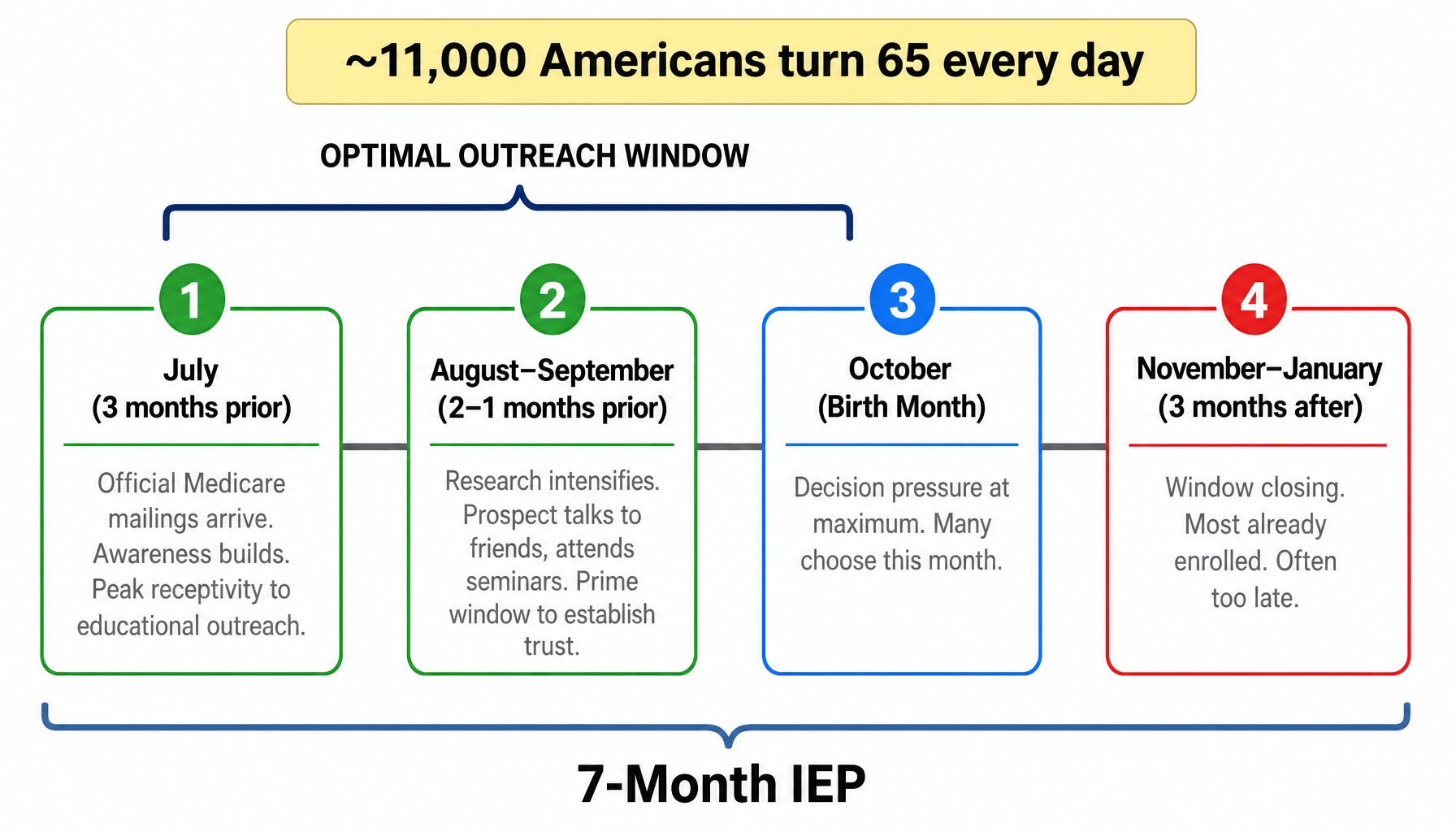
The operational rule is clear: your T65 outreach should target people turning 65 in the next 3 to 6 months. This requires prospect lists filtered by a specific date-of-birth range, not just a birth year. This level of precision is a function of a consumer database, where you can define an age band, rather than a generic business list. With roughly 11,000 Americans turning 65 every day, the opportunity is massive, but it belongs to the agents who master the calendar.
How to Qualify Medicare Leads Before the Appointment
The most expensive lead isn’t the one that costs $35. It’s the one that costs $8 but wastes 45 minutes of appointment time with a prospect who isn’t eligible, is already enrolled, or is looking for a plan you don’t carry. I once spent an afternoon qualifying a batch of twenty-five leads a vendor had labeled ‘Medicare-eligible’ only to discover that six were under 64, three had moved out of my licensed state, and two were already enrolled in Medicare Advantage plans through their employer’s retiree benefits. That single session clarified why pre-appointment filtering is not optional.
Pre-appointment qualification is the highest-leverage activity in Medicare sales, yet most agents skip it, fearing they’ll lose the appointment. The opposite is true: a short, professional qualification call builds credibility and ensures the actual meeting is productive.
Use this five-question framework on every initial call:
-
“When do you turn 65, or are you already on Medicare?”
- Why it matters: This immediately establishes their enrollment status are they in their T65 IEP, a Special Enrollment Period (SEP), or just shopping during AEP? The answer dictates the entire conversation.
-
“Do you have health coverage from a current or former employer?”
- Why it matters: If they have coverage from an employer with 20+ employees, Medicare may be secondary, and they might not need to enroll in Part B yet. Pushing a plan without knowing this is a disservice and a compliance risk.
-
“Are you currently receiving Medicaid or Extra Help with your prescriptions?”
- Why it matters: This identifies potential eligibility for a Dual-Eligible Special Needs Plan (D-SNP) or the Low-Income Subsidy (LIS). These programs have different rules and plan options, and missing this can mean leaving significant benefits on the table for the client.
-
“To help me find the best value, what are some of the regular prescriptions you take?”
- Why it matters: For Part D and most Medicare Advantage plans, prescription drug coverage is the single most important and variable factor. You cannot make a responsible recommendation without this information.
-
“Just to confirm my records, what county do you live in?”
- Why it matters: Medicare Advantage and Part D plans are approved on a county-by-county basis. Plan availability, networks, and premiums can vary dramatically between adjacent counties. A zip code is not specific enough.
Building T65 and Senior Prospect Lists from a Consumer Database
The central challenge in Medicare prospecting is clear: the highest-value activities are filtering and qualifying prospects by age, geography, and other attributes before outreach. Yet, most lead vendors sell pre-packaged lists, denying agents control over these critical filters.
This is a problem that a self-service consumer database is designed to solve. InfoFree’s platform gives you direct access to a database of approximately 270 million U.S. consumers and 170 million households, allowing you to build your own targeted lists from the ground up. Instead of buying a generic “T65 list,” you can apply specific filters to define your ideal prospect.
For a Medicare agent, this means you can:
- Filter by Age Band: Target individuals turning 65 within a specific 3-to-6-month window to perfectly time your outreach to their IEP.
- Filter by Geography: Define your territory by state, county, or even ZIP code to ensure you are only reaching prospects where you are licensed and your plans are available.
- Filter by Household Attributes: Use filters like homeowner status as a proxy for stability and mail deliverability, improving the efficiency of direct mail campaigns.
InfoFree provides unlimited search and view access on a flat-rate subscription, with exports governed by your specific plan level. This allows you to build and refine lists as often as needed without paying per lead. You control the filters, you own the timing, and you can build a repeatable prospecting engine tailored to your exact market.
It’s important to note that these consumer and household records are compiled from a different set of sources than our triple-verified business database and are not rated on the same 95% accuracy standard. As with any prospect data, agents remain fully responsible for complying with DNC, TCPA, CAN-SPAM, and all applicable state laws when conducting outreach.
CMS, TCPA, and Scope of Appointment: The Three Compliance Rules That Get Agents Terminated
Don’t skip this section. Compliance mistakes are the fastest way to lose a career in Medicare sales. A single CMS marketing violation can lead to carrier termination, wiping out your renewal income. A TCPA violation carries statutory damages of $500 to $1,500 per call.
Forget the noise and focus on the three rules that matter most in practice:
- CMS Marketing Guidelines & Scope of Appointment (SOA): You cannot discuss plan-specific benefits or premiums at an educational event or during an unsolicited contact. Plan-specific conversations require a signed Scope of Appointment (SOA) form. The SOA must be completed by the beneficiary before the sales meeting (the 48-hour rule is the standard) and must list only the product types they agreed to discuss. Adding products they didn’t ask for is a violation.
- TCPA and the Do Not Call (DNC) Registry: When calling purchased leads, you must scrub your list against the National DNC Registry and any applicable state lists. Using an autodialer or prerecorded message to call a cell phone requires prior express written consent. The practical rule for cold calling is to use a manual dialer and scrub your lists before every campaign. The real cost of a TCPA violation isn’t just the fine; a complaint can trigger a carrier review that puts your entire book of business at risk.
- CAN-SPAM for Email: If you use email, your commercial messages must include a valid physical postal address, a clear and functional unsubscribe link, and a subject line that isn’t deceptive.
The lead vendor’s claims do not protect you. Liability for compliance rests with the agent and their contracted carriers.
Read more: Marketing Lists – Email and Mailing List Services from Infofree
Conclusion
The agents who build sustainable, profitable Medicare practices do not simply spend more on leads. They build a system. They source from the right channels for their business, they time their T65 outreach to the enrollment window rather than the birthday, they qualify prospects before the appointment, and they treat compliance as a non-negotiable operational discipline.
As the T65 population continues to grow, the competitive advantage will shift further away from the agents who can buy the most medicare leads and toward those who can filter, time, and act on the right ones with the greatest precision. The tools and data to build this discipline are available; the defining factor is the will to use them.
Frequently Asked Questions
What conversion rate should I expect from Medicare supplement leads vs. Medicare Advantage leads?
Conversion rates vary by channel, but as a general industry range, Medicare Supplement leads from a channel like direct mail often convert at 3-8% from response to policy. Medicare Advantage leads from digital sources tend to run higher, around 5-12% from contact to enrollment, partly due to $0 premium plans reducing friction. These are directional figures, not guarantees.
How do live transfer Medicare leads work, and are they worth the cost?
A live transfer is a pre-screened prospect transferred directly to you by a call center, costing $25-$55. The benefit is immediate contact with an interested person. The risk is screening quality; agents report 20-40% of transfers are unqualified. They work best during AEP when intent is high and are less reliable in the off-season.
What is a Scope of Appointment form and when is it required?
A Scope of Appointment (SOA) is a CMS-required form where a beneficiary documents the specific product types (e.g., Medicare Advantage, Part D) they agree to discuss. It must be signed before a sales appointment (typically 48 hours prior). Discussing products not on the SOA is a serious compliance violation that can lead to carrier termination.
Are Extended-Window Medicare leads still worth buying?
Extended-Window leads (30-90+ days old) cost just $0.50-$3, making them a viable supplement for high-volume calling operations. Most will be unresponsive, but because Medicare enrollment windows are long, a small percentage are still in-market. They work when treated as a low-cost, low-probability volume play, not as a primary source of high-quality appointments.
How do FMOs and IMOs help agents get Medicare leads?
Field Marketing Organizations (FMOs) and Independent Marketing Organizations (IMOs) often provide lead programs to their affiliated agents. This can include subsidized direct mail, access to vendor discounts, or free leads for meeting production quotas. Agents should always compare the effective cost, factoring in any commission reductions or production requirements tied to the lead program.
Should I focus on AEP leads or year-round SEP leads?
AEP (Oct. 15 – Dec. 7) has the highest lead volume but also the most competition and highest costs. Year-round Special Enrollment Period (SEP) leads, triggered by events like moving or losing employer coverage, face less competition and often convert well due to the prospect’s immediate need. A balanced strategy incorporates both for more stable year-round production.