


High net worth marketing fails at targeting, not messaging.
TL;DR
- Stop treating “high net worth” as a single audience. Segment your high net worth prospects into categories that allow you to customize your messaging as much as possible.
- Build prospect lists using layered wealth-proxy filters like estimated home value, homeowner status, and age not just income, which can be misleading.
- Match your channel to the wealth tier. Use scaled outbound (direct mail, paid media) for Mass Affluent audiences and shift to referral and event-based marketing for the most affluent of your audience, also known as Very High Net Worth and Ultra High Net Worth, tiers.
- Replace aspirational messaging with specificity. Name the problem you solve and the threshold that qualifies the reader to build trust and earn attention.
- Measure campaign success on value-based metrics like cost per acquired client and pipeline value (AUM), not on volume metrics like response rate, which are misleading for high net worth campaigns.
Most high net worth marketing programs fail long before the first mailer is sent or the first ad is clicked. Teams invest heavily in premium creative, polished copy, and aspirational messaging, only to deliver it to the wrong households. They treat affluent marketing as a messaging problem when it is fundamentally a data and targeting problem.
If your prospect list cannot distinguish a household with $300K in annual income from one with $3M in investable assets, no amount of refinement to your creative will close that gap. Worse, a poorly targeted campaign can backfire. Affluent households are disproportionately represented on the Do Not Call (DNC) registry and are more likely to file complaints, meaning a single unsuppressed calling campaign can generate regulatory exposure that dwarfs the revenue from the entire program.
Effective high net worth marketing starts with a disciplined, data-first approach. This guide provides a practitioner’s framework for getting it right. We will cover how to define the wealth tiers that matter operationally, how to source and filter wealth-proxy data, how to match channels and cadence to each tier, and how to establish measurement that works when volume metrics are misleading. This is a workflow article, not a branding article.
What Counts as High Net Worth and Why the Tiers Change Your Strategy
The term “high net worth” is not a single audience; it is at least three distinct segments with different media habits, privacy expectations, and decision-making structures. Most marketing teams treat HNW as one monolithic bucket, leading to campaigns that are too aggressive for ultra-high-net-worth (UHNW) households and too generic for mass-affluent ones.
Consider an insurance agency mailing the same annuity offer to a household earning $250K per year and a family office managing $30M in assets. The campaign gets predictably poor results from both, for opposite reasons. The mass-affluent household receives a generic offer that doesn’t feel tailored to their specific financial situation, while the family office gatekeeper dismisses the unsolicited mail as unsophisticated and irrelevant.
Success requires segmenting the affluent market into operational tiers and building your strategy around the behaviors of the specific tier you intend to reach.
Standard Wealth Tiers and What They Mean for Targeting
Industry analysts generally segment the market using investable assets excluding primary residences and collectibles. While definitions vary slightly, the standard tiers provide a functional framework for targeting.
- Mass Affluent: $100,000 to $1 million in investable assets.
- High Net Worth (HNW): $1 million to $5 million. This is the core “millionaire next door” segment.
- Very High Net Worth (VHNW): $5 million to $30 million.
- Ultra High Net Worth (UHNW): $30 million or more.
Most marketers who say they target “high net worth” are actually targeting the mass-affluent tier. This is because the proxy data used to identify these households like estimated income, home value, and ZIP code is most available and reliable at this level. It is critical to recognize that net worth itself is almost never a directly available data field in prospecting databases. Teams work with proxies, and this distinction determines what filters are actually usable when building a list.
Why Behavioral Differences Between Tiers Change Every Downstream Decision
These tiers are not just income brackets; they represent fundamentally different buyer behaviors. Ignoring these differences is the most common point of failure in affluent marketing.
Mass-affluent households often behave like general consumers, just with higher discretionary spending. They respond to well-targeted direct mail, digital ads, and email marketing.
As you move into HNW and VHNW tiers, behaviors shift. These individuals are more likely to use gatekeepers (assistants, attorneys, family office staff), are more sensitive to privacy, and make financial decisions on longer timelines. They are less receptive to cold outbound and respond better to referrals, events, and content that provides exclusive insight.
UHNW households are a completely different ecosystem. They are often unreachable through any traditional outbound channel and are acquired almost exclusively through trusted referral networks and centers of influence (COIs). Your campaign for this tier is a relationship-building program, not a list-building exercise. If your target is mass affluent, you can run a scaled direct-mail campaign. If your target is UHNW, your “campaign” is identifying and building trust with their CPA.
How to Actually Identify High Net Worth Individuals in a Prospecting Database
The biggest gap in most HNW marketing programs is not strategy, it is data sourcing. Teams know they want to reach affluent households but do not know which fields in a consumer database serve as reliable wealth proxies or how to combine them.
In practice, you cannot filter a list by a “net worth” field. Instead, you build a proxy segment by layering other filters. A common approach for identifying mass-affluent or lower-HNW prospects includes:
- Estimated Household Income: Set a minimum threshold, such as $200,000+.
- Homeowner Status: Filter for “Owner” to exclude renters. Using homeowner lead lists as a starting filter is one of the most reliable wealth proxies available.
- Estimated Home Value: Set a minimum based on the target market, such as $500,000+. Home value is often a stronger proxy for accumulated wealth than income, but it introduces geographic bias. A $500K home signals different economics in suburban Texas than in coastal California.
- Age Band: Focus on age ranges that align with peak earning or pre-retirement years, like 45-70.
- Geography: Target specific ZIP codes, counties, or a radius around a location known for affluence.
This layering is a game of trade-offs. Tighter filters produce smaller, more accurate lists but risk excluding asset-rich retirees or business owners with low taxable income. Looser filters create larger lists with more noise. The key is to understand that you are building a model, not finding a perfect match.
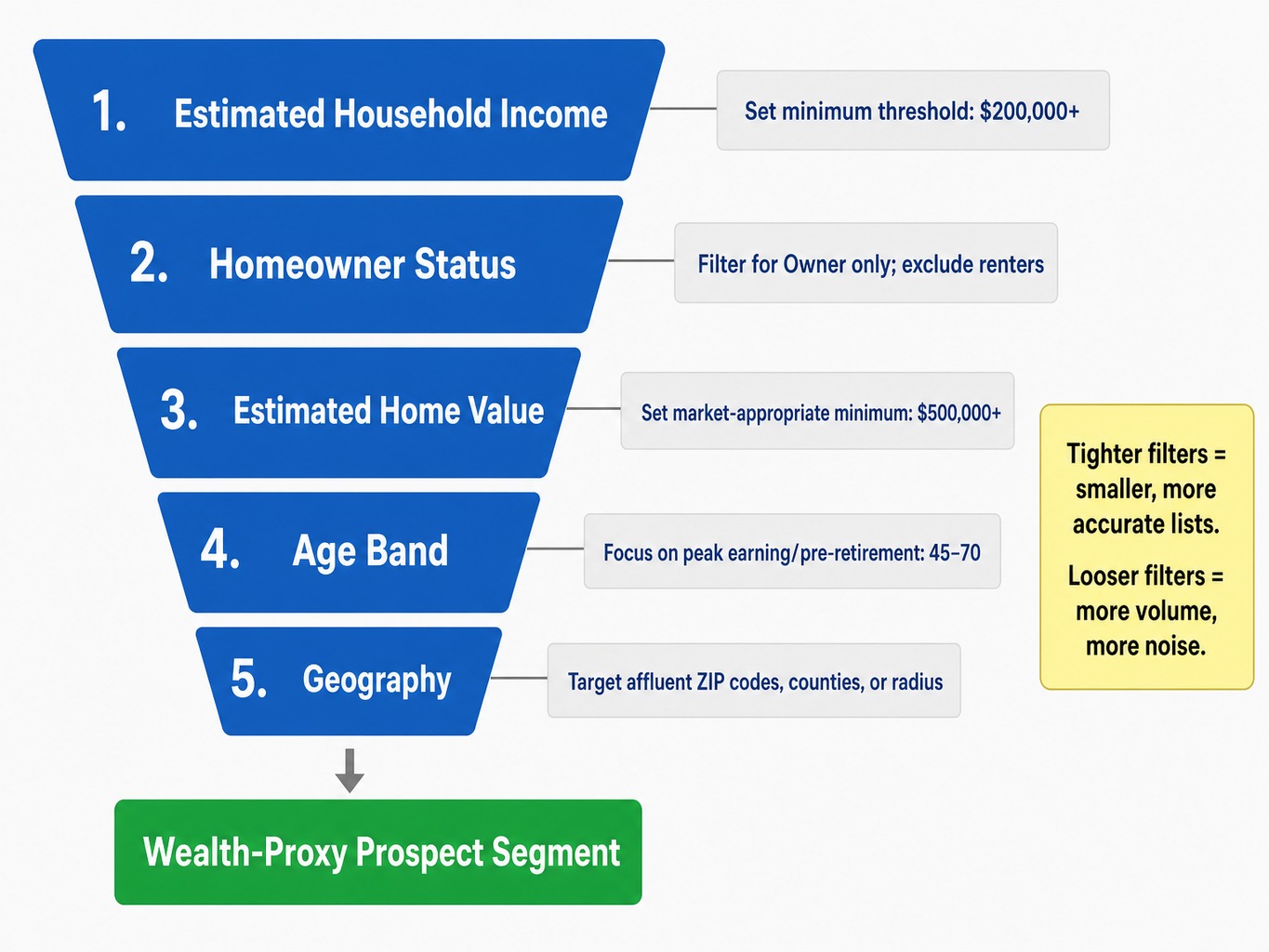
Layer these five filters to build precise high net worth marketing lists.
Read more: ZIP Code Mailing Lists – Buy Mailing Lists by ZIP Code from Infofree
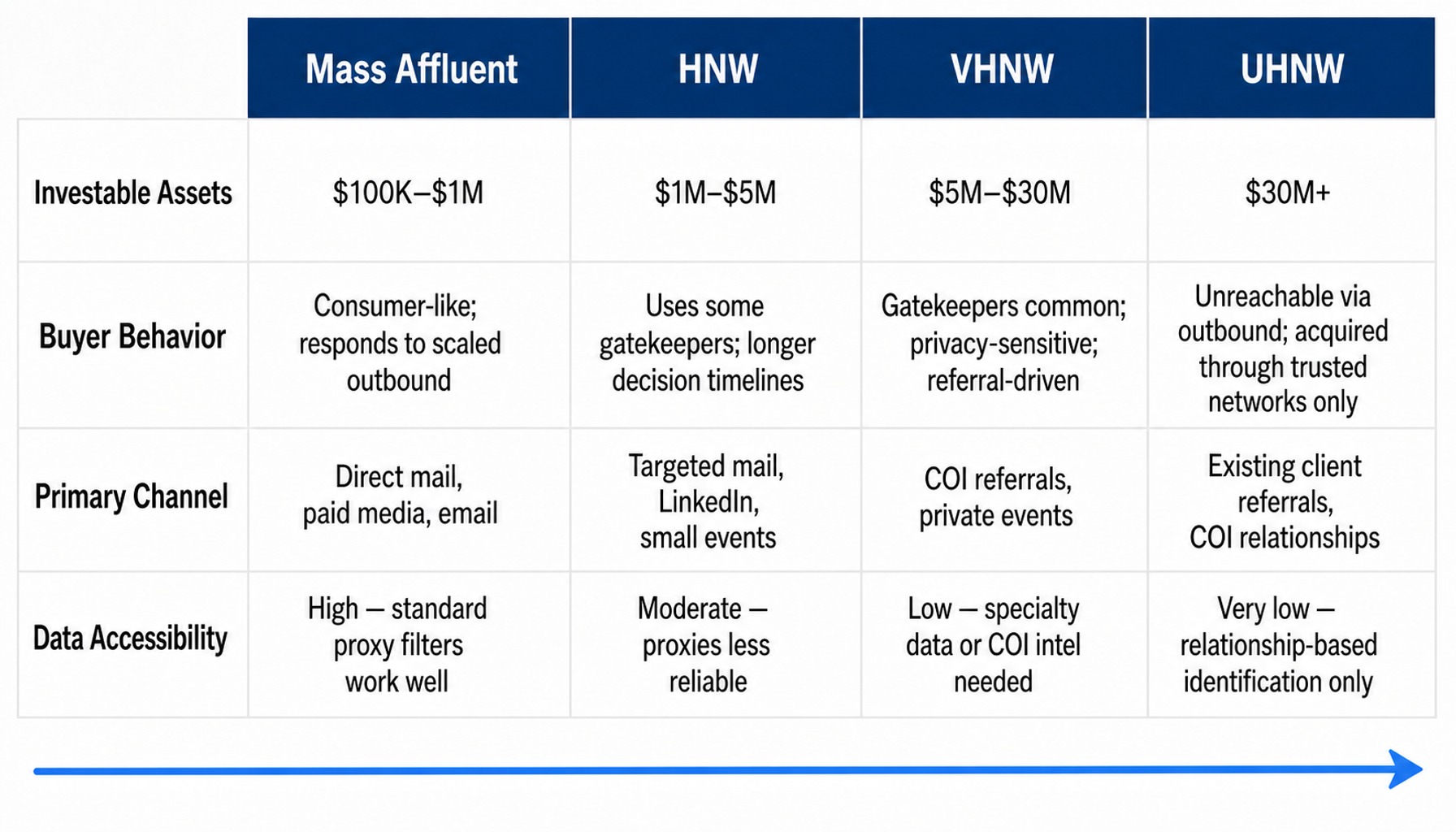
Each wealth tier demands a fundamentally different affluent marketing approach.
Which Channels Reach Which Wealth Tiers and Which Ones Waste Budget
Channel selection in high net worth marketing is not about which channel is “best.” It is about which channel matches the privacy expectations and media habits of your specific wealth tier. Applying mass-market tactics to upper-tier prospects does not just underperform; it can damage your brand’s reputation and future reachability.
A wealth management firm that shifted from cold-calling HNW prospects (with a sub-1% contact rate and high DNC risk) to hosting small educational dinners for pre-qualified attendees discovered this principle firsthand. The channel-tier alignment transformed their acquisition economics.
Scaled Outbound: Direct Mail, Email, Paid Media, and Calling for Mass-Affluent and HNW Tiers
Scaled outbound channels are viable for mass-affluent and lower-HNW tiers but demand far tighter targeting than general consumer campaigns.
- Direct Mail: This remains one of the highest-performing scaled channels for financial services, insurance, and real estate. A piece about estate planning sent to homeowners aged 55-70 with estimated home values above $500K feels relevant. The same piece sent to a general list is junk mail. Well-targeted campaigns can see response rates above the typical 1-3% for consumer mail, but the metric that matters is cost per acquired client.
- Paid Media: LinkedIn allows targeting by job title and seniority, effective for reaching business owners and executives. Meta’s platforms can target users in high-income ZIP codes or those with interests in luxury goods, though this is less precise.
- Email: This works best when the list is permission-based. Cold email to affluent audiences has low deliverability and high complaint rates. Building permission-based email lists with proper opt-in is essential for this channel.
- Calling: While possible, this channel carries the highest compliance risk. The caller is always responsible for scrubbing lists against federal and state DNC registries and complying with the Telephone Consumer Protection Act (TCPA).
The rule for scaled outbound is simple: the list must be filtered so tightly that the offer feels like an invitation, not an interruption.
Relationship Channels: Referrals, Centers of Influence, and Events for VHNW and UHNW Tiers
For VHNW and UHNW tiers, the primary acquisition channel is the referral ecosystem. Your marketing target is not the wealthy individual; it is their trusted advisor.
- Centers of Influence (COIs): These are the gatekeepers: estate attorneys, CPAs, private bankers, and family office managers. The strategy is to identify these COI firms in your market using a business database, filtering by industry code (SIC/NAICS), geography, and firm size. You can source professional lead lists filtered by specialty to identify these gatekeepers efficiently. You then build relationships with their principals through co-hosted events, shared content, or reciprocal introductions. This is a long-term, network-building exercise.
- Small-Format Events: Private dinners, expert panels, or educational seminars with 10-20 hand-picked attendees serve as a bridge between scaled and relationship-based marketing. You can source attendees from a highly filtered direct-mail list, turning a cold prospect into a warm introduction in a trusted setting.
- Client Referrals: The most valuable source of new UHNW clients is existing UHNW clients. The time to ask for an introduction is after you have delivered a measurable result and earned deep trust, not during onboarding.
Marketing to the top of the wealth pyramid is not a volume game. It is a targeted, patient, and relationship-driven discipline.
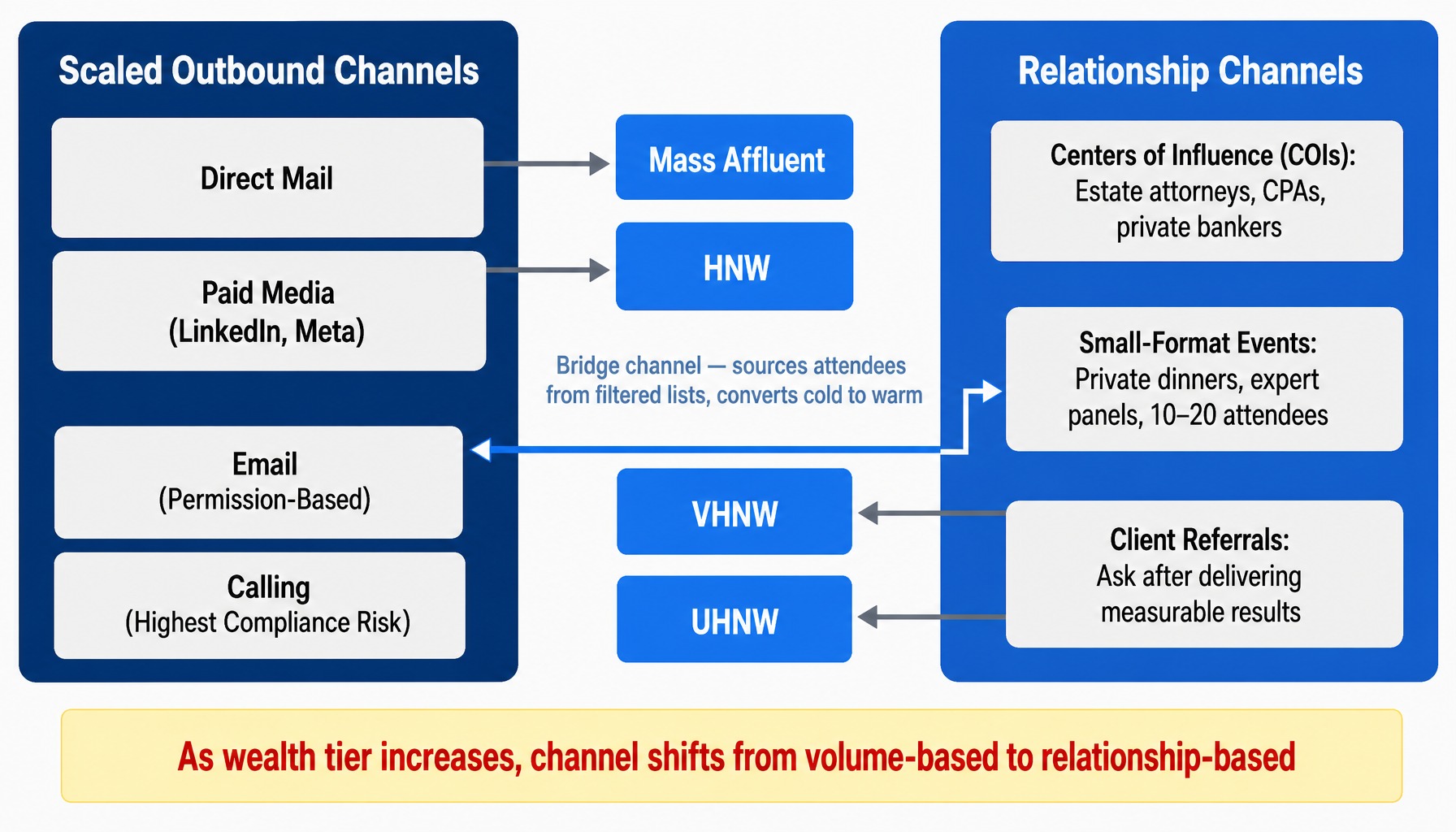
Match your channel to the wealth tier volume for mass affluent, relationships for UHNW.
Messaging That Earns Attention from Affluent Audiences and What Repels Them
Affluent audiences are not impressed by aspirational language; they live the lifestyle that mass-market brands use for inspiration. They have been targeted by every financial services firm, luxury brand, and nonprofit in the country, and they have developed a keen filter for messaging that signals desperation for a sale.
Urgency tactics, aggressive calls-to-action, and vague claims of “exclusivity” are immediately repellent. What works instead is specificity, relevance, and restraint.
Consider this direct-mail comparison:
- Weak: “Exclusive Wealth Management for High-Net-Worth Families. Call Now for a FREE Consultation!”
- Strong: “A Private Briefing on How Recent Estate Tax Changes Affect Families with $5M+ in Transferable Assets. By Invitation | October 26th | The City Club.”
The first example is generic and needy. The second is specific, names the qualifying threshold, and lets that relevance do the selling. It respects the reader’s intelligence and assumes they can decide for themselves if the topic is valuable. The principle is to name the problem you solve with precision and let the audience self-select.
Messaging should also be tier-appropriate. Mass-affluent households often respond to clear value propositions (optimizing returns, saving on taxes). HNW and UHNW households respond more to access and insight information they cannot get elsewhere or introductions to people they want to meet.
Compliance and Privacy as a Competitive Advantage, Not a Constraint
Affluent individuals are more privacy-conscious than the general population. They are more likely to be registered on the DNC list and more likely to resent unsolicited contact that feels invasive. Most marketing guides treat compliance as a legal footnote; the practitioner who treats it as a visible trust signal gains a powerful edge.
Before any calling, emailing, or mailing campaign, your workflow must include scrubbing lists against federal and state DNC registries. You must adhere to TCPA rules for calls, CAN-SPAM requirements for email, and navigate a growing patchwork of state-level privacy laws. For financial services, additional SEC and FINRA marketing rules apply. The sender is always responsible for ensuring compliance.
This is not just about avoiding fines; it is about building trust. When your outreach transparently acknowledges why the recipient was selected, it builds credibility. A simple line on a mailer “You are receiving this invitation because you are a homeowner in the 90210 ZIP code who may be affected by recent property tax changes” signals that you are a professional who has done their homework, not a spammer blasting a generic list. This small act of transparency differentiates you from 99% of the unsolicited mail they receive.
Measuring HNW Campaign Performance When Volume Metrics Are Misleading
High net worth marketing campaigns will always produce lower volume metrics than mass-market campaigns. You will get fewer responses, fewer leads, and fewer raw conversions. Teams that evaluate these efforts using standard KPIs like response rate or cost per lead will always conclude they are failing.
This is the wrong framework. The correct measurement for HNW marketing is based on value, not volume.
Imagine a direct-mail campaign that sends 2,000 pieces and generates only eight responses. A 0.4% response rate looks like a failure by mass-market standards. But if three of those eight responses convert into clients with $2M+ in investable assets each, the campaign produced a $6M+ AUM pipeline from a ~$3,000 spend.
The metrics that matter are:
- Cost Per Acquired Client: Not cost per lead.
- Pipeline Value: The total estimated AUM, premium value, or deal size generated.
- Client Lifetime Value (LTV): The total projected revenue from a new relationship.
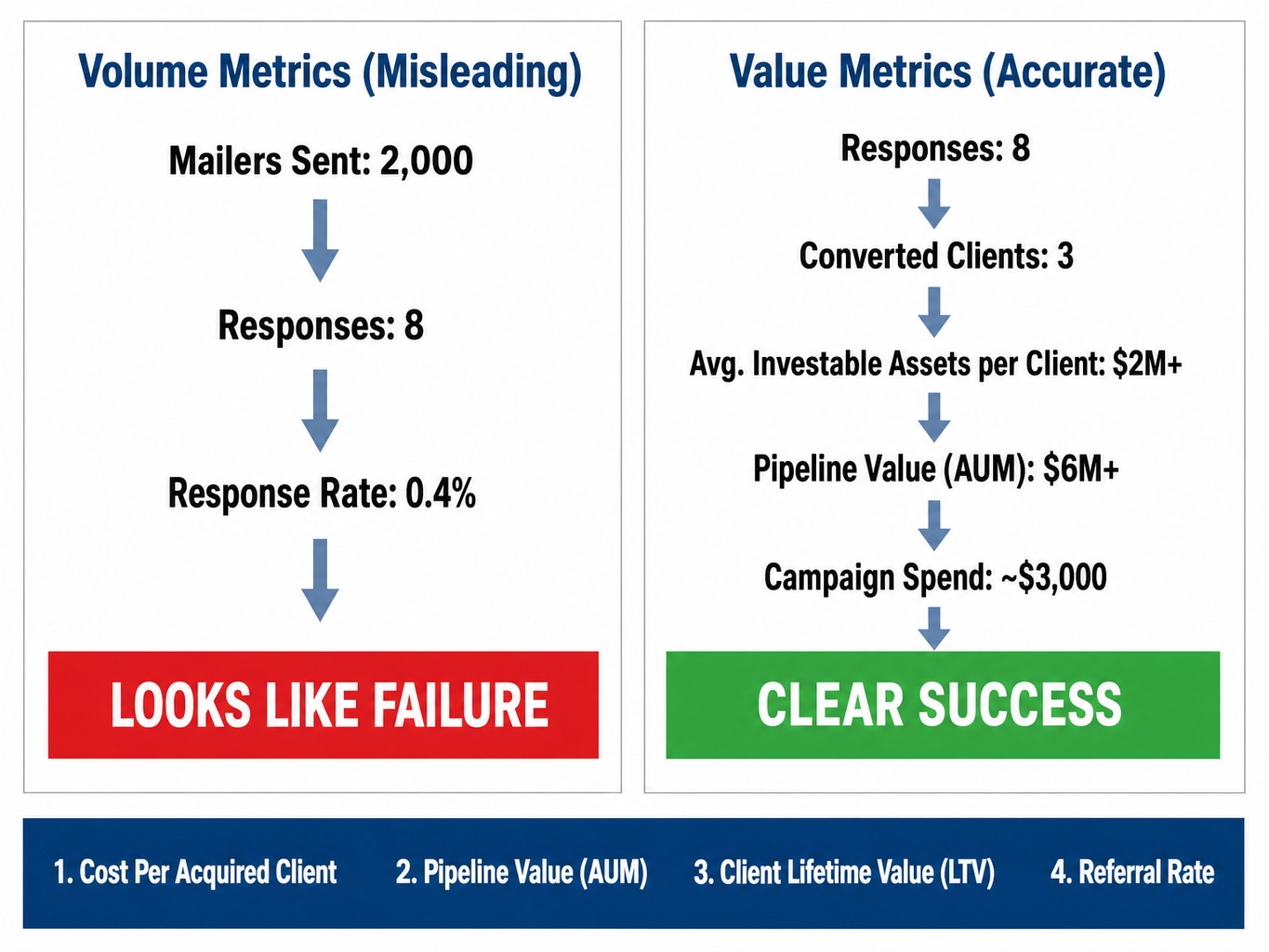
A 0.4% response rate hides a $6M+ pipeline measure value, not volume.
- Referral Rate: The number of new clients referred by clients acquired through the campaign.
When you shift your focus from volume to value, the economics of HNW marketing become clear. Low response rates are expected; high-value conversions are the goal.
Building Wealth-Segmented Prospect Lists Without Per-Record Pricing
This guide has built a specific tension: effective high net worth marketing depends on precise targeting using wealth-proxy data, but specialty vendors often charge per-record fees that are prohibitive for many teams. This forces a choice between running small, expensive campaigns or broader, less effective ones.
A flat-rate data platform like InfoFree resolves this tension. It provides access to a consumer database of approximately 270 million consumers and 170 million households, which you can filter using the exact wealth-proxy fields discussed here: estimated income range, homeowner status, estimated home value, age band, and geographic filters like ZIP code and radius. Because the platform offers unlimited search and view access, you can test and refine different segment combinations without incurring per-record costs. Export limits vary by plan, but the ability to iterate on your targeting is built into the model.
Furthermore, because the same platform provides access to a B2B database of U.S. companies, you can identify and build lists of COI firms like law firms, accounting firms, and private banks by filtering on SIC code and geography. This supports the relationship-based channel strategy essential for reaching VHNW and UHNW tiers.
It is important to note that InfoFree’s consumer and household records are compiled from a separate set of sources than its business records and are not rated on the same 95% accuracy standard that applies to business data. The value is in having a single, affordable workflow to build both consumer and business prospect lists for a comprehensive HNW marketing strategy.
Conclusion
High net worth marketing is a data-quality and targeting problem first, and a channel and messaging problem second. The teams that consistently succeed are not the ones with the biggest budgets or the most aspirational creative. They are the ones who are most disciplined at the data layer.
The winning workflow is straightforward: Define your wealth tier with precision. Build your list using layered proxy filters, not just income. Match your channel and cadence to the tier’s privacy expectations. Let specificity replace aspiration in your messaging. Treat compliance as a visible trust signal. And measure your success based on the value you acquire, not the volume of responses you generate.
Start with a list that is filtered so tightly that every piece of outreach feels like it was meant for the recipient, and you will have already outperformed most of your competition.
Frequently Asked Questions
How large is the high net worth population in the United States?
Recent estimates place the number of U.S. households with $1 million or more in investable assets at around 7 to 8 million. However, the mass-affluent tier ($100K–$1M) is substantially larger, at an estimated 30 to 40 million households. This is the segment most marketing teams are actually targeting when they use the term “HNW.”
Can you target high net worth individuals by net worth directly in a prospecting database?
No, “net worth” is rarely a directly queryable field in standard consumer prospecting databases. It is a modeled score. Practitioners build HNW-proxy segments by layering filters like estimated income, homeowner status, estimated home value, and age. Specialty data providers offer modeled scores, but often at a significant per-record or platform cost.
What content formats work best for affluent audiences?
Affluent audiences respond to content that provides exclusive access or insight market analyses, summaries of tax law changes, and estate-planning frameworks. For HNW and UHNW tiers, invitation-only event content is highly effective. Generic blog posts and broad social media ads perform poorly, while educational webinars and specific guides still work for mass-affluent audiences.
How do you build a referral network among high net worth clients?
Start by identifying centers of influence (COIs): estate attorneys, CPAs, private bankers in your market using a business database. Build relationships with them through co-hosted events or shared content, not cold outreach. For client referrals, ask for an introduction only after you have delivered a significant, measurable result and earned their trust.
How should brands adjust HNW marketing for the generational wealth transfer?
The ongoing wealth transfer, estimated at $84 trillion, means inheritors (often aged 30-55) will soon control these assets. This cohort is more digitally native and values-driven, and as many as 70% may leave their parents’ financial advisor. Marketing to them requires digital-first channels, transparent messaging, and a focus on earning the relationship rather than inheriting it.
What CRM features matter most for managing affluent client relationships?
The most critical features are robust activity logging (calls, emails, meetings), relationship mapping to link household members with their COIs, and pipeline tracking by estimated client value (AUM) rather than deal count. Platforms like Salesforce Financial Services Cloud offer this depth, while lighter-weight tools like CRM101 are effective for tracking calls, notes, and status.