

Key Takeaways
- Tangibility is a real advantage:* A physical mail piece occupies space in a household and gets seen repeatedly, unlike a fleeting digital ad.
- The true cost is not just postage:* Budget for printing, address hygiene (CASS/NCOA), permit fees, and addressing, which can increase the all-in cost per piece well above the postage line.
- List quality determines your outcome:* Every advantage of direct mail is amplified by a well-built list and negated by a bad one. Waste from undeliverable mail and poor targeting is the single largest cost driver.
- EDDM and addressed mail serve different goals:* EDDM is for saturation marketing where everyone on a route is a prospect. Addressed mail is for precision targeting based on household or business attributes.
- Measurement requires planning:* Track response with unique phone numbers, campaign-specific URLs or QR codes, and match-back analysis. You cannot measure what you do not set up in advance.
A home-services company mails 5,000 postcards to new homeowners, filtered by move date and estimated home value. It books over forty calls. A competitor blankets the same ZIP code with the same offer to every address and gets a handful of responses at nearly the same total cost. This is the central tension of direct mail pros and cons: the channel itself is not the variable. The list is.
Direct mail is one of the few outbound channels where the physical piece lands in a prospect’s hands with no algorithm filtering it out. But that advantage only converts when the list behind it is built for the offer.
This is a practitioner’s breakdown of how to make that decision. We will walk through the structural advantages, the real-world disadvantages, the cost math, and the list-quality decision that determines which column your campaign falls into.
What Direct Mail Does Better Than Digital Channels
Direct mail’s advantages are structural they come from the physical medium itself, not from clever execution alone. When aligned with the right audience, these attributes give mail a foothold that digital channels struggle to replicate.
Physical Tangibility Creates Longer Exposure
A physical mail piece occupies space in a household on a counter, a desk, or a refrigerator in a way that a digital ad or email cannot. This is not a soft benefit; it is a mechanical advantage that translates into repeated impressions without repeated ad spend. A pest-control postcard pinned to a kitchen bulletin board gets seen repeatedly over two weeks, while the same offer in an email inbox is scrolled past in seconds.
This extended household presence creates more opportunities for the message to be absorbed and acted upon. Neuromarketing research has shown direct mail is retained in a household for an average of 17 days, giving it a shelf life that no email or social media ad can match. That persistence is direct mail’s core strength.
Less Channel Saturation Than Email or Social
The average U.S. household receives far fewer pieces of addressed mail per day than the average professional receives emails. The practical implication is that a well-designed mail piece faces less direct competition for attention in a physical mailbox than the same message does in a cluttered inbox.
Consider a financial advisor sending an outreach letter. Arriving in a mailbox among three or four other pieces, it has a high probability of being seen and handled. The same message sent via email competes with eighty or more other messages that day, many of them automated, all vying for a few seconds of attention. Lower saturation is a structural advantage of the channel, but it is not a guarantee of response it simply improves the odds that your message will be considered.
Targeting Precision With the Right List
Addressed direct mail allows for granular audience selection that saturation channels cannot match. A campaign can be filtered by homeowner status, estimated home value, age band, income range, move date, geography, or business attributes like SIC code and employee count.
This enables two very different but equally precise campaigns:
- B2B: A commercial cleaning company mails facility managers at companies with 50+ employees within a specific metro area, filtered by SIC code to target office buildings and manufacturing plants.
- B2C: A mortgage lender targets new homeowners who closed on a property within the last 30 days in a specific county, filtered by estimated home value.
This precision is not inherent to direct mail; it depends entirely on the list source and the filters applied. Mailers are responsible for following all applicable federal and state privacy laws when using consumer or business data for outreach.
Reaches Audiences That Under-Engage With Digital
Certain demographic segments particularly adults over 65 and households in rural areas often respond to physical mail at higher rates than to email or digital ads. For businesses serving these audiences, direct mail is not just an alternative channel; it is often the primary one.
For example, an insurance agent selling Medicare Supplement plans to consumers turning 65 (a “T65” list) often finds that a well-timed postcard or letter generates more inbound calls than a digital campaign to the same group. This advantage is demographic-specific, not universal. Younger, digitally native audiences may respond differently. The decision to use direct mail should be informed by who you are trying to reach, as its reach advantage is real but audience-dependent.
Read more: Turning 65 Lead Lists – Email and Mailing Lists from Infofree
Where Direct Mail Costs You More Than You Expect
The disadvantages of direct mail are not abstract. They show up in the cost-per-piece math, the production timeline, and the waste rate from a poorly maintained list. Understanding these costs is the first step to controlling them.
The True Cost Stack Goes Beyond Postage
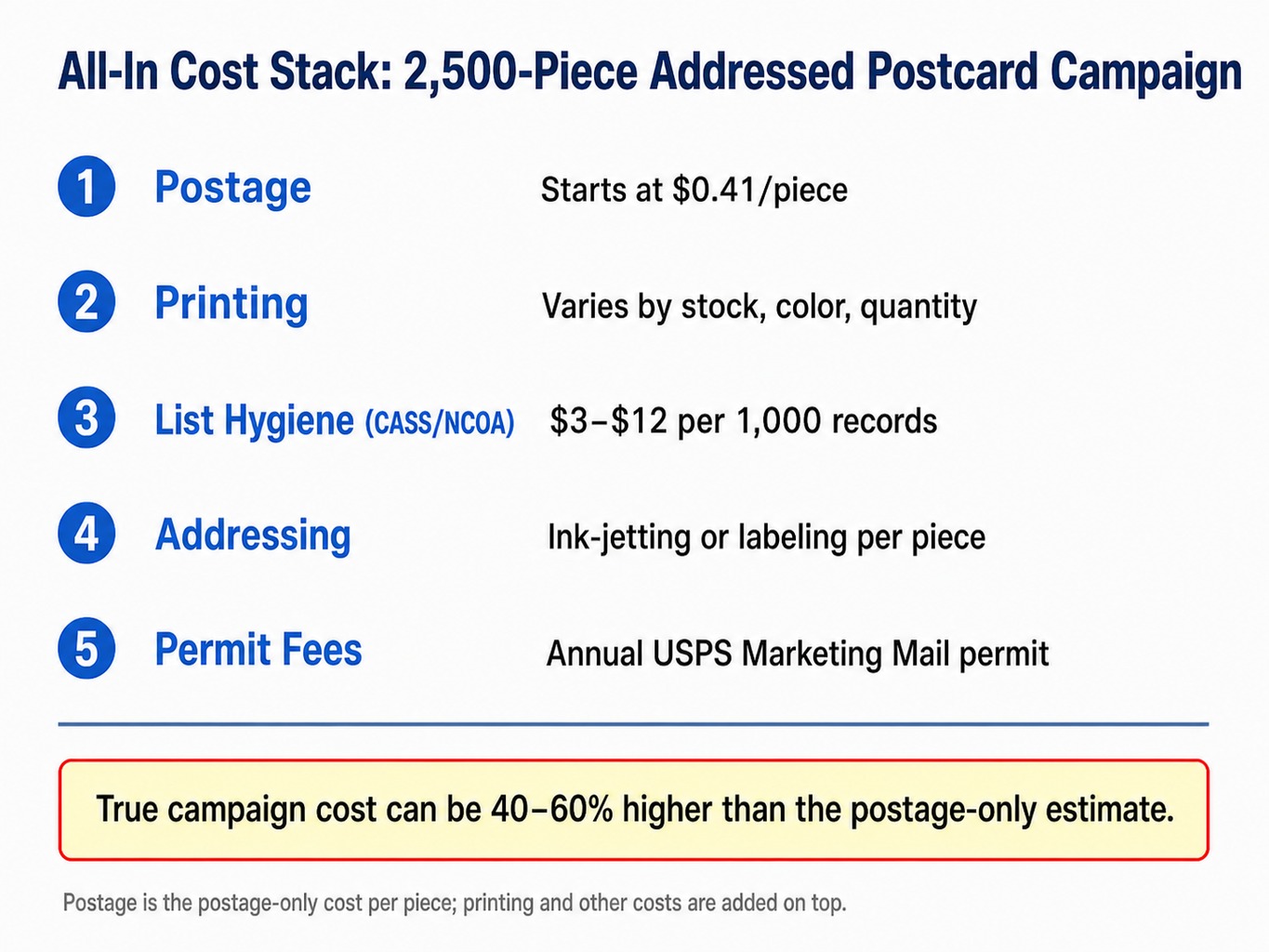
New mailers consistently underestimate direct mail costs because they budget for postage and printing but omit the other necessary components. The all-in cost per piece for addressed Marketing Mail typically lands well above the postage-only line.
Let’s walk through the math for a hypothetical 2,500-piece postcard campaign.
- Postage: Starts at $0.41 per piece for a letter-sized piece mailed via addressed USPS Marketing Mail (based on 2026 rates).
- Printing: Varies by stock, color, and quantity, but adds a significant cost.
- List Hygiene: CASS/NCOA processing is required for postal discounts and typically runs $3 to $12 per 1,000 records.
- Addressing: Ink-jetting or labeling addresses onto each piece.
- Permit Fees: An annual fee is required to maintain a Marketing Mail permit.
Forgetting these additional line items is the most common budgeting error and can lead to a true campaign cost that is 40–60% higher than the initial postage estimate.
Production Lead Time Slows Iteration
Direct mail cannot be launched, paused, or revised in real time the way a digital ad or email campaign can. A typical postcard campaign requires design, list preparation, address hygiene, printing, and postal entry a cycle that often takes 7–14 days from final list to in-home delivery.
If a sales team spots a competitor’s price increase and wants to reach affected prospects immediately, an email or calling campaign can be executed within hours. A direct mail campaign cannot. This lead time is a structural constraint of physical production, not a flaw to be fixed, and it makes the channel a poor fit for reactive marketing.
Measurement Requires Deliberate Tracking Setup
Direct mail attribution is harder than digital attribution by default because there is no automatic click trail. However, measurement is a solvable problem if you set up tracking mechanisms before the mail drops.
There are three common tracking methods:
- Unique Identifiers: Use a campaign-specific phone number, extension, URL, or QR code on the mail piece.
- Dedicated Offer Codes: Provide a unique code for recipients to use online or in-person.
- Match-Back Analysis: After the campaign, compare the list of new customers or responders against the original mailing list to identify matches. This is the practitioner standard for campaigns where leads call a main number or walk in.
Without one of these methods, you are flying blind, unable to calculate response rate or return on investment.
Bad Lists Turn Postage Into Waste
The single largest source of direct mail waste is not the channel itself but the list behind it. An un-hygienized list can produce a nixie rate (the percentage of pieces returned as undeliverable) of 8–15% or more. That means 8 to 15 cents of every postage dollar is spent mailing to addresses that do not exist or where the recipient has moved.
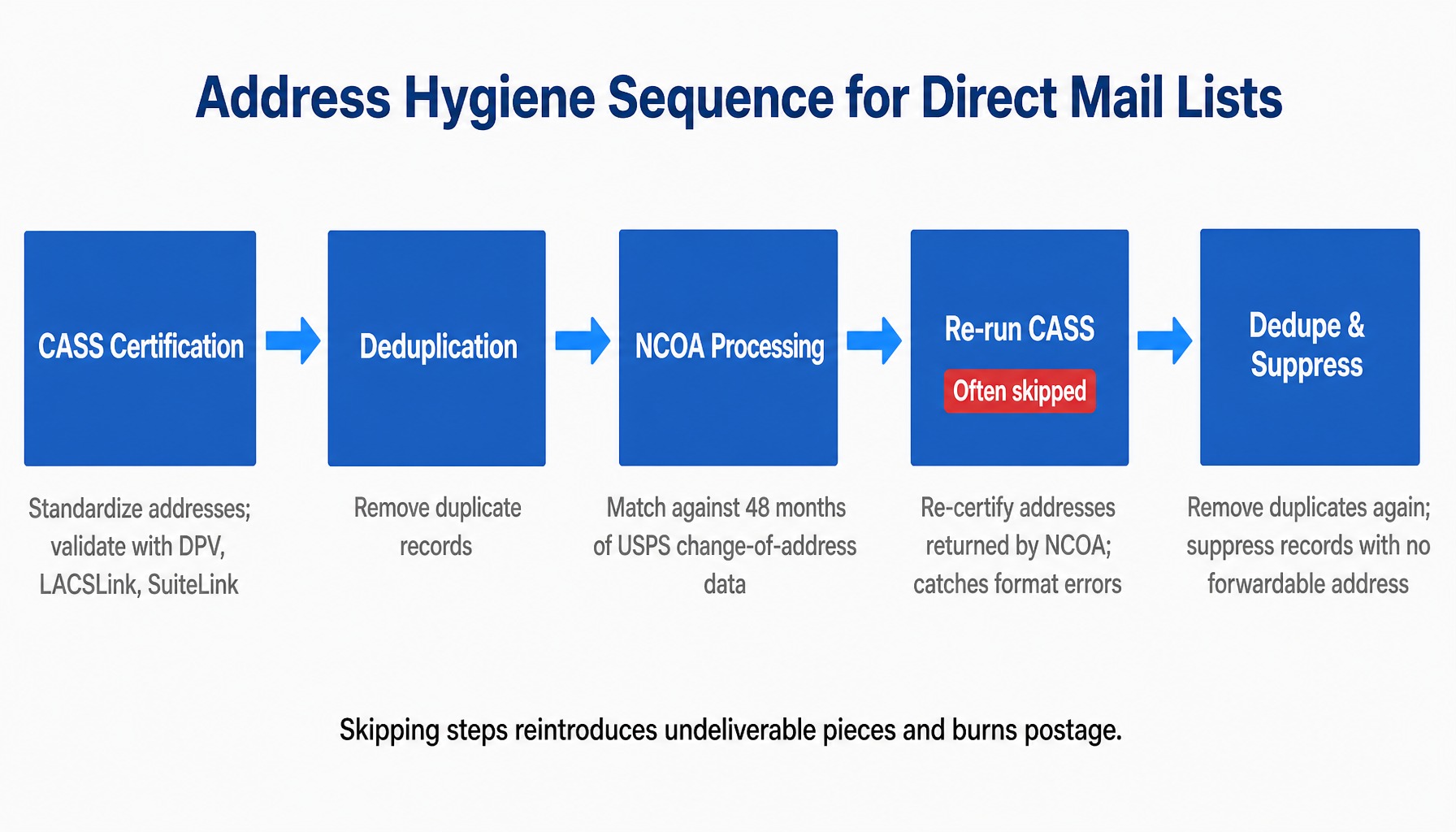
Proper address hygiene is not optional overhead; it is the cost of making the rest of the budget productive. The correct sequence is critical:
- CASS Certification: Standardizes addresses and validates them down to the specific suite or apartment number (DPV, LACSLink, SuiteLink).
- Deduplication: Removes duplicate records from the file.
- NCOA Processing: Matches the list against 48 months of change-of-address data filed with the USPS.
- Re-run CASS: This step is often skipped, but it’s vital. NCOA can return addresses in formats that are no longer CASS-certified, quietly reintroducing undeliverable pieces.
- Dedupe & Suppress: Deduplicate again and, importantly, suppress records that NCOA flagged as moved but did not provide a forwardable address for (e.g., “Moved, Left No Address” or closed P.O. boxes). Mailing these records is pure waste.
EDDM vs. Addressed Marketing Mail: Which Approach Fits
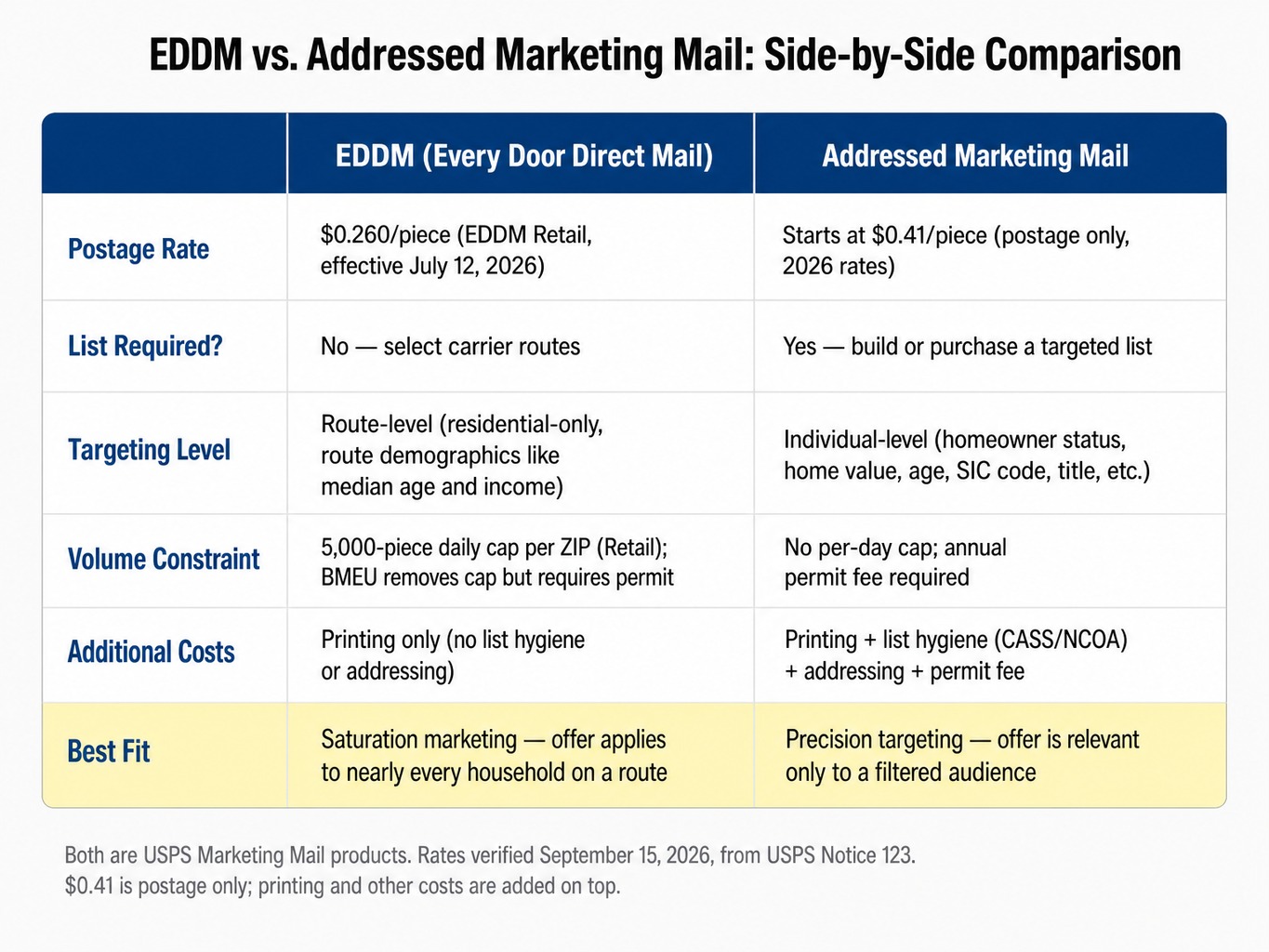
The choice between Every Door Direct Mail (EDDM) and addressed Marketing Mail is a targeting decision disguised as a postage decision. Both are USPS Marketing Mail products, but they serve fundamentally different strategies.
EDDM (Every Door Direct Mail): You select postal carrier routes, and every active delivery point on those routes receives your mail piece. No mailing list is required. The postage is lower the EDDM Retail rate is $0.260 per piece, effective July 12, 2026. While you cannot target individual households, you can use the USPS EDDM tool to filter routes by residential-only delivery and by route-level demographics like median age and income. The main constraint is operational: EDDM Retail has a hard daily cap of 5,000 pieces per ZIP code. To mail more, you must enter through a Business Mail Entry Unit (BMEU), which has a lower rate but requires an annual permit fee and more complex mail preparation.
Addressed Marketing Mail: You build or purchase a targeted list, address each piece individually, and mail via a Marketing Mail permit. Postage starts at $0.41 per piece for a letter (postage only). The cost per piece is higher, but you gain precision.
Here is the decision rule:
- Use EDDM for saturation marketing, where your offer applies to nearly every household on a route (e.g., a pizza delivery special, a local retail grand opening).
- Use addressed Marketing Mail for targeted campaigns, where your offer is only relevant to a filtered audience (e.g., homeowners with high estimated home value, businesses in a specific SIC code, or consumers in a defined age band).
(USPS rates verified on September 15, 2026, from USPS Notice 123.)
List Quality Is the Variable That Decides Everything Else
Every advantage of direct mail tangibility, lower saturation, targeting precision, demographic reach is amplified by a well-built list and negated by a bad one. When a direct mail campaign underperforms, the instinct is to blame the channel, but the actual cost driver is usually the list. Undeliverable addresses burn postage at the full per-piece rate, and every piece that reaches someone outside the target profile dilutes response without reducing spend.
Every disadvantage cost, waste, measurement difficulty is worsened by mailing to the wrong audience.
A 2,500-piece campaign mailed to homeowners who moved into a ZIP code within the last 30 days, filtered by an estimated home value above $250,000, will produce a fundamentally different outcome than the same 2,500 pieces mailed to an unfiltered list purchased from a broker two years ago. The pros-and-cons framework is incomplete without a list-quality decision. The list is not a commodity input; it is the primary determinant of campaign economics.
Read more: Marketing Lists – Email and Mailing List Services from Infofree
Building a Targeted Mailing List in InfoFree
The tension is clear: direct mail’s advantages only materialize when the list is built with the right filters. InfoFree resolves this by giving you direct control over list construction for both B2B and B2C campaigns through a single platform.
You can apply the specific filters this article discusses homeowner status, estimated home value, move date, age band, income range, geography, SIC code, employee count, or executive title to build a targeted audience. InfoFree’s workflow is designed for this precision. You can search business and consumer records with unlimited search and view access, allowing you to test different segment combinations before committing. Once you define your audience, you can build a list, export the selected records according to your plan’s terms, and manage follow-up notes in the included CRM101 tool.
InfoFree compiles its business database in-house and triple-verifies those records to achieve a 95% accuracy rate. Consumer and household records are compiled from a separate set of sources and are not rated on the same standard. This gives you a clear path to building a list that makes your mail spend productive. As a user, you remain responsible for following all DNC, TCPA, CAN-SPAM, and applicable state privacy laws when using exported data for outreach.
Search InfoFree’s business and consumer databases to build your next mailing list
Conclusion
Direct mail’s structural advantages tangibility, lower saturation, and precision targeting are real. But they only convert into results when the list is built for the offer and the full cost stack is budgeted honestly. The disadvantages cost, lead time, and waste are manageable when you control list quality and run proper address hygiene before the first piece prints.
The decision for your business in 2026 is not whether direct mail works. It is whether the list behind your campaign is built well enough to make the postage productive.
Frequently Asked Questions
1. How much does a targeted direct mail campaign cost per piece when you include everything beyond postage?
Addressed Marketing Mail postage starts at $0.41 per piece (2026 USPS Notice 123), but the all-in cost is higher. You must add printing (which varies by format and quantity), CASS/NCOA processing (typically $3–$12 per 1,000 records), addressing services, design work, and an annual USPS permit fee. The final per-piece cost depends heavily on your mail format (letter vs. flat), quantity, and print specifications, but expect it to be meaningfully higher than the postage-only rate.
2. Can direct mail work alongside email and phone outreach in the same campaign?
Yes, and it often performs better as one touchpoint in a multichannel sequence. A common pattern is to mail a postcard, follow up with a phone call 5–7 days after estimated in-home delivery, and then send an email if there is no response. Using match-back analysis can help attribute which channel ultimately drove the conversion. Customers are responsible for ensuring compliance with DNC, TCPA, CAN-SPAM, and applicable state privacy laws when adding phone or email touches to any campaign.
3. How often should a mailing list be updated to avoid undeliverable pieces?
NCOA processing covers address changes filed within the past 48 months, but lists decay faster than that. As a practical rule, run full CASS and NCOA hygiene before any mailing if more than 90 days have passed since the last processing. This catches new moves and other address changes that degrade deliverability. Remember that not every NCOA match provides a forwardable address; records flagged as moved with no forwarding address should be suppressed from your mailing file to avoid waste.
4. Is direct mail effective for B2B prospecting or mainly a B2C channel?
Direct mail is effective for both, but the list-building strategy differs. B2B campaigns succeed by targeting companies by SIC or NAICS code, employee count, and geography, often addressing the piece to a specific executive title. B2C campaigns target individuals or households using filters like homeowner status, age, income, or a recent move date. The channel’s tangibility advantage applies equally in an office or a home; the targeting filters are what determine relevance and response.
5. What is the penalty for not running NCOA processing before a mailing?
USPS requires mailers using discounted Marketing Mail rates to meet its move-update standards. Compliance is measured monthly, with an error threshold of 0.5%; mail pieces with change-of-address errors above this threshold are assessed a fee. The mailer’s signature on the postage statement certifies compliance. The more immediate penalty, however, is a higher nixie rate meaning you pay full postage on pieces that are guaranteed to be undeliverable, directly reducing your campaign’s ROI.