

Key Takeaways
- The total all-in every door direct mail cost for 2026 ranges from $0.40 to over $0.75 per piece, including postage, printing, design, and prep labor.
- EDDM is a saturation format, meaning you mail to every address on a carrier route. This creates waste circulation if a large portion of the route does not match your target customer profile (e.g., renters for a roofing service).
- The key metric is cost per acquired customer, not cost per piece. Waste circulation can make EDDM more expensive per acquisition than a targeted mailing list, even if the per-piece cost is lower.
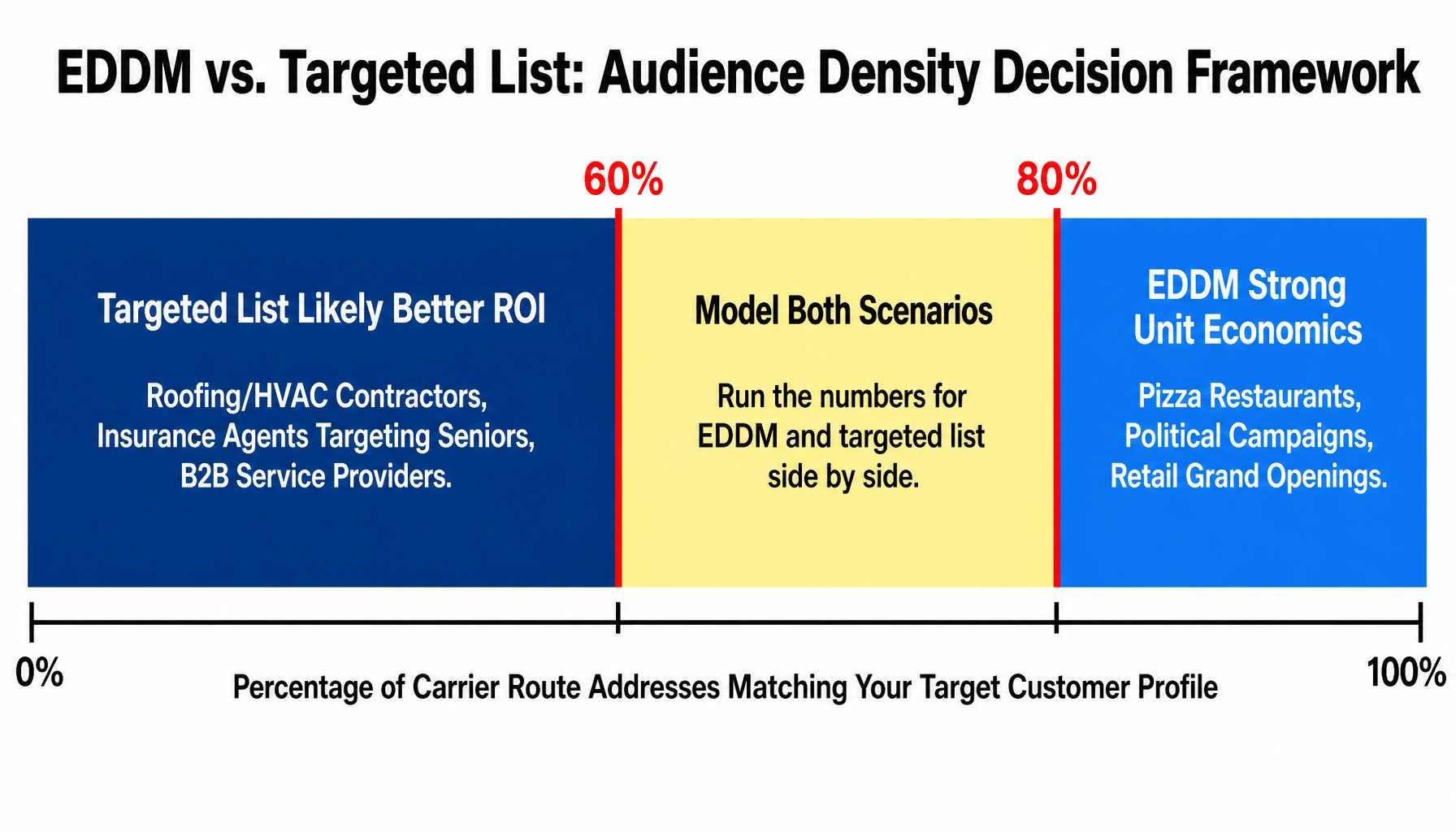
- EDDM works well when over 80% of a carrier route’s addresses are potential customers (e.g., pizza delivery). For businesses with specific audiences (homeowners, seniors), a targeted list often delivers better unit economics.
- Before committing to a campaign, model both scenarios: a saturation drop with EDDM and a filtered list mailed as addressed Marketing Mail to see which yields a lower cost per response for your specific business.
Imagine a home-services business owner mailing 5,000 postcards using Every Door Direct Mail (EDDM) to two carrier routes. The all-in every door direct mail cost looks efficient on paper under $0.50 per piece. But a closer look at the routes reveals that only 1,800 of those 5,000 households are owner-occupied. The other 3,200 pieces are delivered to renters who cannot hire a roofer or buy a new furnace.
The cost to reach a household that can actually become a customer is not $0.50. It is closer to $1.40.
This gap between the advertised per-piece rate and the actual cost to reach a qualified prospect is where direct mail budgets are won and lost. This guide walks through every component of an EDDM campaign with 2026 figures. We will then compare the total cost per acquired customer against a targeted mailing list, giving you the framework to decide which approach fits your audience and budget.
What Makes Up the Total Cost of an EDDM Campaign
The USPS postage rate is the number that gets attention, but it is only one of four cost layers that determine your final spend. A complete budget accounts for postage, printing, design, and the often-overlooked cost of preparation and labor. For a typical campaign, postage represents 34–63% of your total per-piece expenditure.
USPS EDDM Retail Postage
The USPS raised the EDDM Retail postage rate to $0.260 per piece on July 12, 2026. This rate applies specifically to flat-size mailpieces that meet USPS dimensional requirements taller than 6.125″ or longer than 11.5″, but no larger than 12″x15″ and weighing no more than 3.3 ounces. The rate is set by the USPS and is subject to change, so you should always verify the current postage at the time of your campaign. This EDDM Retail rate allows you to mail without a postal permit by using a simplified indicia.
Rates verified on July 12, 2026.
Printing, Design, and Preparation Costs
The other half of your budget is consumed by three non-postage components:
- Printing: Cost varies by format and volume. For a 5,000-piece run, expect to pay between $0.12 and $0.35 per piece. A 6.25″x9″ postcard is on the lower end, while a larger 9″x12″ flat on heavier card stock with a UV coating will be on the higher end.
- Design: A one-time mail piece design from a freelance designer or template service typically costs between $150 and $500. Some print vendors offer basic design templates, which can reduce this upfront cost.
- Preparation and Labor: This is the most commonly overlooked cost. EDDM Retail requires you to bundle mailpieces in stacks of 50 to 100, attach a facing slip to each bundle, complete USPS Form PS 3587, and physically deliver the bundles to the correct destination post office. If you do this in-house, the cost is your labor time. If you outsource it to a mail house, it can add $0.02 to $0.05 per piece.
All-In Cost Per Piece: Summary Table
This table provides a quick reference for estimating your all-in per-piece cost. The low-end estimate assumes a high-volume run of a standard postcard with in-house preparation, while the high-end reflects a smaller run of a large flat with outsourced prep and custom design.
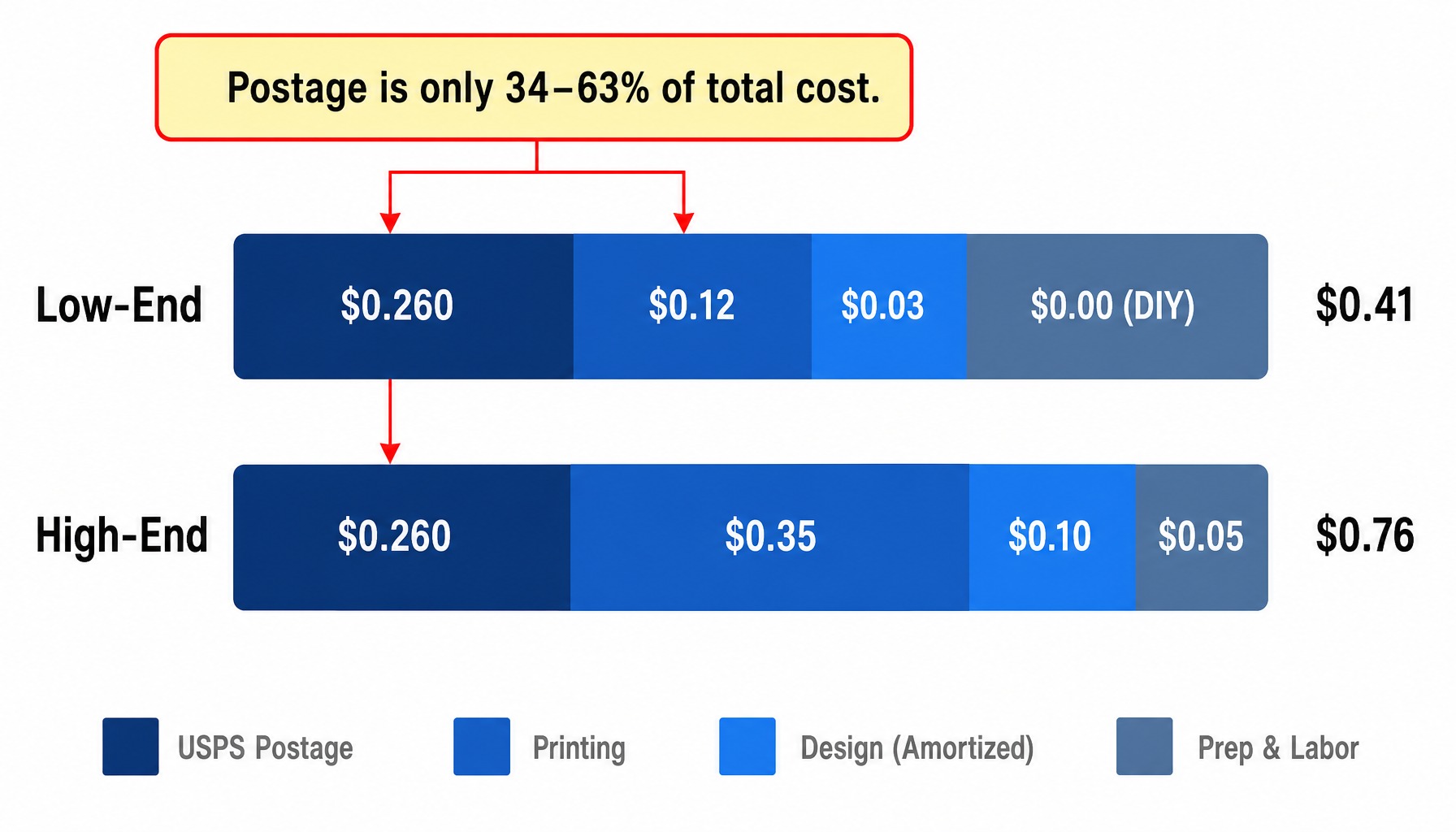
| Cost Component | Low-End Estimate (Per Piece) | High-End Estimate (Per Piece) |
|---|---|---|
| USPS Postage | $0.260 | $0.260 |
| Printing | $0.12 | $0.35 |
| Design (Amortized) | $0.03 | $0.10 |
| Prep & Labor | $0.00 (DIY) | $0.05 |
| Total All-In Cost | $0.41 | $0.76 |
How to Calculate Total EDDM Campaign Cost by Volume
To make this concrete, let’s walk through a scenario. Consider a local dental practice mailing a 6.25″x9″ postcard to carrier routes in two ZIP codes. The practice can use the USPS EDDM Online Portal to identify routes and find the exact number of residential and business addresses, known as the route density count.
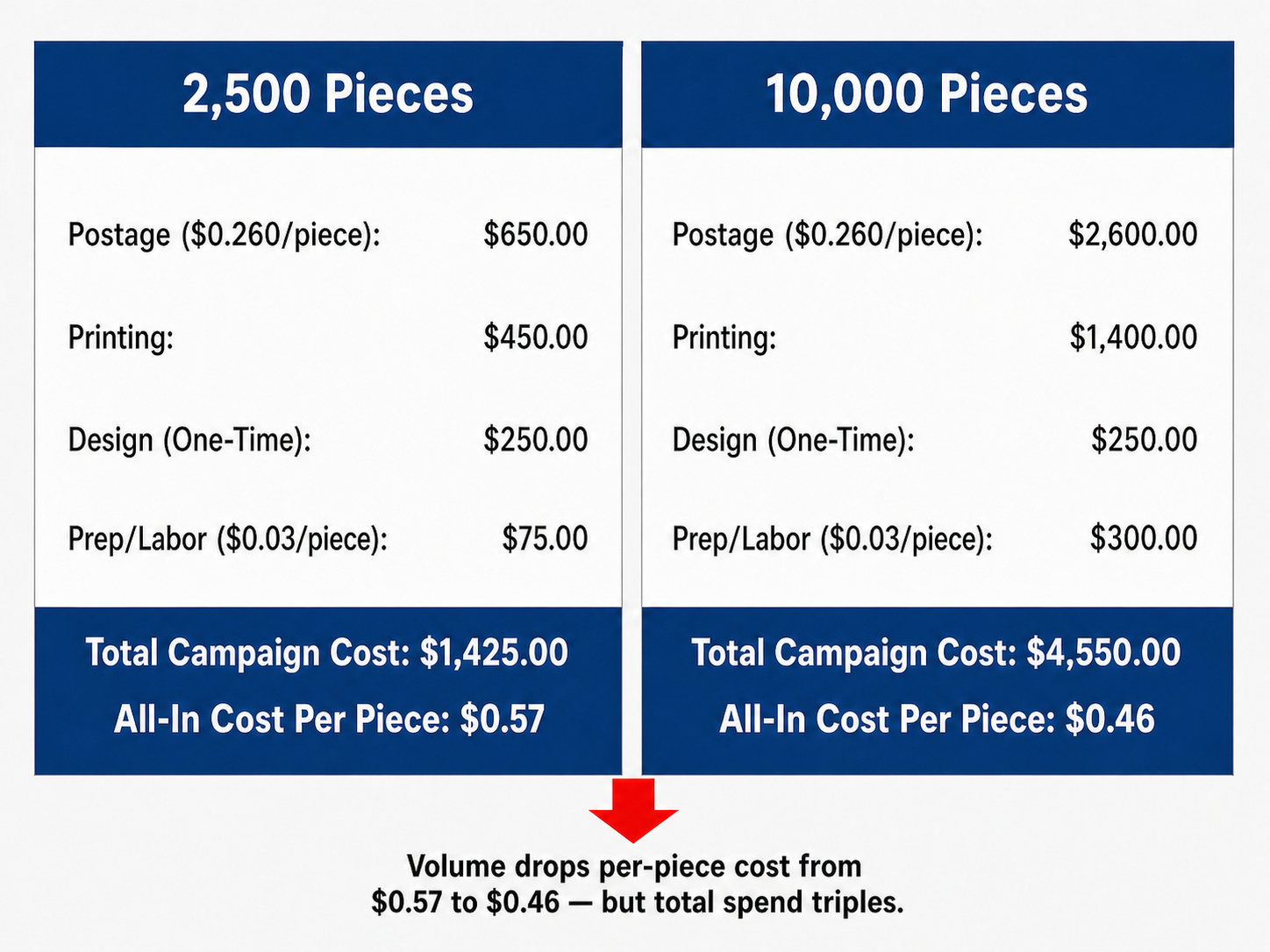
Here is how the math works at two different volumes, assuming a mid-range printing cost of $0.18 per piece at 2,500 pieces and $0.14 at 10,000 pieces due to volume discounts.
Campaign Cost Calculation
| Cost Item | 2,500 Pieces | 10,000 Pieces |
|---|---|---|
| Postage ($0.260/piece) | $650.00 | $2,600.00 |
| Printing | $450.00 | $1,400.00 |
| Design (One-Time) | $250.00 | $250.00 |
| Prep/Labor ($0.03/piece) | $75.00 | $300.00 |
| Total Campaign Cost | $1,425.00 | $4,550.00 |
| All-In Cost Per Piece | $0.57 | $0.46 |
As the table shows, the per-piece cost drops at higher volumes, but the total cash outlay increases substantially. The decision depends on your total available budget, not just the unit economics of a single mailpiece.
How Waste Circulation Inflates Your Real Cost Per Response
EDDM’s low per-piece cost is attractive, but it is not the metric that determines campaign return on investment (ROI). Cost per response and cost per acquisition are what matter. The core challenge with EDDM is waste circulation, paying to mail to addresses that can never become customers.
To make this concrete, consider a hypothetical pest-control operator comparing two spring campaigns in the same geography. The first is an EDDM saturation drop to 8,000 addresses. At an all-in cost of $0.48 per piece, the total spend is $3,840. If the campaign generates 96 responses and converts 18 into new customers, the cost per response is $40.00 and the cost per acquisition is $213.33.
Now add the audience-match problem. Even if the operator uses the USPS EDDM tool to choose residential-only delivery and reviews route-level demographic averages such as age and income, the route set can still contain many renter households. In this hypothetical route set, only 4,500 of those 8,000 residential addresses are owner-occupied single-family homes, or 56.25% of the total. The other 3,500 pieces go to apartments and renter households that are unlikely to authorize recurring pest-control service.
Now compare that to a targeted mailing sent only to those 4,500 homeowner addresses. Assume a list cost of $225 at $0.05 per record, postage of $1,530 at $0.34 per piece, printing of $720 at $0.16 per piece, and design, addressing, CASS and NCOA processing, and permit overhead of $395. That brings the total targeted campaign spend to $2,870, or about $0.64 per piece. If that campaign generates 90 responses and converts 23 into new customers, the cost per response is $31.89 and the cost per acquisition is $124.78.
Read more: Homeowner Lead Lists – Email and Mailing Lists from Infofree
This is the kind of math that defines the real threshold. In this example, the targeted campaign costs more per piece but less per customer because the route match rate is only 56.25%. That places it below the break-even threshold implied by the side-by-side budget model. Route-level filters can improve audience fit, but once you select a route, EDDM still does not let you suppress the individual renter households inside it.
EDDM Cost vs. Targeted Mailing List Cost: Side-by-Side Budget Model
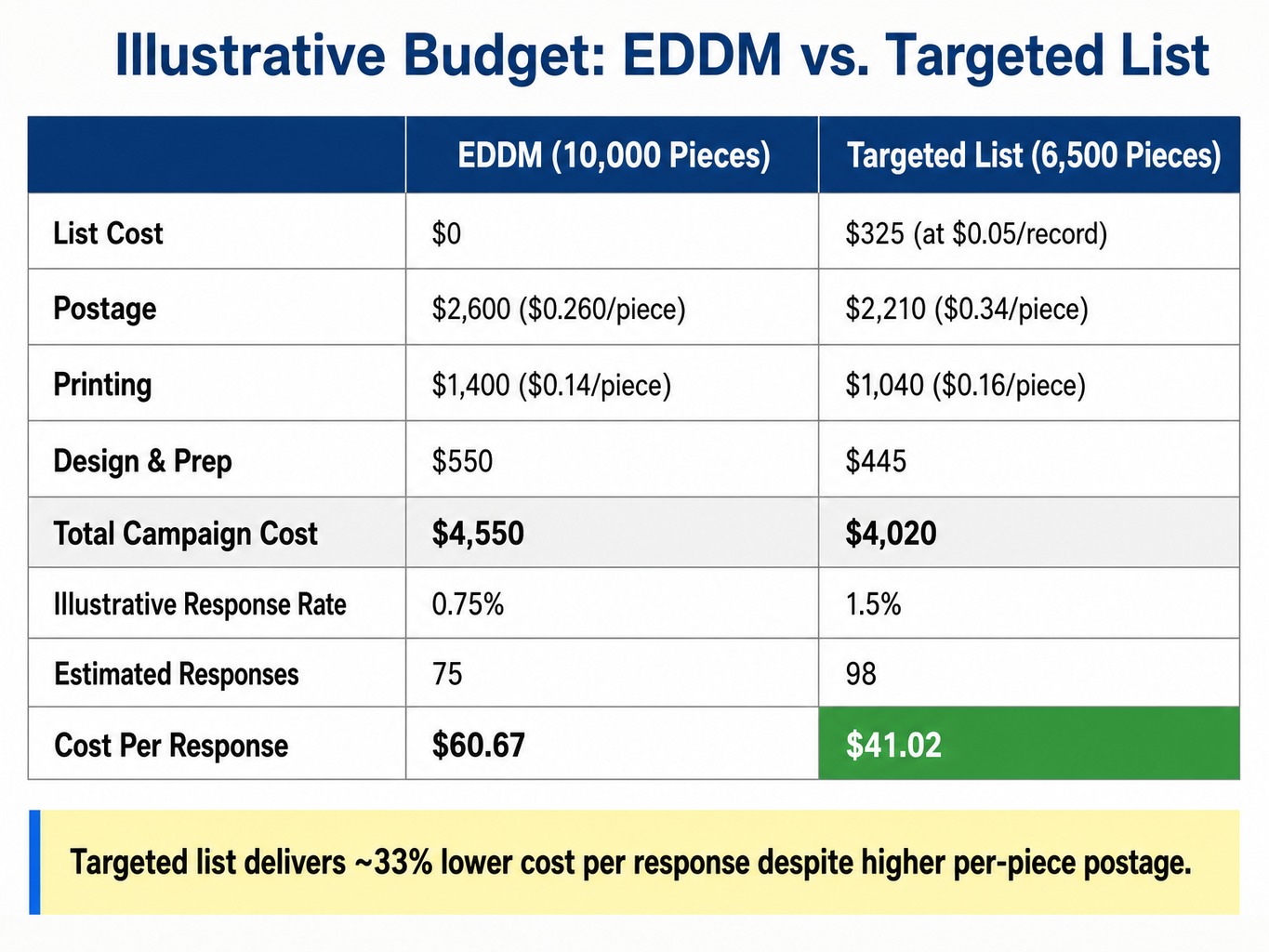
Let’s model this decision for a 10,000-household radius. The EDDM baseline produces 75 responses on 10,000 pieces, for a 0.75% response rate and a cost per response of $60.67. The targeted list scenario uses the same geography but filters the audience down to 6,500 qualified homeowners. To keep the comparison realistic, the targeted model includes list access, addressing, CASS and NCOA processing, and permit or annual mailing overhead folded into preparation costs. If targeting only matches EDDM’s baseline response rate among qualified homes, the targeted mailing still generates 75 responses at a cost per response of $60.73. If targeting lifts response rate to 1.5%, the targeted mailing generates 98 responses and drops cost per response to $46.48.
Here is a side-by-side budget comparing an EDDM saturation drop to a targeted mailing. We will assume the targeted list identifies 6,500 homeowners within the same 10,000-address area.
Illustrative Budget: EDDM vs. Targeted List
| Cost Item | EDDM (10,000 Pieces) | Targeted List (Conservative) | Targeted List (Optimistic, 6,500 Pieces) |
|---|---|---|---|
| List Cost | $0 | $325 (at $0.05/record) | $325 (at $0.05/record) |
| Postage | $2,600 ($0.260/piece) | $2,210 ($0.34/piece) | $2,210 ($0.34/piece) |
| Printing | $1,400 ($0.14/piece) | $1,040 ($0.16/piece) | $1,040 ($0.16/piece) |
| Design & Prep | $550 | $980 | $980 |
| Total Campaign Cost | $4,550 | $4,555 | $4,555 |
| Illustrative Response Rate | 0.75% | 1.15% | 1.5% |
| Estimated Responses | 75 | 75 | 98 |
| Illustrative Close Rate | 20% | 20% | 22.4% |
| Acquired Customers | 15 | 15 | 22 |
| Cost Per Response | $60.67 | $60.73 | $46.48 |
| Cost Per Acquisition | $303.33 | $303.67 | $207.05 |
For the targeted side, the $0.34 postage assumption is based on USPS Notice 123 commercial addressed Marketing Mail pricing for automation-compatible letters or flats entered at commercial rates. Actual pricing varies by mailpiece shape, weight, automation eligibility, and presort level, so this line should be treated as an illustrative midpoint rather than a universal addressed Marketing Mail rate.
In this revised model, the targeted list no longer wins automatically on total spend once you account for operational costs that EDDM does not require, such as addressing, CASS and NCOA hygiene, and permit overhead. The conservative case is essentially cost-neutral on response economics. The optimistic case still shows why targeting can win when better audience fit lifts response and close rates enough to overcome the higher operational burden.
Note that any mailing campaign requires the sender to comply with applicable postal regulations. If you plan to combine direct mail with calling or email, you are also responsible for adhering to DNC, TCPA, CAN-SPAM, and relevant state privacy laws.
When EDDM Makes Financial Sense and When It Does Not
The decision to use EDDM comes down to audience density. Using the model in this article, the break-even point is about 74%. The math is straightforward: EDDM breaks even when the carrier route’s match rate equals the EDDM all-in per-piece cost divided by the targeted list’s all-in per-piece cost, or $0.455 ÷ $0.618 = 0.736. Rounded, that is 74%.
EDDM works well for businesses with broad appeal:
- Pizza Restaurants: Nearly every household is a potential customer.
- Political Campaigns: Reaching every registered voter in a precinct is the goal.
- Retail Grand Openings: Any local resident is a potential source of foot traffic.
EDDM works poorly for businesses with specific audiences:
- Roofing/HVAC Contractors: The target audience is homeowners, often filtered by home value or age of home. Renters and commercial properties are pure waste, so these campaigns fall below the 74% break-even point quickly.
- Insurance Agents Targeting Seniors: An agent selling Medicare-related products needs to reach households where at least one resident is turning 65. This is a narrow demographic slice of any residential carrier route. Building a targeted insurance agent prospect list filtered by age eliminates the waste inherent in saturation mail.
- B2B Service Providers: Businesses targeting specific industries, such as accounting firms using SIC or NAICS codes, find that commercial addresses are a small fraction of a typical residential carrier route.
Businesses in the second category often start with EDDM because the low per-piece cost is appealing, only to shift to targeted lists after measuring a high cost per acquisition across their first few campaigns.
Building a Targeted Mailing List Without Per-Record Costs
The analysis is clear: EDDM is efficient for saturation, but targeting is better for ROI when your audience is specific. The traditional objection to targeted lists is the cost, paying per record or per list can feel expensive, especially when testing multiple campaigns.
This is where a flat-rate data platform changes the math. InfoFree builds targeted, filtered mailing lists, not EDDM saturation drops. With InfoFree, you can build your own targeted mailing lists without accumulating per-record research charges. The platform provides unlimited search and view access across consumer and household records, allowing you to filter by geography, homeowner status, estimated home value, age, income, move date, and other demographic attributes.
You can test dozens of filter combinations, compare audience sizes across different ZIP codes, and refine your mailing list until it precisely matches your ideal customer profile. Only then do you export the records, with export limits governed by your plan. This approach eliminates the financial penalty for research and lets you focus your budget on mailing to prospects who can actually convert. InfoFree’s consumer database includes approximately 270 million records compiled from a separate set of sources.
When using any exported data, customers are responsible for following all applicable local, state, and federal laws, including DNC, TCPA, CAN-SPAM, and state privacy statutes. InfoFree provides the data; it is not liable for how customers use it.
The lowest every door direct mail cost is a misleading metric. The number that drives growth is cost per acquired customer. EDDM delivers exceptional economics when your target audience and the carrier route are nearly identical. When they are not, the campaign pays to deliver mail to thousands of addresses that will never respond.
Using the article’s own model, the break-even match rate is about 74%. The math is EDDM all-in per-piece cost ÷ targeted list all-in per-piece cost, or $0.455 ÷ $0.618 = 0.736. Rounded, that means once a carrier route falls below about 74% audience match, a filtered mailing list can produce a lower cost per acquisition even with higher per-piece postage.
Frequently Asked Questions
What is the difference between EDDM Retail and EDDM BMEU entry?
EDDM Retail is designed for small businesses and allows you to drop mailings at a local post office without a mailing permit. You use a simplified address format and complete Form PS 3587, but Retail also comes with a hard daily limit of 5,000 pieces per ZIP code. EDDM entered through a Business Mail Entry Unit, or BMEU, removes that daily cap and usually offers a lower per-piece postage rate, which matters when you are comparing total campaign cost at scale. The trade-off is that BMEU requires a USPS permit and an annual permit fee, along with more formal mail preparation requirements.
Can I exclude specific addresses or demographic groups from an EDDM mailing?
Not at the individual address level. The USPS EDDM tool does let you choose residential-only delivery and review route-level demographic averages such as age and median income before selecting routes. That can improve route selection. However, once you choose a route, EDDM still requires you to mail every included address on that route type, and you cannot suppress individual households by homeowner status, age, income, or renter status. If you need address-level selection, you need a targeted mailing list instead of EDDM.
Are there fees beyond postage and printing that EDDM mailers overlook?
Yes, the two costs that surprise first-time mailers are prep labor and design revisions. Bundling pieces, attaching facing slips, and delivering the mail to the correct post office can take several hours for a 5,000-piece drop. Additionally, if your mailpiece fails to meet USPS flat-size requirements due to incorrect dimensions, weight over 3.3 oz, or a missing facing identification mark the cost to reprint the entire job can be substantial.
What mail piece sizes qualify for EDDM postage rates?
To qualify for EDDM postage, mailpieces must be classified as “flats.” This means the piece must be taller than 6.125 inches OR longer than 11.5 inches. It cannot be larger than 12 by 15 inches or weigh more than 3.3 ounces. Common qualifying formats include 6.25″x9″ postcards and 8.5″x11″ or 9″x12″ flyers. Standard letter-size mail, such as a 4″x6″ postcard or a #10 envelope, does not qualify.
How do I use the USPS EDDM Online Portal to estimate campaign cost by ZIP code?
Navigate to the USPS EDDM Online Portal and enter a starting address or ZIP code. The tool will display a map of all carrier routes in the area, showing the total number of residential and business deliveries for each. As you select routes, the portal calculates your total postage based on the current EDDM Retail rate. Remember, this tool only estimates postage; you must add printing, design, and prep costs separately to find your total campaign spend.