


Key Takeaways
- The widely cited best times to cold call, late morning (10 a.m.–12 p.m.) and late afternoon (4–5 p.m.) on Wednesdays and Thursdays, are based on studies of B2B office workers and do not apply universally.
- The optimal calling window changes based on who is on your list. Owner-operators are often more available before 9 a.m., while consumers and homeowners are best reached between 5 p.m. and 7 p.m.
- Extend your productive dialing day from six hours to nine by using time-zone stacking: segment your list by geography and call East to West, matching your dial block to the prospect’s local clock.
- Structure your day with dedicated, uninterrupted call blocks. Mixing dialing with CRM updates and email follow-ups breaks your rhythm and reduces live connects per hour.
- List freshness is as important as timing. Dialing a stale list during a perfect window still results in disconnected numbers and wasted time; data quality constrains your entire outbound effort.
A sales rep dials 80 numbers between 10 a.m. and noon. A blog post, citing multiple studies, promised this was the prime window for outbound calls. But the list was made up mostly of small-business owners who were already serving customers by then. The result was a long run of voicemails, rushed brush-offs, and gatekeepers saying the owner was tied up. The problem was not effort. It was applying the wrong calling window to the wrong kind of prospect.
The best time to cold call depends entirely on who you are calling. A VP of Operations at a 200-person company, a dentist who owns a solo practice, and a homeowner on a consumer list each have different availability patterns. The published research that recommends late-morning and late-afternoon calls measured only one of those groups.
This guide provides a framework for building a calling schedule that aligns with your actual prospect list. We will cover the consensus from major studies, show how the window shifts by prospect type, and provide operational tactics for time-zone stacking and structuring a daily call block. More importantly, we will explain why the freshness of your data ultimately determines whether your best hours produce conversations or just more voicemails.
What the Major Studies Actually Agree On
If you have researched the best time to call prospects, you have likely seen the same data points repeated. Four major analyses from CallHippo, InsightSquared, Revenue.io, and PhoneBurner form the backbone of conventional wisdom on cold call timing.
They converge on a few key findings:
- Best Times: Late morning (10 a.m. to 12 p.m.) and late afternoon (4 p.m. to 5 p.m.) consistently produce the highest connect rates.
- Best Days: Wednesday and Thursday generally outperform other days of the week, with Monday mornings being particularly difficult and Friday afternoons showing a sharp drop-off in live answers.
Specifically, a CallHippo analysis found 4 p.m. to 5 p.m. was the single best hour, with 11 a.m. to 12 p.m. as the second-best. Research from InsightSquared pointed to two windows: 10 a.m. to 11 a.m. and 4 p.m. to 5 p.m. Revenue.io also identified the late afternoon as a peak time for conversations. And a PhoneBurner study of over 11 million calls confirmed that the 10 a.m. to 2 p.m. block was broadly effective.
However, there is a critical piece of context that is almost always omitted. The widely cited ‘Wednesday and Thursday are the best days to cold call’ finding comes almost entirely from B2B software-as-a-service (SaaS) pipeline data. Every one of these studies measured connect rates for B2B prospects in office environments. If your list contains small-business owners who answer their own phones or consumers you are reaching at home, these windows are a starting hypothesis, not a proven schedule.
Why the Person on Your List Changes the Window
The studies above assume your list contains mid-level to senior professionals at companies with standard 9-to-5 business hours. But outbound callers work lists that include at least three distinct prospect types, each with a different availability curve. Applying a single universal call window to a mixed list systematically under-serves at least two of those segments.
The higher-leverage move is to segment your list by prospect type before scheduling your calls.
B2B Executives and Owner-Operators
Even within B2B prospecting, the optimal window splits based on company size and the decision-maker’s role.
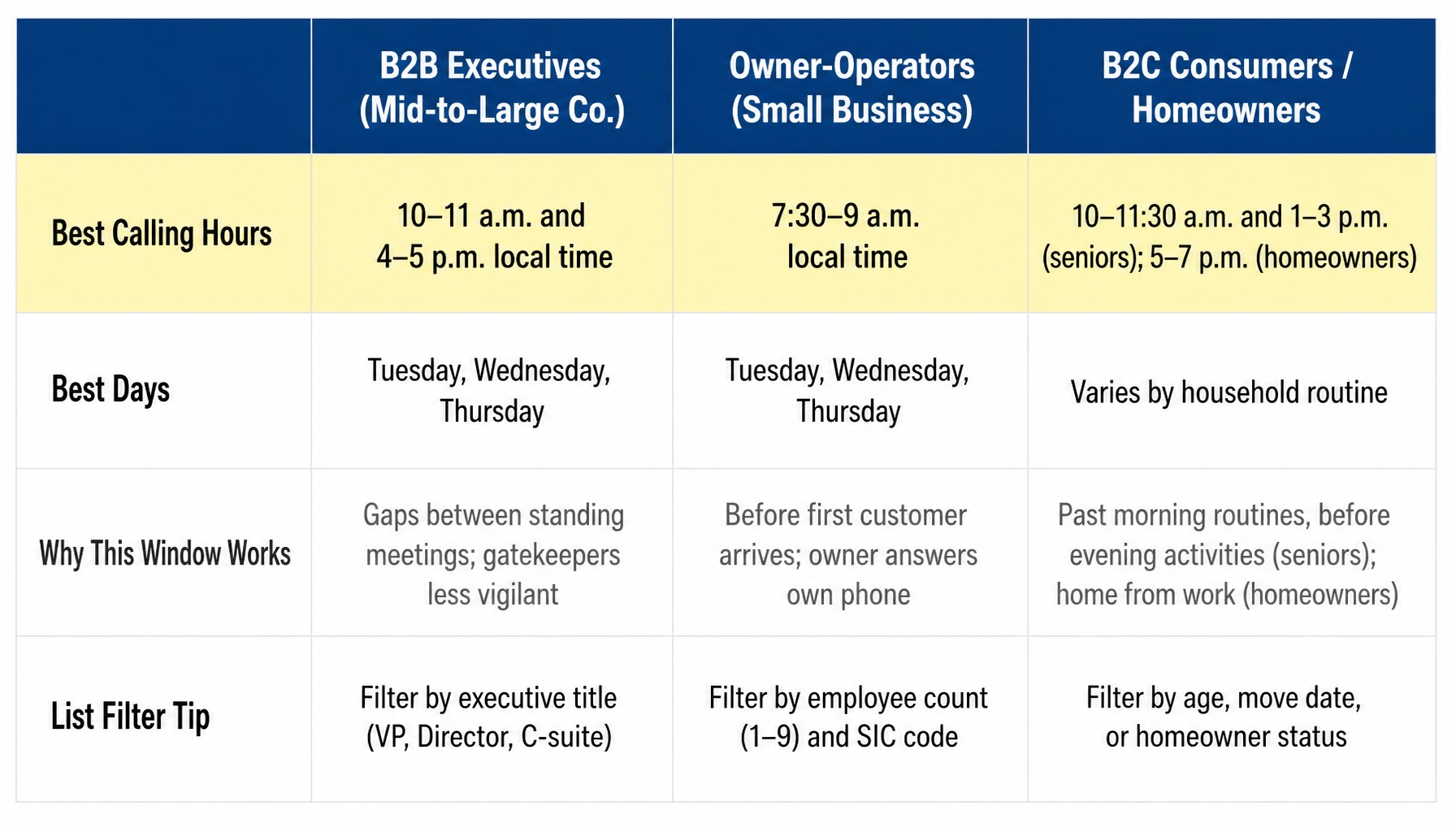
For executives at mid-to-large companies (VPs, Directors, C-suite), the published studies are a reliable guide. The 10–11 a.m. and 4–5 p.m. windows on Tuesdays, Wednesdays, and Thursdays work well because their calendars have gaps between standing meetings and gatekeepers may be less vigilant. Reaching these decision makers during those gaps is the key to higher connect rates.
For owner-operators and small-business owners who answer their own phones, the window shifts much earlier. Consider an illustrative example: an SDR team selling payroll software to businesses with fewer than ten employees. They stack their entire dial block into the 10 a.m.-to-noon window and see mediocre connect rates. When they shift a portion of their dials to 8–9 a.m. local time, before the owner’s first customer walks in, live pickups jump.
Many of these prospects dentists, contractors, accountants, independent insurance agents are most reachable between 7:30 a.m. and 9 a.m. local time. A rep calling a list filtered by Standard Industrial Classification (SIC) code for dental offices (SIC 8021) or HVAC contractors (SIC 1711) should test an early-morning block. Filtering your list by employee count (e.g., 1–9 employees) is a direct way to isolate these owner-operator records from companies large enough to have dedicated gatekeepers.
B2C Consumers and Homeowners
The B2B cold-calling studies do not apply to consumer lists. Homeowners, seniors, and other household-level prospects follow a schedule dictated by life patterns, not office hours.
For insurance agents calling Medicare-eligible seniors on a Turning 65 (T65) list, late morning (10–11:30 a.m.) and early afternoon (1–3 p.m.) often produce the highest answer rates. These prospects are typically home, past their morning routines, and not yet into evening activities.
For reps working new-homeowner or new-mover lists, timing is less about the hour of the day and more about the days since the move. Calling within the first 10–14 days of a recorded move date is critical, as the household has not yet locked in its local service providers for things like insurance, internet, or home security.
Read more: Homeowner Lead Lists – Email and Mailing Lists from Infofree
Any outreach to consumer or household phone numbers requires the caller to scrub lists against the National Do Not Call (DNC) Registry and operate in full compliance with the Telephone Consumer Protection Act (TCPA) and all applicable state privacy laws.
How to Extend Your Calling Day Across U.S. Time Zones
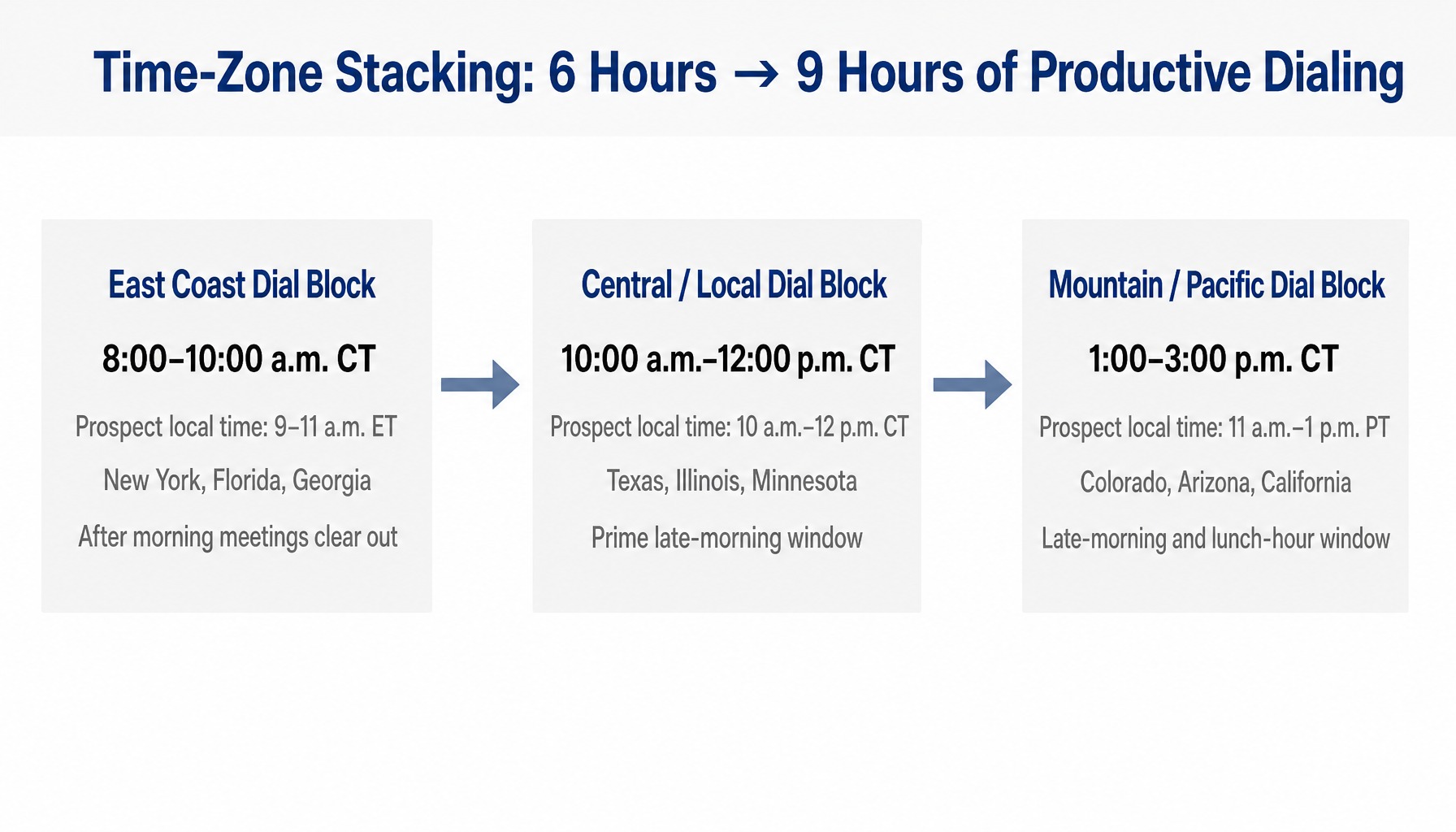
A rep based in the Central time zone who only dials during their local 10 a.m.–12 p.m. window is ignoring a massive opportunity. When it is 10 a.m. in Dallas, it is already 11 a.m. in Atlanta and only 8 a.m. in Los Angeles. A national list sorted by time zone allows a single rep to extend their productive dialing from roughly six hours to a full eight or nine.
This scheduling tactic, known as time-zone stacking, requires your list to include a state or ZIP code field so you can sort prospects by geography.
Here is a practical example for a Central-time rep working a national list of accounting firms (SIC 8721):
- 8:00 a.m. – 10:00 a.m. Central: Dial prospects on the East Coast (New York, Florida, Georgia). You are hitting their 9 a.m.–11 a.m. window, just after morning meetings clear out.
- 10:00 a.m. – 12:00 p.m. Central: Shift to prospects in your own time zone (Texas, Illinois, Minnesota), catching their prime late-morning window.
- 1:00 p.m. – 3:00 p.m. Central: Move to prospects in Mountain and Pacific time zones (Colorado, Arizona, California). You are reaching them during their 11 a.m.–1 p.m. block, hitting the late-morning and lunch-hour sweet spot on the West Coast.
This sequence allows one person to cover three distinct prime windows across the country in a single day. InfoFree’s business and consumer databases both include geography filters like state, ZIP code, and radius search, making it possible to build these geographically segmented lists before you export your data and begin a dial session.
Building a Daily Call Block That Separates Dialing from Everything Else
The most common operational mistake in outbound calling is mixing activities. Reps who alternate between making a dial, writing a follow-up email, updating CRM notes, and researching the next prospect in the same hour produce consistently fewer live connects. The reason is not a lack of discipline; it is that the cognitive cost of context-switching breaks the rhythm needed to achieve high dial volume. A “call block” that includes CRM note-taking between dials is not a true call block.
High-output teams build schedules that batch these activities into dedicated, non-overlapping blocks.
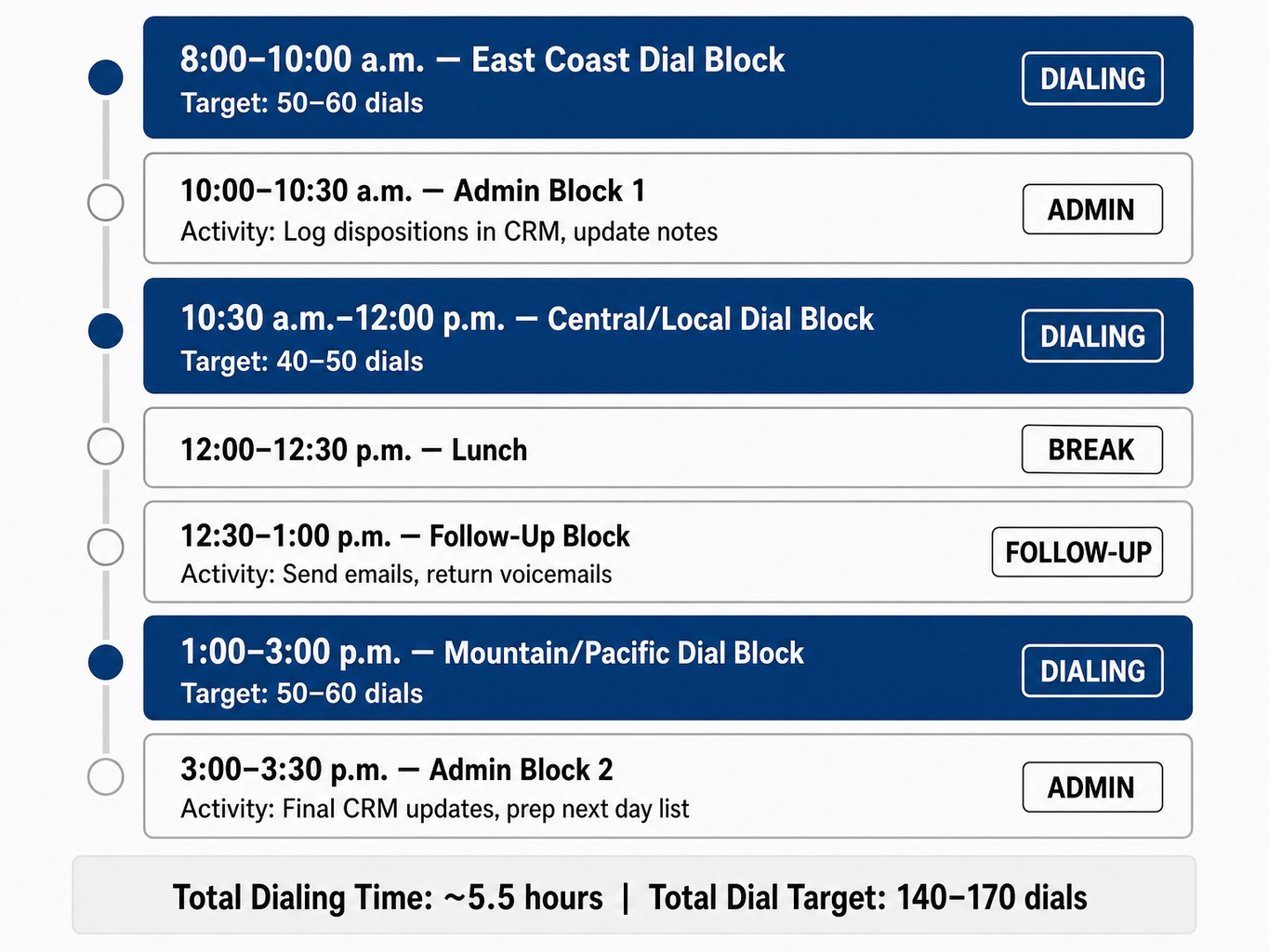
Sample Daily Call Block (Central Time, B2B List):
- 8:00 – 10:00 a.m. East Coast Dial Block (Target: 50–60 dials)
- 10:00 – 10:30 a.m. Admin Block 1: Log dispositions in CRM, update notes from morning calls.
- 10:30 a.m. – 12:00 p.m. Central/Local Dial Block (Target: 40–50 dials)
- 12:00 – 12:30 p.m. Lunch
- 12:30 – 1:00 p.m. Follow-Up Block: Send emails and return voicemails from the morning.
- 1:00 – 3:00 p.m. Mountain/Pacific Dial Block (Target: 50–60 dials)
- 3:00 – 3:30 p.m. Admin Block 2: Final CRM updates, prep next day’s list.
This structure assumes the list is already built and exported before the day begins. Building the list during dial hours is the single largest time leak in outbound sales. The specific hour blocks should be adjusted based on the prospect type guidance from the earlier section, but the principle of separating dialing from administration remains constant.
When Stale Records Waste Your Best Calling Hours
A rep who dials sixty numbers during a two-hour prime window and reaches only four live humans has not failed at timing; they have failed at list preparation. The cost is measured in the salary hours consumed by ringing disconnected lines. The timing was right, but the data was stale.
Business contact data decay is a constant drag on productivity. As is widely recognized in B2B sales circles, contact databases decay at a rate of roughly 2–3% per month as employees change roles, leave companies, or get new direct dials. For consumer records, phone-number freshness decays at different rates depending on record type: business direct-dial numbers tend to go stale when an employee changes roles, while consumer mobile numbers churn when a household moves or switches carriers.
A new-mover record that is 90 days old has likely passed the window where the household is actively choosing local providers. The practical implication is clear: optimizing your calling schedule while neglecting list freshness is like tuning an engine and filling the tank with old fuel. The upstream decision where your list comes from and how recently it was verified constrains the effectiveness of every downstream action, including your call timing.
How InfoFree Helps You Start Each Dial Block with a Fresh, Filtered List
The tension is clear: timing your calls well only works if the list underneath is accurate, filtered to the right prospect type, and recent enough to produce live connects. InfoFree is designed to resolve this tension through three specific capabilities.
First, the platform allows you to search and filter records to match the prospect type you are actually calling. For B2B, you can build lists using SIC or NAICS codes, employee count, geography, and executive titles. For B2C, you can segment by homeowner status, move date, age, income, and other demographic attributes. This ensures your schedule aligns with your list.
Second, InfoFree’s business records are triple-verified and rated at 95% accuracy. This directly addresses the dead-number problem that wastes prime calling hours. It is important to note that consumer and household records are compiled from a separate set of sources and are not rated on this same standard.
Third, unlimited search and view access with exports governed by your plan means a rep can refine or rebuild a list before each dial block without accumulating per-record research costs. Once you have your list, the included CRM101 lets you log call dispositions and schedule follow-up from the same environment, keeping your workflow connected.
When using any exported data for calling, you are responsible for following all applicable local, state, and federal laws. InfoFree provides the data; it is not liable for how customers use it.
Search business or consumer records and build a filtered calling list
The most important takeaway is this: the best time to cold call is not a universal hour. It is the hour that matches the availability pattern of the specific prospect on your list, dialed from a record that was accurate when you exported it.
The published studies provide a starting range for B2B office workers. But the prospect type be it a corporate executive, a small-business owner, or a consumer is what truly defines the window. Time-zone sequencing extends your reach, and a structured call block protects your focus. Before you optimize your schedule for tomorrow, look at the list you plan to dial. Ask whether the records are filtered tightly enough and fresh enough to deserve your best hours.
Frequently Asked Questions
Should I leave a voicemail on the first cold call attempt?
Leaving a voicemail on the first attempt can work if the message is under 30 seconds and offers a specific reason for the call tied to the prospect’s role, rather than a generic pitch. Some reps prefer to call twice without a voicemail (spaced a few days apart) before leaving one, as a message from an unknown number can cause the prospect to screen future calls.
How many call attempts should I make before removing a prospect from my list?
A common working threshold is 6–8 attempts spread across different days and times over a two-to-three-week period. After that, the probability of a right-party contact (RPC) drops sharply. Log each attempt with a disposition code in your CRM so the decision to stop dialing is based on data, not memory.
Does local presence dialing still improve pickup rates?
Local presence dialing, which displays a caller ID with the prospect’s area code, can modestly improve answer rates on initial attempts. However, its effectiveness has declined as carriers aggressively flag high-volume numbers with spam labels. The more durable factor is list accuracy: a verified direct-dial number will always outperform a local-presence call to a wrong number.
Are cold calling windows different for insurance agents versus SaaS sales reps?
Yes, because the prospect types differ. A SaaS rep calling directors of IT is working a B2B office-hours list where 10–11 a.m. and 4–5 p.m. apply. An insurance agent calling Medicare-eligible seniors is working a B2C household list where late morning (10–11:30 a.m.) and early afternoon (1–3 p.m.) are more effective. The vertical matters less than the prospect and phone number type.
What day of the week has the highest callback rate after leaving a voicemail?
There is no reliable study isolating callback rates by day, as it depends heavily on message quality and prospect type. Practitioners report that voicemails left Tuesday through Thursday produce more callbacks within 48 hours than those left on Friday or Monday, but this likely reflects general prospect availability, not a voicemail-specific effect.
Is 100 cold calls a day a realistic target?
Manually, 100 dials a day is achievable with 4–5 hours dedicated exclusively to dialing. With a parallel or power dialer, it can take 2–3 hours. The more useful metric is live connects per hour. A hundred dials that produce three conversations is a list-quality problem, not a volume achievement, and connect-rate benchmarks from dialer vendors can be inflated because they measure connects per attempt, not per unique prospect.