


Key Takeaways
- Stop waiting for inbound leads. Build a predictable listing pipeline by using homeowner data to target sellers based on life events, ownership duration, and equity.
- Implement a saturation marketing plan by defining a 400-500 home zone with specific filters and mailing a rotating sequence of pieces monthly for at least six months.
- Prioritize expired and FSBO outreach by layering data like estimated home value and ownership duration to identify the best-fit prospects before you contact them.
- Target underworked seller pools like absentee owner landlords or inherited-property holders by filtering for mailing-address-to-property-address mismatches.
- Win the appointment by presenting a pre-listing package with a one-page CMA summary and a 90-day marketing calendar, showing sellers you know how to read and apply the numbers.
The agents who consistently carry listing inventory are not always the ones with the largest sphere or the flashiest brand they are the ones running a repeatable outbound system. They build that system on homeowner data they control. The default path for many agents is waiting for portal leads, hoping for referrals, or cold-calling without filter criteria. This approach creates an unpredictable pipeline entirely dependent on outside forces.
Listing acquisition is a data problem first and a relationship problem second. If you cannot identify which homeowners in your target area are likely to sell based on ownership duration, equity position, a recent life event, or absentee status you are prospecting blind. This guide details the specific data filters, outreach cadences, and prospecting workflows that turn raw homeowner records into signed listing agreements.
Use Life-Event Data to Reach Homeowners Before They List
The highest-value listing prospects are homeowners experiencing a life event that creates selling motivation. This could be a recent move into the area (they may still own a previous property), a long ownership tenure that has built substantial equity, or a household change that triggers relocation. These homeowners are identifiable through data filters before they ever contact an agent. An agent who prospects without filtering homeowner records by ownership duration or equity position is spending the same per-contact cost on a retiree with no selling intent as on a recently divorced homeowner with two properties. Platforms like InfoFree exist precisely to let agents apply those filters before a single mailer ships or a single call is dialed. Timing is a listing agent’s primary advantage, and data is what creates that timing.
Mover Data: Identifying Sellers on Both Ends of a Move
New-mover records identify households that have recently relocated into an area, but the outbound side of that move often means a property to sell at the origin. A new-mover record loses its outreach value quickly; contact within the first 10-14 days is critical. After 30 days, the household has typically selected its local service providers and settled in.
The key filters are move date, geography (both origin and destination ZIP codes), and homeowner status. An agent in a growing suburb can pull new-mover records monthly, filter for inbound movers from a metro area 60 miles away, and send a letter offering to connect them with a trusted listing agent in their origin market. If licensed in that state, the agent can offer to list the origin property themselves. This turns mover data, a tool often seen as buyer-side, into a two-sided listing opportunity.
Ownership Duration and Equity Position as Selling Indicators
Homeowners who have owned a property for 8-15 years in an appreciating market often sit on substantial equity and are statistically more likely to consider a move than recent buyers. Filtering by length of residence, estimated home value, and geography creates a list of pre-market sellers. Combining ownership duration with a life-stage filter, such as an age band or a change in household size, can narrow the list to homeowners with even higher motivation.
Consider an agent who decides to work a 500-home subdivision built 12 years prior. By filtering for owner-occupied homes with an estimated value above $300,000, they create a defined, repeatable campaign segment. This is a prospecting system, not a hope-based door knock. This approach allows an agent to build a list of potential sellers based on data-backed indicators rather than guessing which doors to knock.
Read more: Homeowner Lead Lists – Email and Mailing Lists from Infofree
Build a Saturation Marketing Plan Around Homeowner Records
Saturation marketing systematically mailing every homeowner in a defined zone on a recurring cadence is a high-return listing acquisition channel for agents who commit to it for 12 months or more. It fails when agents mail too broadly, too infrequently, or with irrelevant content. The difference between a profitable saturation campaign and an expensive one is the quality of the homeowner list that powers it. This workflow, when executed with discipline, can become the operational backbone of a predictable listing pipeline.
Defining Your Target Zone with Homeowner Filters
A successful saturation campaign begins with a well-defined list. Start with geography, using a ZIP code, a specific mail carrier route, or a radius around a recent sale. Then, layer on filters to refine the audience. Filter for homeowner status to target owner-occupied properties only, which avoids wasting budget on renters. Add a filter for an estimated home value range to align the list with your price-point expertise and market positioning.
USPS Every Door Direct Mail (EDDM) is a lower-cost option for geographic saturation, but it mails to every address on a route, including renters and businesses. A purchased homeowner list from a database allows for the critical filtering of homeowner status, property type, and even length of residence, ensuring your message reaches a more qualified audience.
Cadence and Mail-Piece Sequencing That Builds Recognition
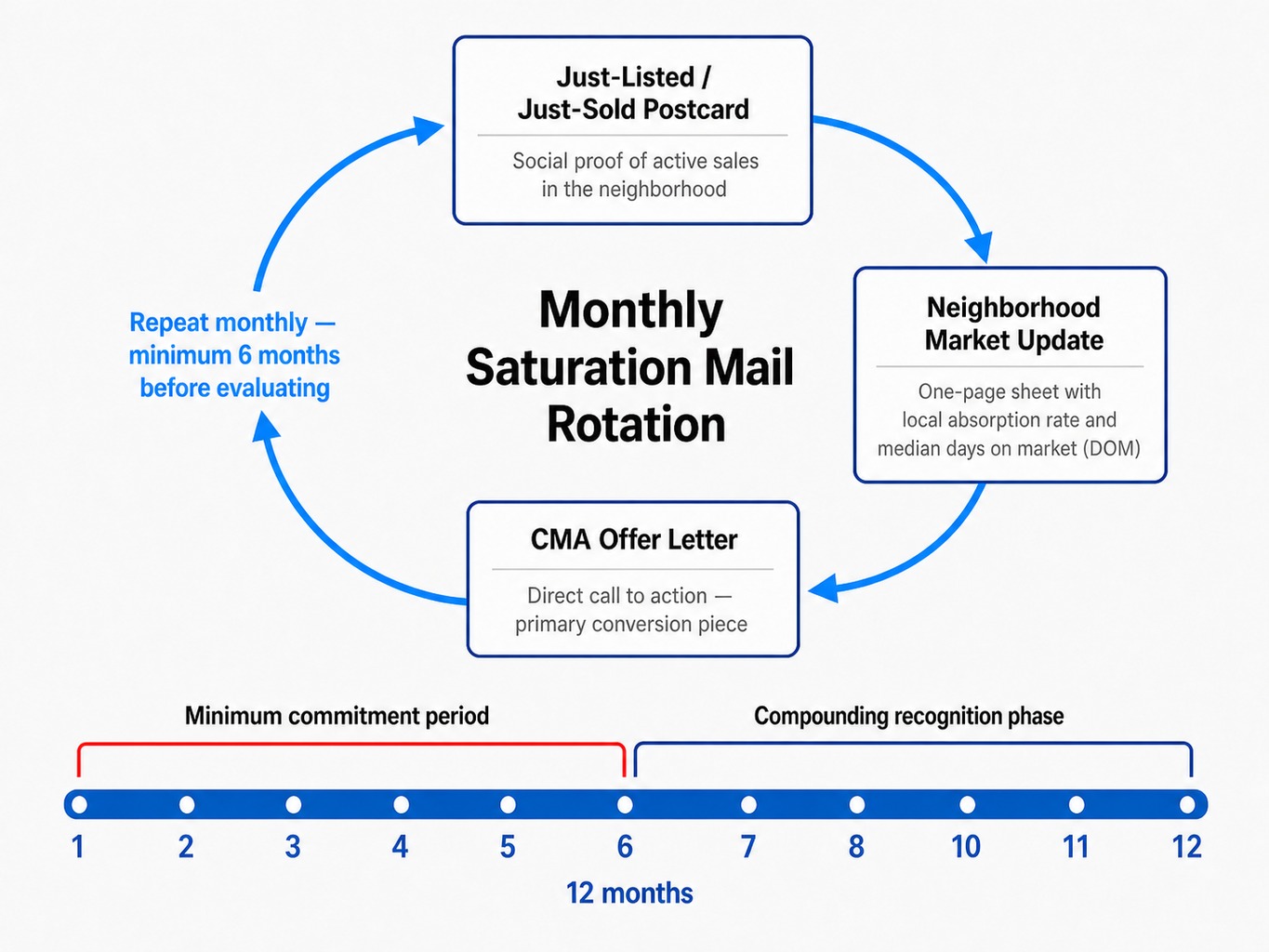
Consistency is what separates successful saturation campaigns from failed ones. Plan to mail your target zone at least once per month for the first six months, then evaluate whether to adjust the frequency. A rotating sequence of mail pieces builds recognition and authority over time.
A proven rotation includes three pieces:
- Just-Listed/Just-Sold Postcards: These provide social proof that you are active and successful in the neighborhood.
- Neighborhood Market Updates: A simple one-page sheet showing the local absorption rate or median days on market (DOM) positions you as a data-fluent expert.
- CMA Offer Letter: This is the direct call to action and the primary conversion piece. The other mailers exist so this one gets opened.
A saturation campaign is a long-term investment. It can take 6-12 months of consistent mailing to produce the first listing appointment. Agents who quit at month four are abandoning the effort just before the compounding effects begin to generate returns.
Prospect Expired Listings and FSBOs with Data, Not Just Persistence
Expired listings and For-Sale-By-Owner (FSBO) properties represent the two seller pools where motivation is already established. The homeowner has demonstrated clear intent to sell. The challenge is not finding them the MLS and public records surface them daily but prioritizing which ones to contact and how. Agents who layer data filters like ownership duration, estimated value, and days on market onto expired and FSBO lists contact fewer homeowners but convert at a higher rate.
A critical note on compliance: Any calling, emailing, or mailing to these homeowners must comply with the National Do Not Call Registry, the Telephone Consumer Protection Act (TCPA), and all applicable state privacy laws. The agent is responsible for ensuring compliance before initiating contact, not the data provider.
Expired Listings: Filtering for Fit Before You Dial
The daily expired list from the MLS or a service like REDX provides names and addresses, but it lacks the homeowner context that determines fit. By cross-referencing this list against a consumer and homeowner database, you can layer on filters for estimated home value, ownership duration, and property type. This allows you to prioritize the expired listings that match your market expertise and price point. An agent might see 40 expireds in a day but find that only 8-12 are high-fit contacts worth pursuing.
A disciplined contact sequence for these high-fit expireds could be a mailed Comparative Market Analysis (CMA) within 48 hours of expiration, followed by a phone call 3-5 days later referencing the mailed package. This data-layering approach turns expired prospecting from a volume game into a targeted, fit-based strategy.
FSBO Sellers: Leading with Market Data, Not a Sales Pitch
FSBO sellers choose to sell without an agent for a reason, which is frequently to save on commission. Leading a conversation with a pitch about your commission is a fast way to get rejected. A better approach is to lead with value, providing neighborhood-specific market data that the seller may not have. This includes the local absorption rate, median days on market for similar homes, and recent comparable sales.
Pair this MLS data with homeowner records to understand the FSBO seller’s equity position and ownership duration. One effective tactic is to send a one-page neighborhood market snapshot not a listing pitch to every new FSBO in your target ZIP code. Follow up with a phone call 7-10 days later to ask if they have any questions about the data you sent. This positions you as a helpful resource, opening the door for a future listing conversation.
Read more: Real Estate Lists – Email, Phone and Mailing Lists from Infofree
Target Absentee Owners Who May Be Ready to Sell
An absentee owner is someone whose mailing address in public records differs from the property address. This group includes landlords, inherited-property holders, and people who have relocated but not yet sold their previous home. These owners are often disproportionately open to selling because they are managing a property remotely, a task that comes with its own set of challenges.
Consider an agent who pulls a list of absentee owners in a single ZIP code, filters by ownership duration above ten years and estimated equity above 60%, and ends up with 140 records instead of the 2,200 the unfiltered absentee query returned. That smaller list, mailed on a monthly cadence with a personalized CMA offer, could produce listing conversations that a blast to the full 2,200 never would, because the filter combination isolates owners whose holding period and equity position make a sale financially attractive.
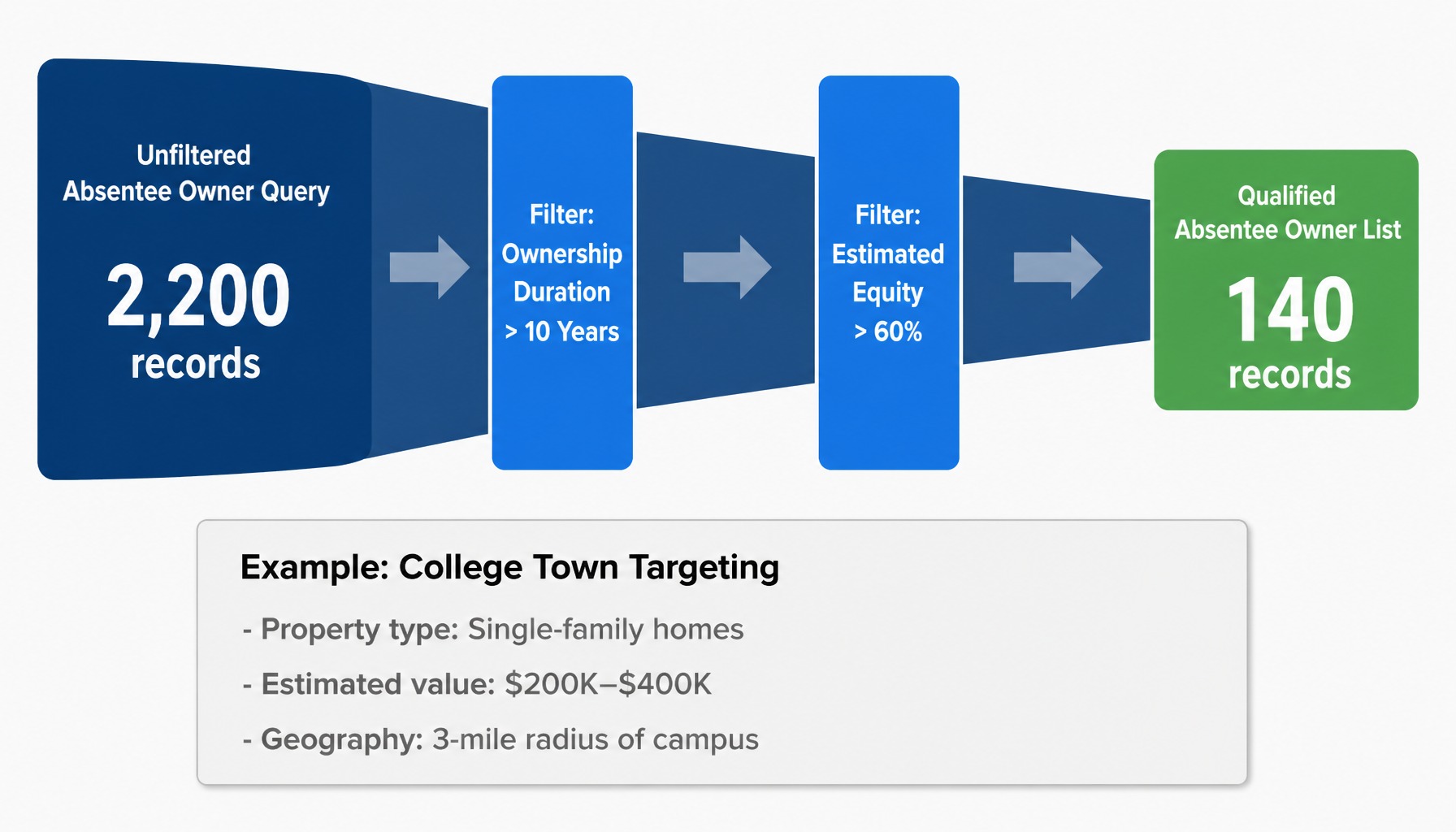
These records are identifiable through filters for homeowner status, mailing-address-vs-property-address mismatch, estimated home value, and geography. For example, an agent in a college town could filter for absentee owners of single-family homes valued between $200K and $400K within a three-mile radius of campus. This produces a targeted list of likely landlords who may be tired of tenant management, making a mailed offer for a no-obligation market valuation highly relevant.
Reactivate Your Sphere and Past Clients with Data-Backed Triggers
Sphere-of-influence outreach is a frequently cited listing strategy—and often the least systematically executed. The problem is not that agents forget to call their sphere; it is that they call without a specific reason tied to the homeowner’s actual situation. A generic holiday card or check-in call is easily forgotten.
The solution is to drive outreach with data. By running your past-client list from your CRM through a homeowner database, you can append current data fields like estimated home value and length of residence. This gives you a specific, data-backed reason to make contact. An agent can identify 30 past clients who have owned for 7+ years in an appreciating ZIP code and send a personalized letter with neighborhood comps. The message shifts from a generic “hope you’re well” to a valuable “Your home has likely appreciated by $X since you purchased would a current market valuation be useful?” This transforms sphere reactivation from a relationship-maintenance task into a data-driven prospecting system.
Win the Listing Appointment with a Pre-Listing Package That Shows Your Data
Every prospecting tactic in this guide is designed to produce one outcome: a listing appointment. If you lose that appointment because your pre-listing package is a generic company brochure, the entire prospecting investment is wasted. The package you deliver should demonstrate the same data fluency that secured you the meeting in the first place, reinforcing that you are the most prepared agent to sell their home.
The CMA and Market Data That Sellers Actually Read
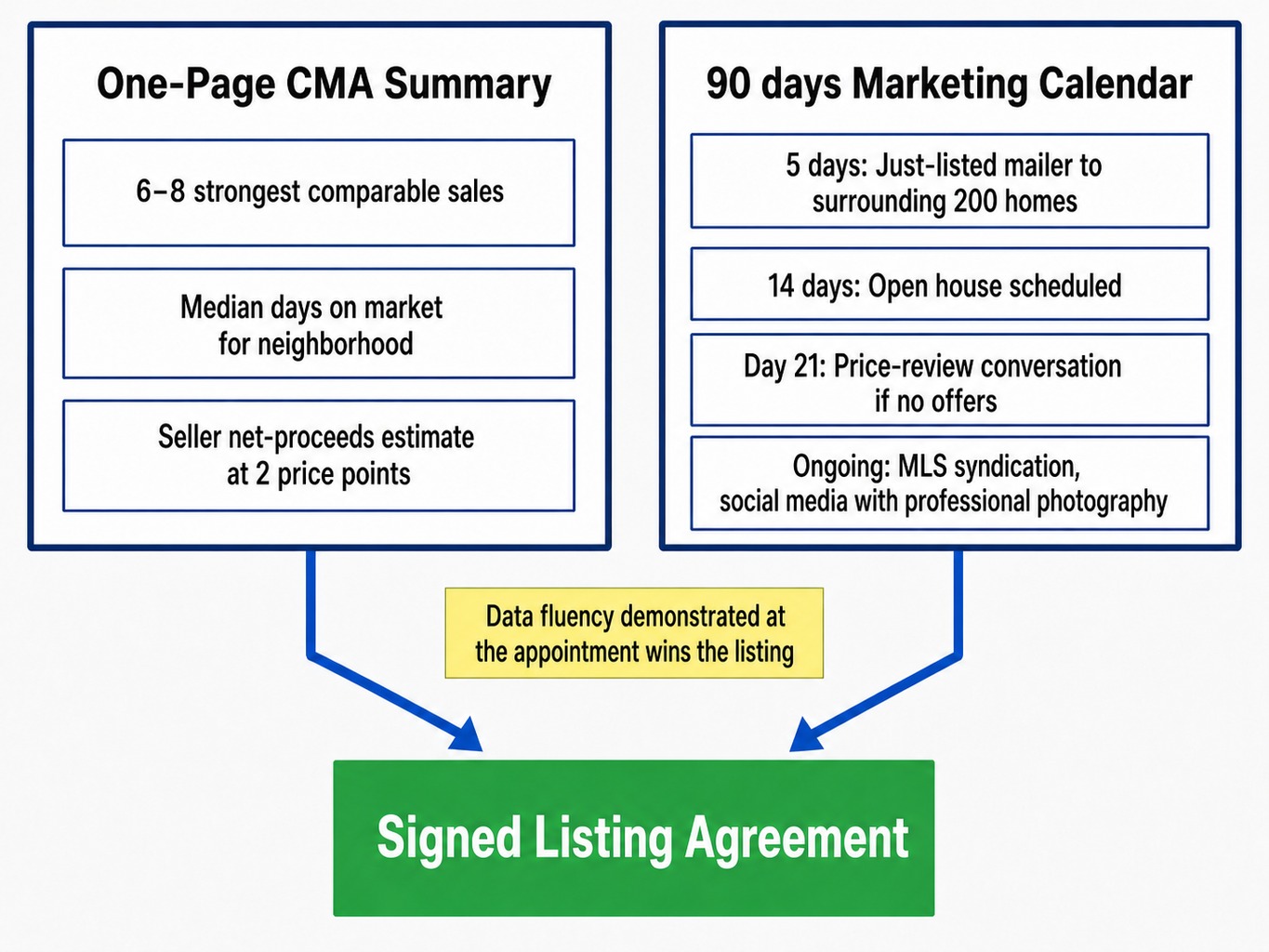
Sellers care about three numbers: what comparable homes sold for, how long they took to sell, and what they will net after commissions and closing costs. A CMA that buries these figures in 20 pages of MLS printouts will lose the seller’s attention. Instead, provide a one-page CMA summary featuring 6-8 of the strongest comps, the median days on market for the neighborhood, and a seller net-proceeds estimate at two potential price points. This shows respect for the seller’s time and focuses the conversation on what matters. You can pull this data from the MLS, property tax records, and a homeowner database for neighborhood context.
Present a Marketing Plan, Not a Company Brochure
Sellers often choose the agent who presents a specific, credible marketing plan over the agent who relies on their brand’s reputation. Your pre-listing package should include a 90-day marketing calendar that details the actions you will take to sell their home. Name the channels (MLS syndication, direct mail to the surrounding 200 homes, social media posts with professional photography) and the cadence (just-listed mailer within 5 days, open house within 14 days, price-review conversation at day 21 if no offers are received). This demonstrates a clear process and sets you apart from competitors who offer vague promises.
How to Build These Homeowner Lists Without Assembling Multiple Data Tools
Every tactic in this playbook saturation marketing, expired-listing filtering, absentee-owner targeting, and sphere reactivation depends on access to accurate, filterable homeowner records. Access to accurate, filterable homeowner records is what makes these tactics repeatable.
InfoFree provides a single platform where agents can search and filter consumer and household records by the exact fields needed for these campaigns: homeowner status, estimated home value, length of residence, move date, age, income, and geography. You can build targeted lists, export selected records according to your plan’s terms, and manage follow-up in the included CRM101 prospect management tool.
The flat-rate subscription model includes unlimited search and view access, which means you can test multiple saturation zones, pull mover lists monthly, and cross-reference past clients without accumulating per-record research charges. Export limits vary by plan. It is important to note that consumer and household records are compiled from a separate set of sources than InfoFree’s triple-verified business database and are not covered by the 95% business-data accuracy claim. Any calling, emailing, or mailing using exported records is the agent’s responsibility to conduct in compliance with DNC, TCPA, CAN-SPAM, and applicable state privacy laws.
Conclusion
Agents who treat listing acquisition as a data-driven outbound system build pipelines that do not depend on portal lead-sharing or referral timing. By filtering homeowner records by ownership duration, equity position, move date, and absentee status, and then mailing on a defined cadence, you create a predictable flow of opportunities. The agents who carry consistent listing inventory are not luckier or better networked; they control their own prospecting data and work it systematically. The next step is to put this into action: define a 400-500 home saturation zone in your strongest ZIP code, pull the homeowner list with the filters described, and commit to a six-month monthly mail cadence before evaluating the results.
Frequently Asked Questions
Is it legal to cold call homeowners about selling their home?
Cold calling homeowners is legal in the United States, but the caller must first scrub their contact list against the National Do Not Call Registry and any applicable state do-not-call lists. Violations of DNC, TCPA, or state telemarketing laws can result in per-call fines. The agent not the data provider is responsible for compliance before dialing.
What is the difference between buying a prospecting list and building one from a database?
A purchased list is a static file delivered once, with records that begin aging from the moment of delivery. Building a list from a database allows you to re-run the same filter criteria on updated records, adjust filters as your campaign evolves, and avoid paying for records you do not use. Both approaches supply prospect records for outreach; the trade-off is that a database subscription requires you to define your own filters rather than receiving a pre-built list.
How many direct mail touches does it typically take before a homeowner responds to a listing offer?
Industry direct-mail benchmarks suggest that recognition and response build over 6-12 monthly touches. Response timing depends on the homeowner’s selling motivation, the relevance of the mail piece, and local market conditions. Agents who quit a saturation campaign before the sixth touch rarely see measurable appointment volume from that effort.
Can I use property tax and ownership records to prospect for listings?
Yes. Property tax records, deed transfers, and ownership filings are public records in the U.S. A consumer or homeowner database aggregates these public records into a single source with filterable fields owner name, mailing address, estimated home value, ownership duration so you do not have to pull them county by county. The records are public, but outreach using them must still comply with DNC and applicable privacy laws.
How do I get listings as a new realtor with no sphere of influence?
New agents without a large sphere should start with data-driven outbound channels. These include saturation marketing a defined homeowner zone with monthly direct mail, prospecting expired listings filtered by price and ownership duration, and targeting absentee owners. These channels produce appointments based on the quality of the list and the consistency of the cadence, not the size of the agent’s contact list.