

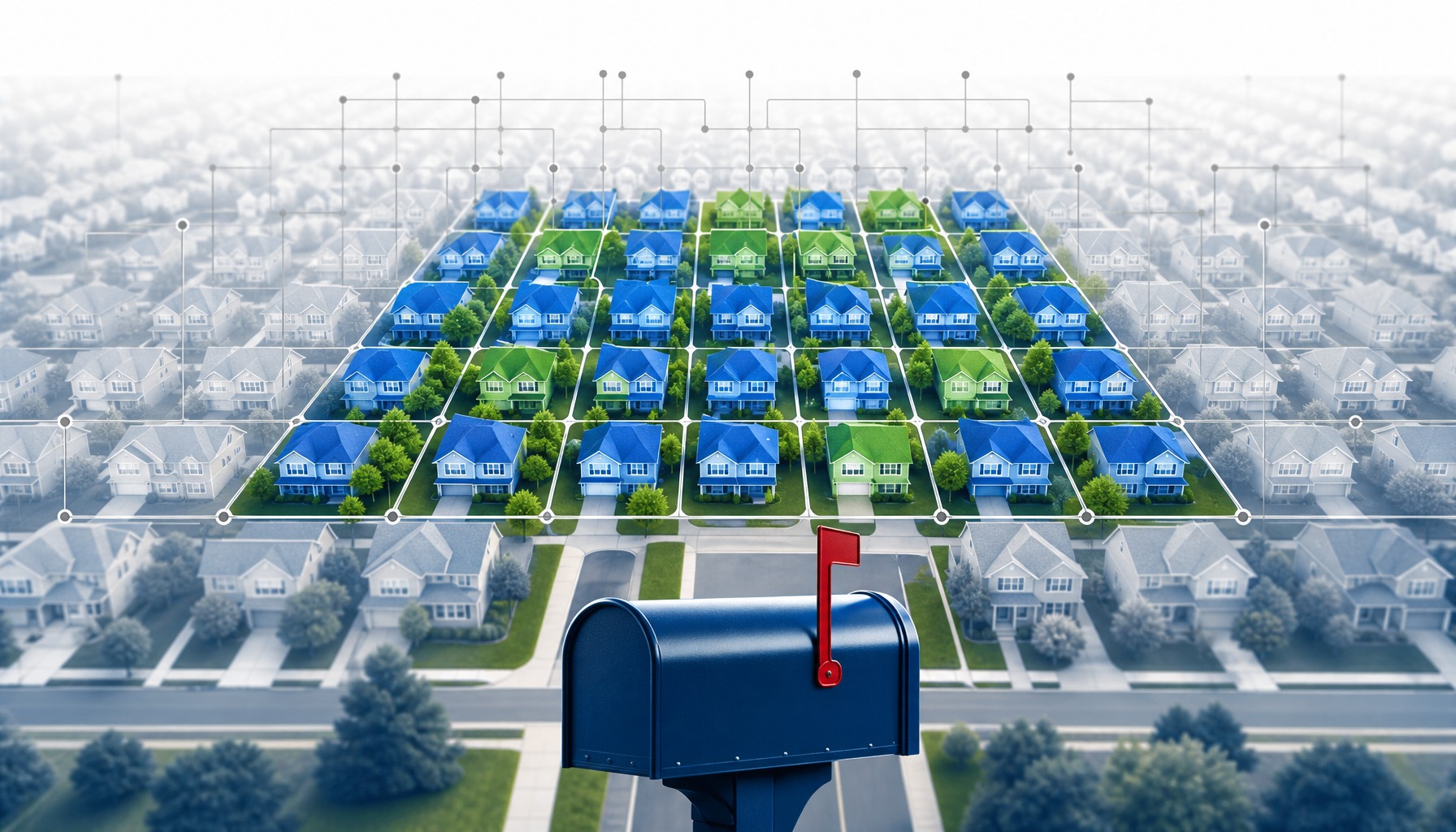
Successful Hyper-Focused Real Estate Marketing, also known as Real Estate Farming, is a long-term marketing strategy where an agent focuses all promotional efforts on a specific community or group to become the recognized local expert.
TL;DR
- Evaluate potential areas using a 5-point checklist: turnover rate (6-8% is ideal), absorption rate, home count (300-500 homes), competition levels, and homeowner equity/tenure.
- Build a targeted homeowner list that eliminates waste by filtering for owner-occupied homes with specific attributes.
- Mail monthly at a minimum. A 400-home mailing costs roughly $2,400-$3,120 annually, a cost easily covered by a single listing.
- Track which mailers generate leads using unique QR codes, CRM source tagging, or simply asking homeowners how they heard about you at the listing appointment.
- The success of your real estate marketing campaign depends on the quality of your contact list. It’s a data problem before it’s a marketing problem.
When a Hyper-Focused Real Estate Marketing campaign fails, agents tend to blame the postcards, the mail frequency, or the neighborhood itself. After six to twelve months of spending with little to show for it, they conclude it just doesn’t work. In most cases, they’re diagnosing the wrong problem. The campaign’s true failure point is almost always the contact list.
Geographic Farming vs. Demographic Farming: Which List You Actually Need
Most guides treat Real Estate Farming as a single tactic, but success starts with deciding which of two distinct approaches you’re taking, because each requires a different kind of contact list.
Geographic farming is the classic model: you target homeowners within a specific, bounded area like a subdivision, a set of ZIP codes, or a postal carrier route. The primary goal is to become the dominant agent for that location. The list-building logic is straightforward, filtering primarily on address and homeowner status to isolate the right properties within your chosen boundaries.
Demographic farming, by contrast, targets homeowners who share specific attributes, regardless of where they live within a broader market. Your “farm” isn’t a place; it’s an audience segment. Examples include equity-rich owners with 15+ years of tenure, seniors in the 65-75 age band who are likely to downsize, or households with a certain estimated income. The list-building logic is more layered, filtering on fields like estimated home value, length of residence, age, and income to find qualified households across an entire metro area.
Consider an agent in a Denver suburb. If their goal is to win the 400-home Whispering Pines subdivision, they are practicing geographic farming. They need a homeowner mailing list filtered by those subdivision boundaries. But if they specialize in helping seniors downsize, their approach is demographic. They need a consumer list filtered for homeowners aged 65-75 with an estimated home value above $500K and a length of residence over 10 years, pulled from across the entire Denver metro.
The practical difference is which filters you apply when you build your list. While this guide focuses primarily on geographic farming, the data principles apply to both.
How to Evaluate a Farm Area Before You Spend a Dollar on Mail
A farm area is a financial bet. Before you commit to a year or more of mail, you need to underwrite that bet with data from your MLS and a clear-eyed look at the market. A viable farm meets a clear set of quantitative and qualitative criteria.
The Three Numbers That Predict Farm Viability
Three core metrics, all derivable from your MLS, will tell you if a neighborhood has enough transactions to support a farming campaign.
- Turnover Rate: This is the percentage of homes in an area that sell in a year. The formula is simple:
Homes Sold in Last 12 Months / Total Homes in Area. As most experienced agents will tell you, a turnover rate below 5% is generally not viable for a solo agent; there simply aren’t enough listings to justify the mail cost. The ideal working range is 6% to 8%. Anything above 10% is strong but often attracts heavier competition. - Absorption Rate: This tells you how quickly homes are selling. Calculate it as
Currently Active Listings / Average Monthly Sales Over Last 12 Months. The result is the number of months it would take to sell all current inventory. A rate below four months suggests a seller-friendly market where listings move fast. This means your marketing touches need to be consistent and timely, landing before a homeowner has already picked their agent. - Home Count: For a solo agent mailing monthly, conventional wisdom holds that a farm of 300-500 homes is the sweet spot. Fewer than 200 homes limits your total listing potential, while more than 800 can strain a typical solo-agent budget for consistent, high-quality mail.
Imagine a 400-home subdivision with 28 sales in the past year. That’s a 7% turnover rate, projecting 28 potential transactions. A nearby 400-home area with only 12 sales has a 3% turnover rate the potential income is less than half, but the mail cost is identical. The math has to work first.
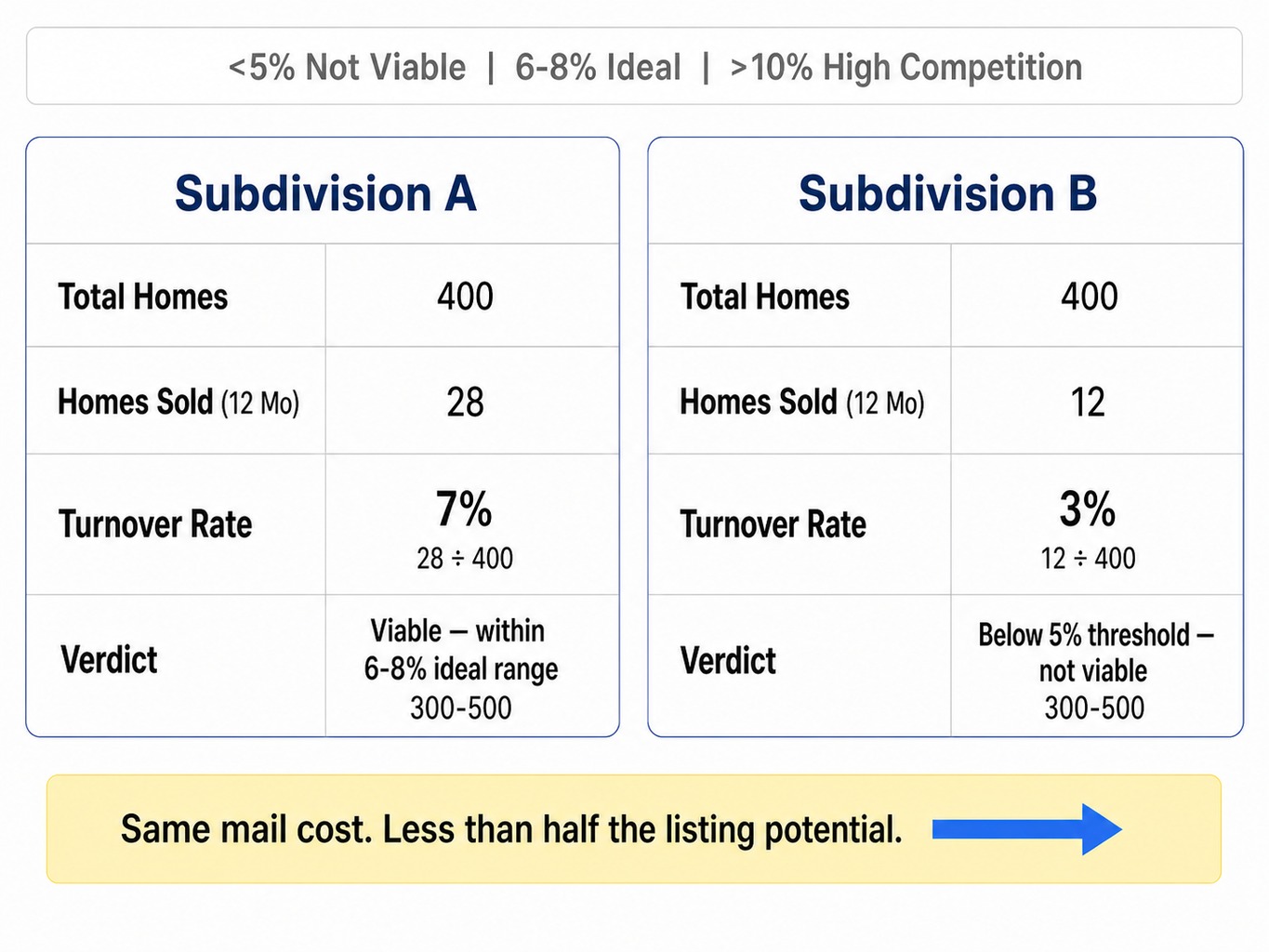
Turnover rate separates a profitable farm from a money pit.
Competition, Tenure, and Equity: The Judgment Calls
Once the numbers point to a viable area, two qualitative factors help you make the final call.
- Competition: Check your MLS for the last 24 months. Has one agent taken more than 30% of the listings in the neighborhood? If so, that agent has established dominance. Displacing them is possible, but it will require a longer timeline and a larger budget. An adjacent neighborhood with a similar turnover rate but no single dominant agent will almost always yield a faster return on investment.
- Homeowner Tenure and Equity: The math alone doesn’t tell you who is most likely to sell. Homeowners with a longer length of residence typically 7+ years are more likely to be approaching a natural life-stage trigger for moving. Likewise, equity-rich homeowners have more financial flexibility to sell. These attributes, such as homeowner status, estimated home value, and length of residence, are filterable fields in most modern consumer databases and provide a layer of seller-intent prediction that raw turnover rates miss.
EDDM vs. A Targeted Homeowner List: The Decision That Shapes Your Campaign
This is the fork in the road that most farming guides ignore. Your choice between blanketing a postal route and mailing a filtered list determines your cost, waste, and targeting capability for the entire campaign.
I once ran a side-by-side test on two adjacent subdivisions. One received USPS Every Door Direct Mail (EDDM) saturation mail. The other received addressed mail sent only to owner-occupied households filtered by estimated home value and a length of residence over seven years. The targeted, addressed list was 35% smaller but generated more than twice the inbound calls over six months, because every single mail piece reached a homeowner with equity and tenure.
When EDDM Makes Sense
USPS Every Door Direct Mail (EDDM) delivers your mail piece to every single address on a selected carrier route homeowners, renters, and businesses alike. No mailing list is required. You select routes via the USPS online tool, produce a flat-sized mailer, and drop it at the designated post office.
EDDM works best in two scenarios:
- When your farm area is a dense, uniform subdivision where nearly every door is an owner-occupied, single-family home. In this case, the waste from hitting non-owners is minimal.
- When your goal is pure brand saturation and you are less concerned with targeting high-propensity sellers.
The trade-off is control. EDDM is a blunt instrument. You cannot filter by homeowner status, home value, or any other demographic. You’re also mailing to postal delivery units, not real estate market units; a carrier route often includes addresses outside your target neighborhood while missing others that are inside it. The USPS retail rate for EDDM flats runs roughly $0.20-0.23 per piece for postcard-sized mail, making it cheap on a per-piece basis. But cost-per-piece isn’t the right metric.
When a Targeted Homeowner List Outperforms EDDM
A targeted homeowner list is almost always the better choice when your farm area is mixed-use, has a significant number of renters, or when you want to segment your messaging. This approach costs more per piece, but you eliminate waste by ensuring every mailer reaches a verified homeowner.
This is where you move from brand awareness to lead generation. A targeted list lets you apply specific filters. You can send a home valuation offer only to owners with 10+ years of tenure, or a different message to new homeowners versus long-time residents. Key data fields make this possible:
- Homeowner Status: Isolates owner-occupied properties.
- Estimated Home Value: Helps target higher-end properties.
- Length of Residence: A strong predictor of seller intent.
- Mailing Address vs. Property Address: Identifies absentee owners for farming investor-held properties.
- Age of Head of Household: Useful for targeting specific demographics like downsizers.
Consider a carrier route with 500 addresses where only 60% are owner-occupied homes. EDDM reaches all 500 doors for about $105 ($0.21/piece). A targeted list reaches the 300 verified homeowners for about $165 ($0.55/piece). The cost per homeowner reached is actually $0.35 for EDDM vs. $0.55 for the targeted list. But with the targeted list, you can filter further to the 180 homeowners most likely to sell. Now your cost per qualified contact is around $0.92, an investment in precision that EDDM cannot offer.
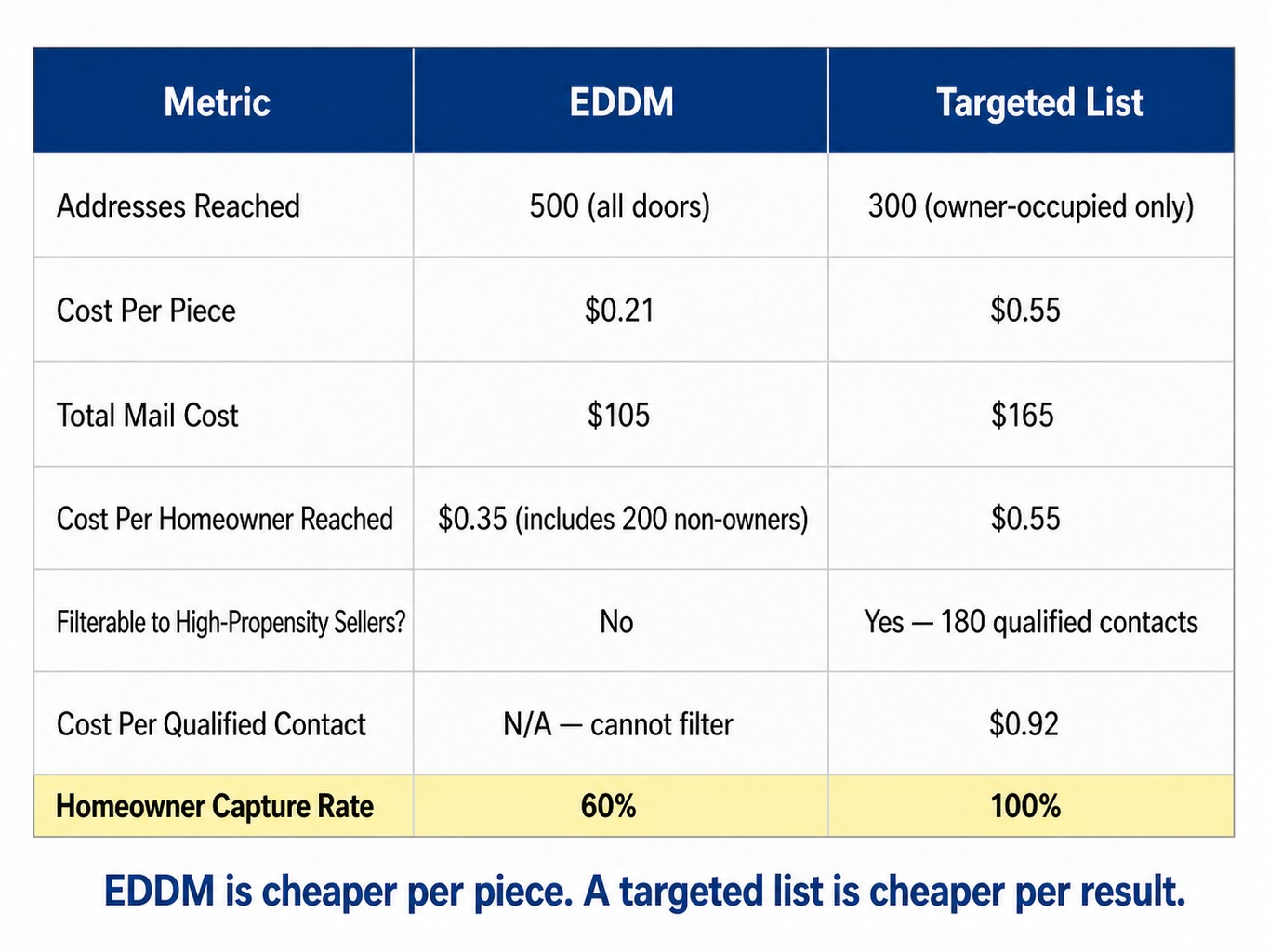
Real estate direct mail ROI depends on cost per qualified contact, not cost per piece.
Of course, any outreach campaign requires you to operate responsibly. Agents are responsible for complying with all applicable postal regulations and, when combining mail with phone or email follow-up, with DNC, TCPA, CAN-SPAM, and state privacy laws.
Read more: Real Estate Lists – Email, Phone and Mailing Lists from Infofree
Mail Frequency, Content Rotation, and Monthly Budget Math
For geographic farming, monthly mail is the minimum viable cadence. The marketing principle of effective frequency that it takes 7 to 12 touches to build brand recall. Anything less frequent fails to build the mental association you need to become the default agent when a homeowner decides to sell.
Let’s walk through the budget math. For a 400-home farm, assuming a blended cost of $0.55 per piece for printing and pre-sort standard postage, your monthly investment is $220. Annually, that’s $2,640.
Now, calculate your breakeven point. If your average GCI per listing side is $10,000, one single listing from the farm more than covers your entire annual mail cost. Two listings puts the campaign squarely in profit. This isn’t a guarantee; it’s the underwriting you should do to determine if the investment is viable for your market.
To maintain homeowner attention, rotate your content. Mailing the same design every month leads to fatigue. A simple four-month rotation works well:
- Month 1: Market Update. A postcard with hyperlocal stats from the MLS: median price, days on market, and current inventory in the farm area.
- Month 2: Just Listed / Just Sold. Social proof showing you are active in their neighborhood. Use a specific address and sale price.
- Month 3: Home Valuation Offer. A direct response piece, driving homeowners to a landing page or phone call to find out their home’s current value.
- Month 4: Community Content. A local event calendar, seasonal home maintenance tips, or information about a neighborhood charity drive.
Then, repeat the cycle with updated data. This variety keeps your mail from becoming background noise.
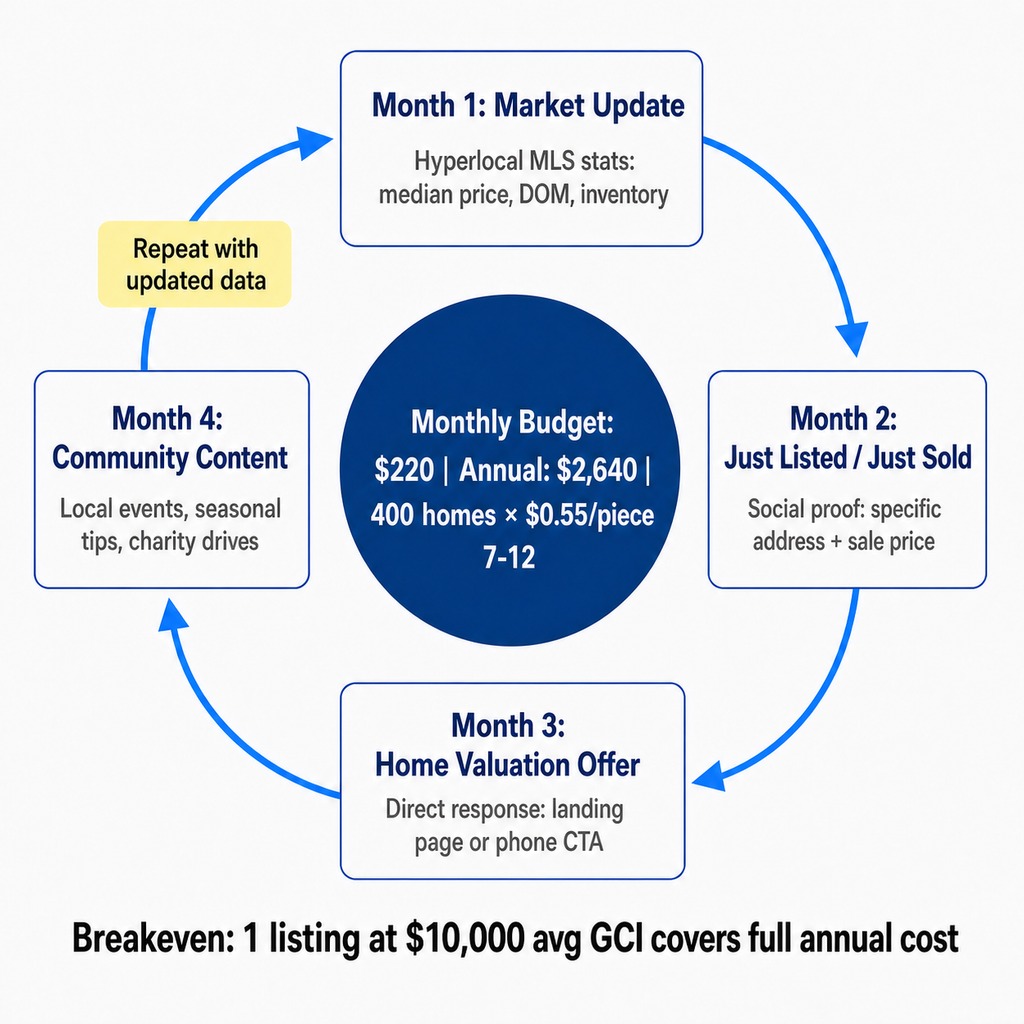
A single listing covers the full annual cost of farming for real estate agents.
Layering Digital Retargeting on Top of Direct Mail
Direct mail and digital advertising are not competing channels; they are complementary touches that reinforce one another. A homeowner who gets your postcard on Tuesday and sees your display ad on their phone on Wednesday has received two impressions, building brand recall faster.
Geofenced Display Ads: You can define a geographic boundary around your farm area and serve display ads only to devices within that zone. This is a common feature in programmatic ad platforms like Adwerx as well as through location targeting on Facebook, Instagram, and the Google Display Network. Geofenced display campaigns for hyperlocal real estate typically run $200-$500/month, a manageable addition to an existing mail budget.
QR Code Attribution: The simplest way to connect your physical mail to digital action is by including a unique QR code or short URL on every postcard. This link should lead to a dedicated landing page offering something of value, like an instant home valuation, a detailed market report, or a consultation booking form. By tracking scans or clicks, you can directly attribute web traffic to specific mail drops and postcard designs. This is the closest a mail campaign comes to direct response attribution.
One important note: layering digital ads via a custom audience upload depends heavily on the quality of your source file. A homeowner list matched to a platform like Meta or Google relies on having current email addresses and phone numbers. A list with stale contact data will produce a low match rate, rendering your digital ad spend ineffective.
How to Track Which Mail Pieces Are Producing Listings
Most agents who abandon farming do so because they can’t prove it’s working. They can’t tell their broker or their spouse which mailer produced which lead. That makes the monthly expense feel like a cost rather than an investment. Disciplined tracking solves this.
There are three straightforward methods for attributing listings to your farm:
- Direct Response Tracking: Use unique QR codes, vanity URLs (e.g.,
YourNeighborhoodValue.com), or dedicated phone numbers for each mail campaign or even each monthly drop. This provides clear, unambiguous data on which pieces are driving calls and clicks. - CRM Source Tagging: This requires discipline but no special technology. When any lead comes in from your farm area, immediately tag it in your CRM (or even a spreadsheet) with the source:
Farm Mail - May 2026orFarm Digital Ad. Track that lead through to closing. Over time, you’ll see exactly what your cost per listing acquired from the farm is. - The Listing Appointment Ask: The simplest method is often overlooked. When a homeowner from your farm calls for a listing appointment, ask them: “How did you hear about me?” If the answer is, “I’ve been getting your postcards for a year,” you have a farm-attributed listing.
With attribution in place, you can calculate your return. Divide your total annual mail cost by your average GCI per listing side. That’s the number of listings you need to break even. By tracking each lead, you’ll know by month eight or ten whether your campaign is on track to be profitable.
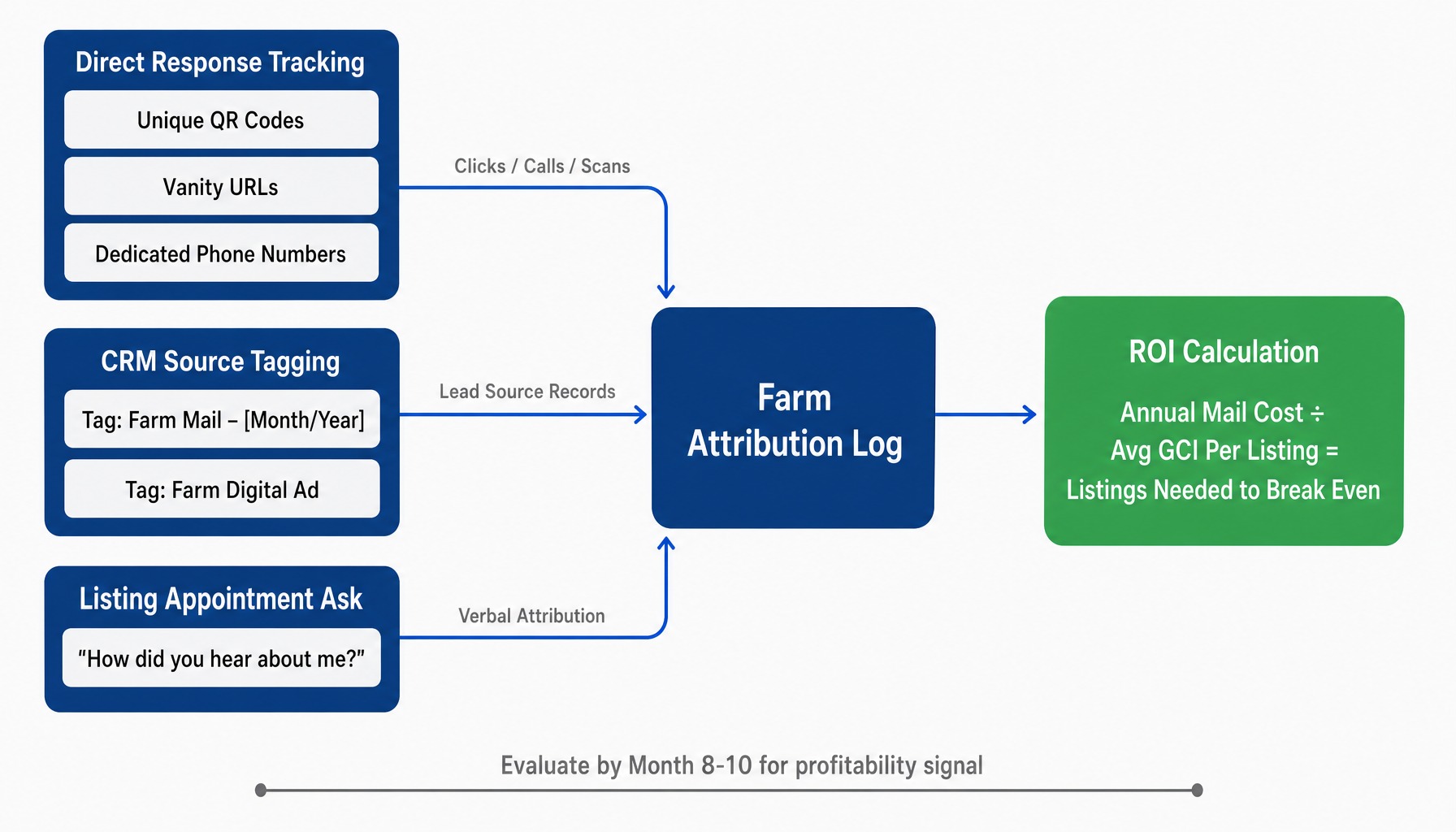
Track every lead source so your real estate farming spend is an investment, not a guess.
Building the Homeowner List Behind Your Farm
This entire guide is built on a single premise: the success of a real estate farm depends on the quality and specificity of the contact list. The postcard design matters, but only if it reaches the right person. The challenge for most agents is sourcing a list that allows for the kind of filtering needed for a modern, data-driven campaign.
This is where a comprehensive data platform becomes a strategic asset. InfoFree’s consumer and household database is built to support this exact workflow. It allows you to search approximately 270 million consumer records and filter by the specific fields discussed in this article:
- Homeowner status
- Estimated home value
- Length of residence
- Age of head of household
- Geographic boundaries (ZIP code, radius, neighborhood)
- Mailing address vs. property address (for absentee owners)
InfoFree compiles its consumer and household records in-house from thousands of sources, providing a deep well of data for building your farm. The platform offers unlimited search and view, with export limits that vary by plan, so you can build your list, export mailing addresses, and refresh it regularly to catch new movers and remove old records. It’s important to note that while our business database is triple-verified and rated at 95% accuracy, our consumer and household records are compiled from a separate set of sources and are not rated on the same standard.
Your Farm’s Success Is a Data Decision
Real estate farming is a long-term play, but it shouldn’t be a blind one. The agents who succeed are the ones who treat it as a data problem first and a marketing problem second. They evaluate areas by turnover rate and home count, build targeted marketing lists instead of relying on blanket saturation, and track which touches produce listings. They reach profitability not by chance, but because they underwrote their campaign from the start. The postcard is the last mile of your strategy, not the first decision. The first, and most important, decision is the list.
Frequently Asked Questions
Should I farm a neighborhood where another agent already dominates?
You can, but adjust your expectations. If one agent has taken more than 30% of listing sides in the area over the past 24 months, displacing them requires a longer timeline typically 18-24 months of consistent monthly mail. Factor the extended breakeven period into your budget. An adjacent neighborhood with comparable turnover and no dominant agent will likely produce faster returns.
How often should I refresh or update my farm mailing list?
At a minimum, refresh your list quarterly. Homeowner records change as properties sell and people move. A list pulled in January will have measurable decay by April, meaning you’re mailing to former owners. If your data source allows for monthly refreshes within your subscription, use them. Every piece mailed to a former homeowner is wasted postage.
What is a realistic market-share goal for my first year of farming?
In a 400-home farm with a 7% turnover rate, roughly 28 homes will sell in a year. Capturing one listing side in year one about 3-4% of transactions is a realistic benchmark for a solo agent mailing monthly. By year two, 10-15% market share becomes achievable. Expecting more in the first year often leads to premature quitting.
Can I farm an area that has a high percentage of apartments or renters?
Yes, but a targeted homeowner list becomes essential. EDDM will deliver to every unit, including renters who cannot list a property, driving up your effective cost per homeowner. If owner-occupied units make up less than 40% of addresses in the area, a filtered list that eliminates that waste is almost always more cost-efficient.
How long does it typically take to see the first listing from a farming campaign?
Most agents who mail monthly to a well-selected farm report their first inquiry between month six and month ten. The marketing principle of effective frequency needing 7-12 touches to build name recognition sets the floor. Agents who quit before month eight almost never see a return, which is why the upfront budget commitment is so critical.