


A new mover mailing list works best when your message arrives before competitors’.
TL;DR
- A new mover lead’s value decays sharply after the first 30 days. Your outreach must be timed to reach households within 1-2 weeks of their move date to maximize ROI.
- Treat new mover data as a recurring feed, not a one-time list. Build a cadence of pulling fresh records every 2-4 weeks to maintain a pipeline of high-intent prospects.
- Evaluate any new mover mailing list provider on four criteria: data update frequency, CASS/NCOA processing, source transparency, and your ability to suppress existing customers.
- Layering digital ads on top of direct mail by using your mailing list to create a custom audience can increase brand recall and response rates.
- Subscription-based access to new mover data makes the recommended high-frequency outreach cadence economically practical compared to buying single lists.
Households that have recently moved make more purchasing decisions in a few months than most established residents make in years. They need new service providers for everything: utilities, insurance, home services, healthcare, and even their new favorite pizza place. For local businesses, these new movers represent a predictable stream of high-intent customers.
But there’s a tension most marketers miss. The data that identifies these households is a decaying asset. A record that is 10 days old is dramatically more valuable than one that is 60 days old, because by day 60, the household has likely already chosen its providers. Most businesses that buy a new mover mailing list treat it like any other prospect list, mailing once and moving on, which guarantees they miss the window.
This guide explains how to avoid that mistake. We’ll cover what a new mover mailing list actually contains, why timing dictates your ROI, how to structure an effective outreach cadence, and what questions to ask before you ever spend a dollar on data.
What a New Mover Mailing List Actually Contains
A new mover mailing list is a compiled database of households that have recently changed their primary residential address. This data is not magic; it’s aggregated from multiple sources, including USPS National Change of Address (NCOA) filings, public deed transfer and mortgage trigger records, new utility connections, and proprietary address-matching algorithms from data compilers. The quality of the list depends entirely on the quality and freshness of these underlying sources.
A standard new movers database should provide several key data fields: full name, the new and complete mailing address (ideally CASS-certified with ZIP+4 for deliverability), and the approximate move date. Depending on the provider, you can often apply powerful overlays to refine your targeting, such as:
- Homeowner vs. Renter status
- Estimated household income or home value
- Presence of children and age of head of household
- Geographic selects like ZIP code, city, or a radius around your business
For example, a home services company could build a new movers list of just homeowners who moved within the last 30 days into a 15-mile radius, with an estimated home value above $250,000. That level of filtering is what separates a targeted new mover campaign from a generic residential mailing. It’s also important to ask if you’re buying a compiled list (aggregated from public/proprietary sources) or a response list (built from consumer actions). Most new mover data is compiled, offering broader coverage but more variable accuracy.
Why the First 90 Days After a Move Determine Your ROI
The value of a new mover lead is not static. It declines sharply as a household settles in and makes its initial purchasing decisions. Industry benchmarks often state that new movers spend more in their first six months than established households do in several years, but that spending is heavily front-loaded. The businesses that capture the most value from new mover data are those that understand this decay curve and time their outreach to hit the peak decision-making window.
The Decay Curve: How New Mover Lead Value Drops Week by Week
A new mover lead’s value follows a steep decay curve, not a gradual decline. In the first one to two weeks post-move, the household is in an active state of procurement, searching for nearly every local service category HVAC, landscaping, pest control, dentistry, insurance, banking, and restaurants. By weeks four to six, most of those critical decisions are locked in. By day 90, the household has settled into its new routines, and the unique “new mover advantage” is effectively gone.
Consider an HVAC company. A postcard that arrives on day eight reaches a household that is actively looking for a reliable technician for their first system inspection. The same postcard arriving on day 50 reaches someone who booked that service a month ago with a competitor who mailed earlier. List recency how many days have passed since the move date is the single most important variable in new mover campaign performance. It’s often more critical than creative quality or the offer itself.
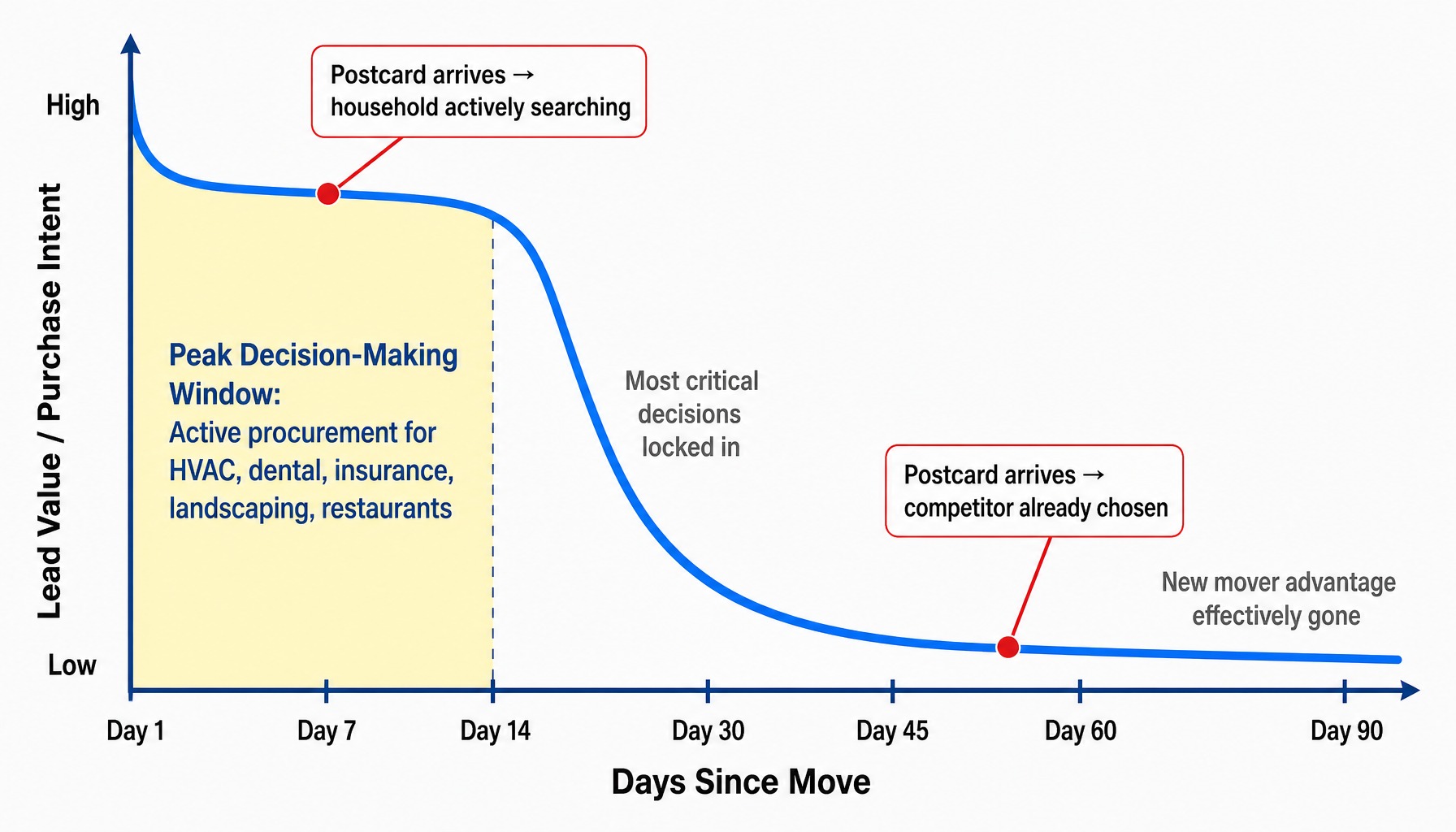
New mover leads lose most of their value within the first 30 days.
Pre-Mover vs. Post-Mover Data: Which One Are You Actually Buying?
It’s crucial to understand that there are two fundamentally different types of new mover data. Most commercially available new mover mailing lists contain post-mover data records generated after the household has already relocated. These are typically sourced from NCOA filings, completed deed transfers, or new utility connections.
Pre-mover data, by contrast, captures intent signals before the move occurs. These records are sourced from mortgage applications, new home listings, or advanced change-of-address filings. This data is rarer and generally more expensive, but it’s invaluable for businesses like moving companies, mortgage lenders, and home warranty providers who need to engage prospects before the relocation.
Most list providers sell only post-mover data. You need to ask which type you are getting. A 30-day-old pre-mover record might represent a household that hasn’t even packed yet, while a 30-day-old post-mover record is a household that moved a month ago and may have already chosen their go-to service providers.
How to Structure Outreach Around New Mover Data
The most effective way to use a new mover mailing list is to stop thinking of it as a one-time campaign asset. It’s a recurring data feed that should power a repeatable outreach system. The businesses that get the best results treat new mover data as an ongoing pipeline, not a batch-and-blast project. This requires a shift in thinking from “buying a list” to “managing a flow.” While response rates for direct mail to new movers can be strong often in the 1-3% range for a single touch and pushing higher with a sequence those results are entirely dependent on cadence and timing.
Building a Monthly Cadence Instead of a One-Time Drop
The most common mistake businesses make is buying a batch of records once, mailing them, and judging the results. This approach guarantees that a significant portion of the records are already stale by the time your mail piece arrives. The correct approach is to set up a recurring pull ideally every two weeks, and at a minimum, monthly so that every household receives outreach within the first 10-14 days of their move.
Let’s look at a dental practice as an example. Instead of one big annual mailer, they could:
- Pull a fresh new movers database for their target ZIP codes on the 1st and 15th of each month.
- Send a “Welcome to the Neighborhood” postcard with a new patient offer within five business days of each pull.
- Follow up with a second mail piece (perhaps a different format or offer) three weeks later.
This two-touch sequence, executed entirely within the first 45 days, ensures the practice engages the family during their peak search for a new healthcare provider. This isn’t a vague recommendation to “mail regularly”; it’s a concrete, repeatable system.
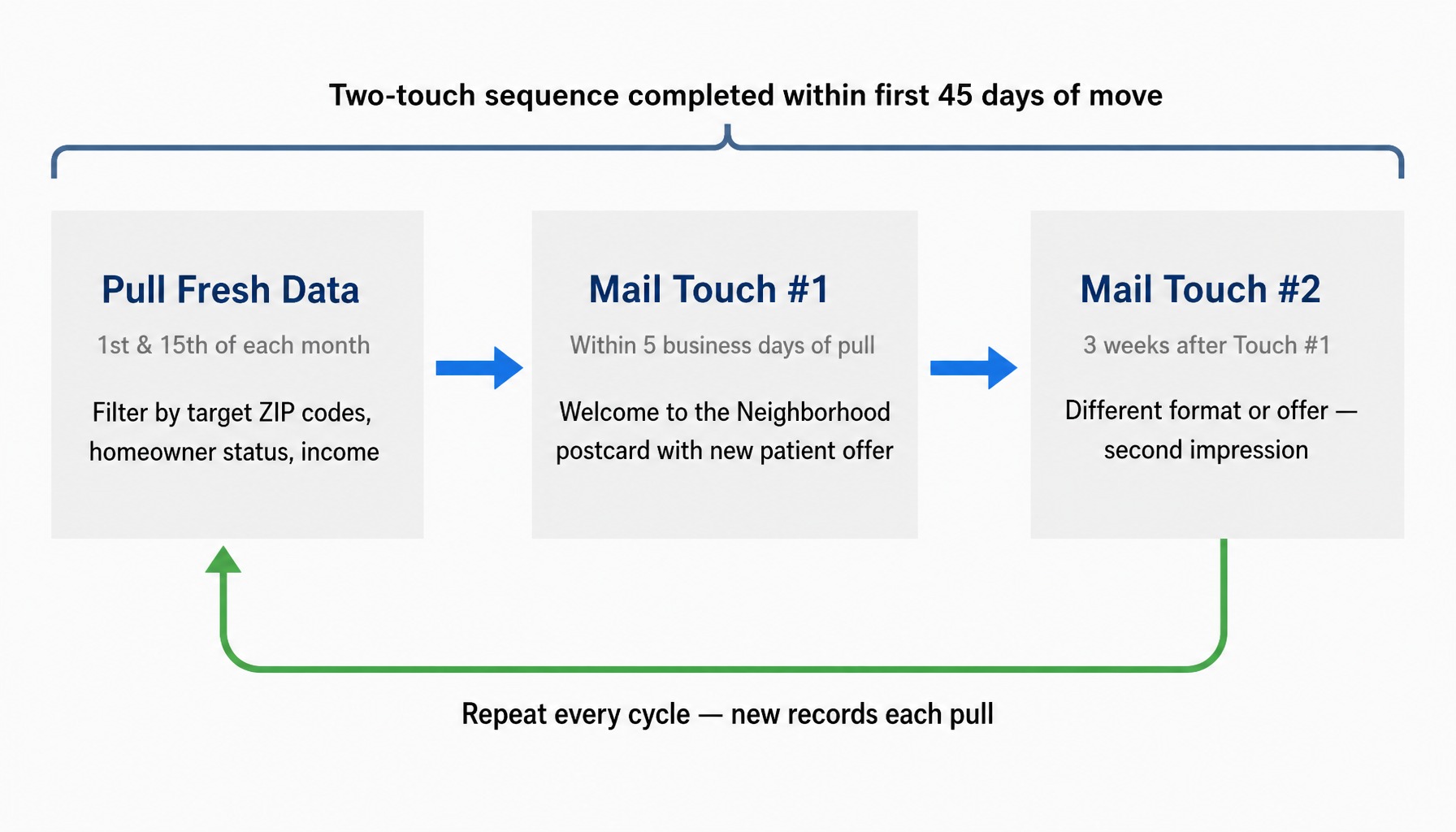
A recurring cadence turns a new movers list into a repeatable outreach system.
Read more: Mailing Lists – Connect with Prospects from Infofree
Layering Digital Targeting on Top of Direct Mail
Direct mail to new movers works best when it isn’t the only touchpoint. The same mailing list that drives your postcard campaign can be uploaded as a custom audience to platforms like Facebook or Google Ads. This creates a multi-channel “surround sound” effect, where the household sees your brand in their mailbox and in their social feed within the same week. This isn’t about replacing direct mail; it’s about reinforcing it, making your brand feel familiar when the household is ready to act.
Of course, there are practical constraints. Custom audience match rates on hashed mailing addresses typically fall in the 40-60% range, so this digital layer won’t reach every household on your list. It will, however, meaningfully increase the probability that the prospects it does reach will remember your brand and respond. This approach also provides a way to measure digital engagement alongside mail response, helping you attribute results more precisely.
How to Evaluate a New Movers List Before You Buy
Let’s be honest: many businesses have been burned by bad mailing lists stale data, high bounce rates, or records that don’t match the targeting. The difference between a productive new mover campaign and a wasted one often comes down to the questions you ask before you purchase.
Here is a four-point checklist to use with any list provider:
- How frequently is the data updated? Ask for a specific cadence: weekly, bi-weekly, or monthly. A list that is only updated monthly means some records could already be 30 days old before you even receive them. This single factor can cripple your campaign before it starts.
- Is the data CASS-certified and NCOA-processed? CASS (Coding Accuracy Support System) certification is a USPS process that standardizes addresses for deliverability. NCOA (National Change of Address) processing cross-references the list against the official USPS database to flag movers. Without both, your undeliverable mail rate will climb, wasting postage and opportunity.
- Where do the records come from? Ask the provider to explain their data provenance. Do they source from deed transfers, utility connections, NCOA filings, or a proprietary mix? Providers who are vague or cannot explain their sources are likely just reselling someone else’s data at a markup, adding another layer of delay and potential inaccuracy.
- Can you suppress your existing customer file? You should never waste money mailing people who are already your customers. Before you buy, confirm the provider can perform a merge-purge to remove your current customer list from the new mover file.
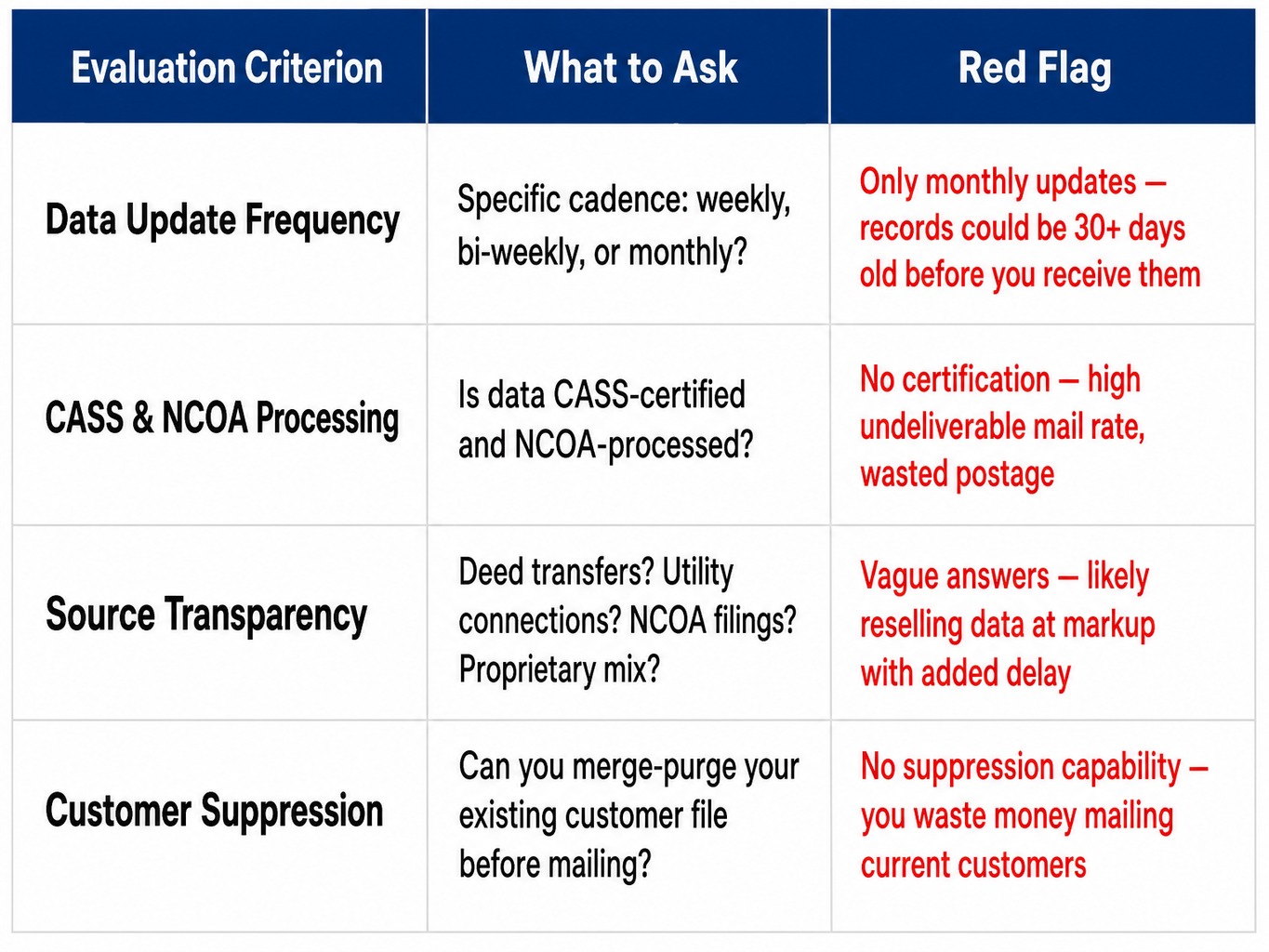
Evaluate any new movers database provider against these four criteria before buying.
How InfoFree Keeps New Mover Data Fresh Without Per-List Pricing
The central tension of new mover marketing is clear: you need frequent, recurring access to fresh data, but traditional list brokers charge per-thousand (CPM) for each pull. This pricing model discourages the very cadence that drives results, forcing businesses into less effective, one-time batch buys.
This is the exact problem InfoFree’s subscription model solves. Instead of paying for each individual list, a flat monthly subscription provides unlimited access to our new mover leads. This removes the cost barrier to pulling fresh data as often as your campaign requires, making a bi-weekly or monthly cadence economically practical.
You can build a highly targeted new mover mailing list using the same filters we’ve discussed geography (ZIP code, city, or radius), homeowner status, estimated income, and more and pull new records on your schedule. This aligns your costs with the strategy that actually works: reaching new households within days of their move, not weeks or months. By integrating data access with a simple contact manager and CRM, you can build a complete, repeatable system for turning new movers into loyal customers.
Explore InfoFree’s new mover lists and start building your first pull
Your New Mover Strategy: From a List to a System
The single most important shift to make is this: new mover data is not a list you buy once. It is a recurring data feed that powers an ongoing outreach system, and its value is determined almost entirely by how quickly you act on it.
The businesses that win with new mover marketing are the ones that internalize the decay curve, build a repeatable cadence around fresh data, and evaluate providers on update frequency and data provenance not just price. If you are currently buying new mover lists as one-off batches, the highest-leverage change you can make is to switch to a recurring pull that gets your message into mailboxes within the first 10-14 days. That is where the ROI is found.
Frequently Asked Questions
Can I filter a new movers list by homeowner status, income level, or home value?
Yes, most compiled new mover databases allow for demographic and property overlays, including homeowner vs. renter, estimated household income, home value ranges, and presence of children. These “selects” narrow your list but improve relevance, leading to higher response rates for businesses whose offers appeal to specific segments, like high-value homeowners.
What is the typical cost per thousand for a new mover mailing list?
One-time list purchases from traditional brokers typically range from $40-$80 per thousand records (CPM) for base data, with extra fees for demographic selects. In contrast, subscription-based providers like InfoFree offer unlimited access for a flat monthly fee, which dramatically reduces the effective CPM for businesses running the recommended recurring campaigns.
Is it legal to use deed transfer and mortgage data to build a new mover mailing list?
In most U.S. jurisdictions, deed transfers and mortgage filings are public records, and using them for marketing is generally permitted. However, state-level data privacy laws are constantly evolving. It’s wise to consult with legal counsel familiar with your specific state’s regulations before building campaigns around property transaction data to ensure compliance.
How do new mover mailing lists compare to Every Door Direct Mail (EDDM) for reaching new residents?
EDDM is a saturation tool that hits every address on a postal carrier route, meaning most recipients are established residents. A targeted new mover list reaches only households that recently relocated, providing much higher relevance and typically a better response rate for mover-specific offers. EDDM has lower postage costs, but a new mover list has less waste.
How do I suppress my existing customers from a new movers database before mailing?
This process is called a “merge-purge.” You export your current customer list from your CRM and provide it to your list provider or mail house, who will then deduplicate it against the new mover records before mailing. If you use a self-serve platform like InfoFree, you can often upload your suppression file directly before exporting your final list.
What industries see the strongest results from new mover direct mail?
Industries where new residents must choose a local provider quickly see the best results. This includes HVAC, pest control, dental, veterinary, insurance, banking, and landscaping. Restaurants, gyms, and local retail also perform well as new residents explore their neighborhood. Categories with longer purchase cycles, like roofing or major remodeling, see lower immediate response but can build a valuable long-term pipeline.